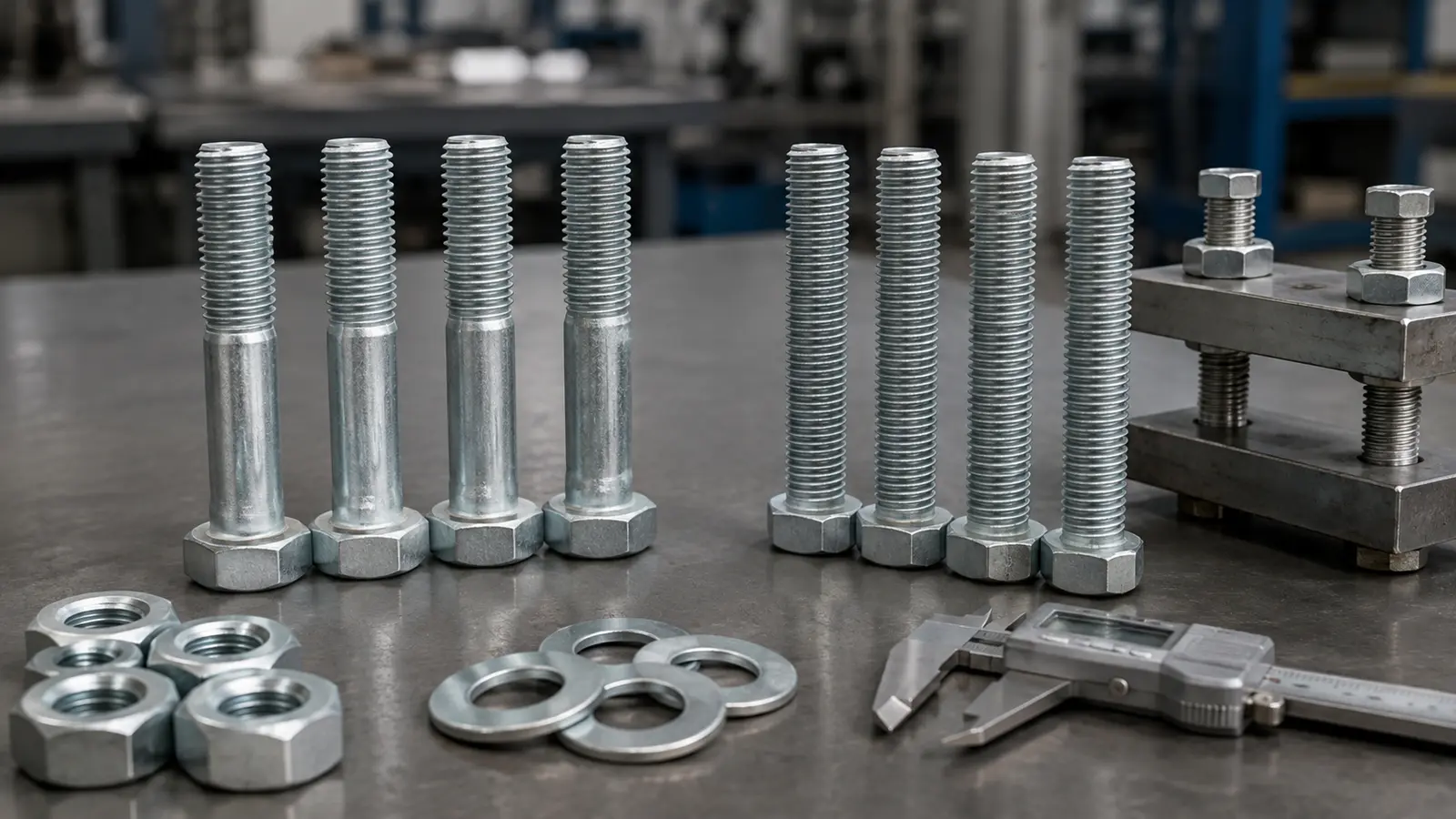
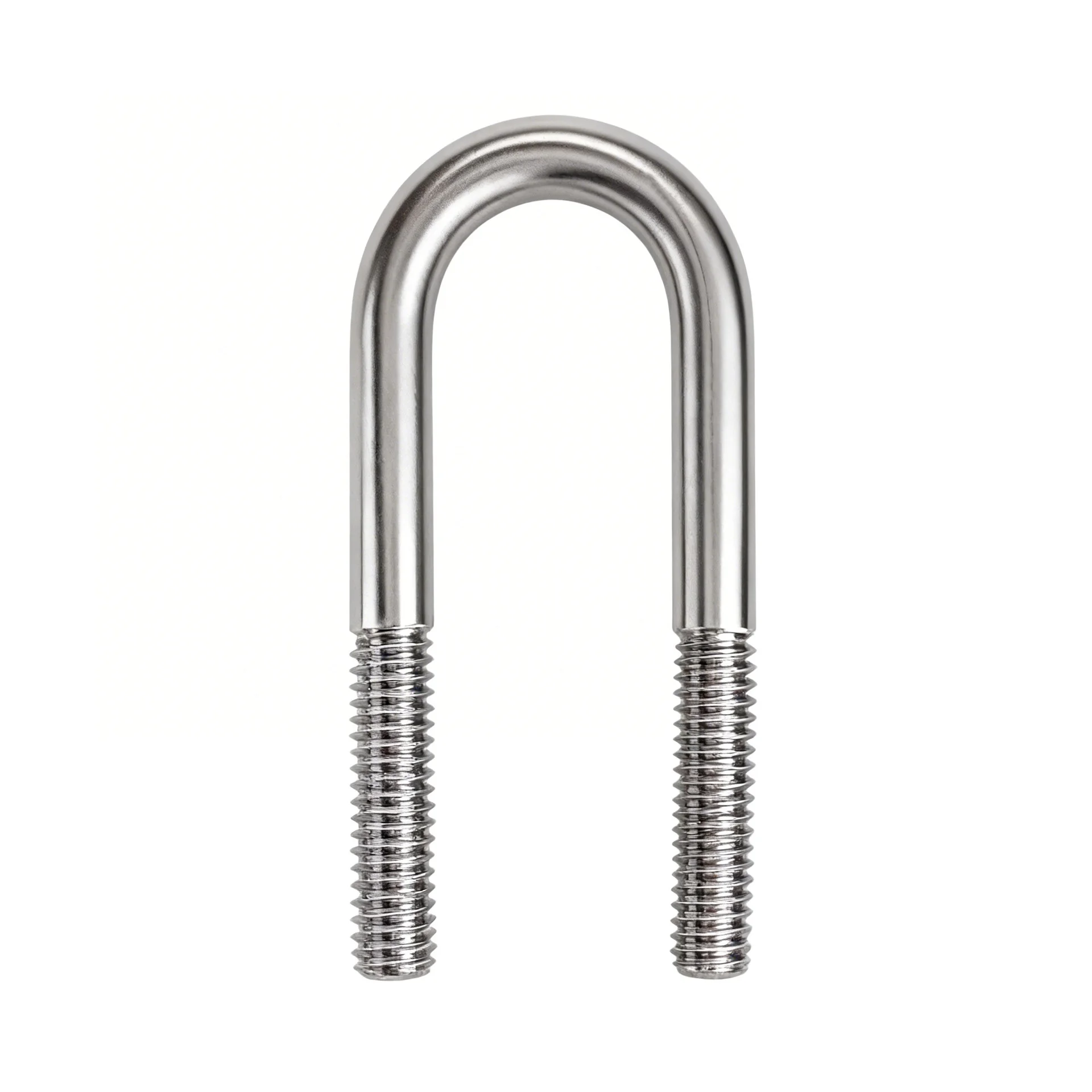
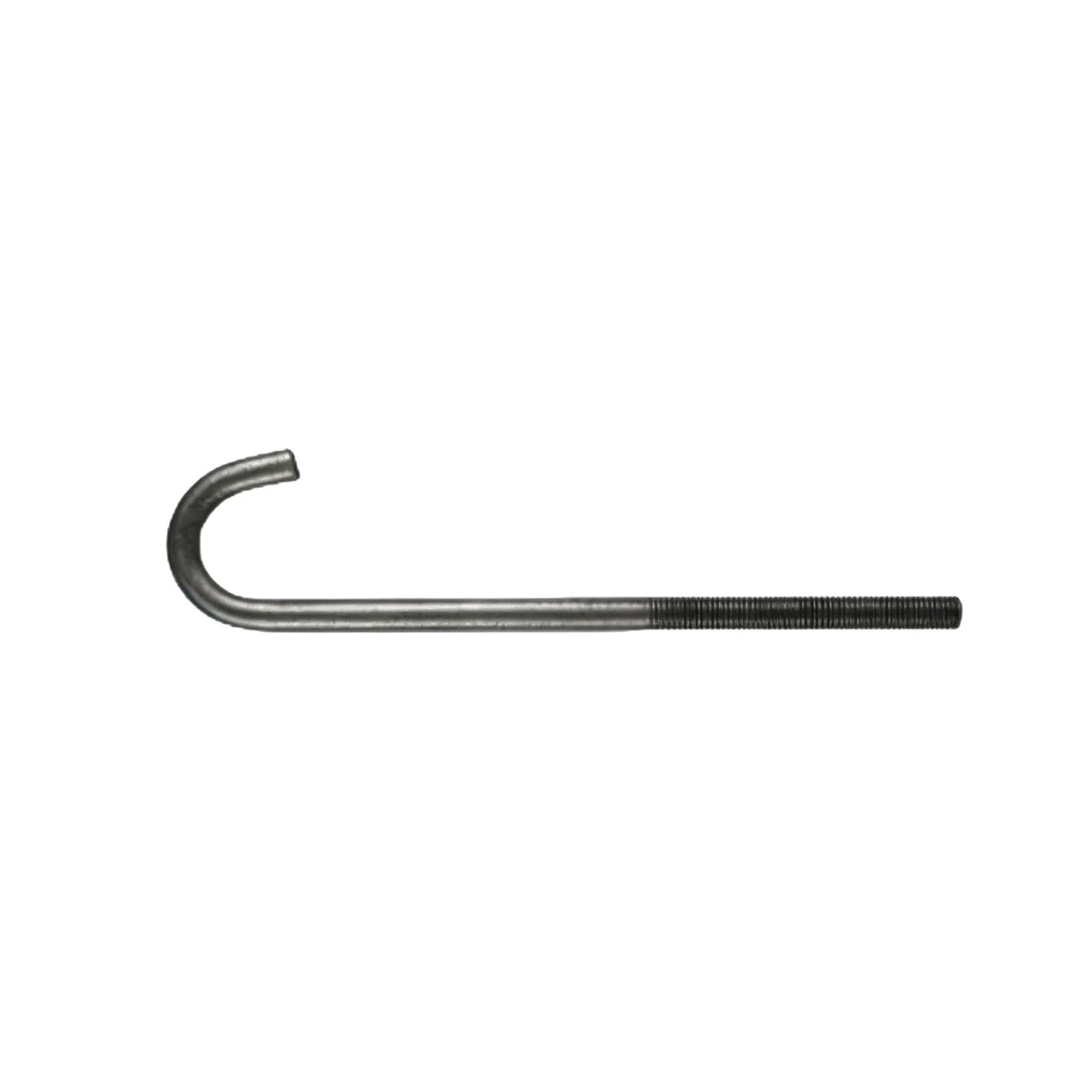
DIN 931-style half-thread and DIN 933-style full-thread hex bolts should not be selected from diameter and overall length alone. The practical choice depends on the joint stack, required grip, location of the thread transition, available nut engagement, mating hardware, material or property requirement, coating system and governing product specification. A half-thread bolt is not automatically “stronger,” and a full-thread bolt is not automatically more versatile for every assembly. Buyers should provide the drawing and clamp-stack dimensions, then require the supplier to identify the offered thread configuration and any deviation. Comparable quotations must describe the same geometry, finish, bolt set, inspection evidence and packaging boundary.
What Is the Practical Difference Between Half-Thread and Full-Thread Hex Bolts?
A half-thread hex bolt has an unthreaded shank over part of its length and a threaded portion near the end. A full-thread configuration carries thread over a much larger part of the shank. This geometry changes where a smooth shank or thread lies within the assembled joint, how much thread is available to the nut and how the supplier measures the threaded length.
The geometric difference does not, by itself, decide structural suitability. Load direction, joint stiffness, preload, connected materials, hole condition, installation method and the governing design all matter. Procurement should not convert a general observation about partial or full thread into an engineering approval. The drawing or responsible engineer must define the acceptable configuration.
The commercial names “DIN 931” and “DIN 933” are often used to distinguish half-thread and full-thread product families. They should be treated as a starting identifier. The RFQ still needs the governing standard and edition, dimensional basis, property requirement and approved equivalents. A familiar name does not close the specification.
Start With the Grip Length and Joint Stack
The grip is the portion of the bolt passing through the clamped components. To define it, add the thicknesses of every plate, bracket, spacer and washer within the clamped stack. Do not include the nut as though it were another plate. Then compare that stack with the proposed unthreaded shank, thread transition and available thread beyond the joint.
This step matters because two M16 bolts with the same nominal overall length can place the thread differently. In one offer, the thread transition may lie outside the connected plates. In another, thread may enter the plate interface or the nut may have insufficient usable engagement. Neither configuration can be judged from “M16 × 80” alone.
The buyer should send a section drawing that shows the connected materials, holes, washers, nut position and installed orientation. If tolerances allow the clamp stack to vary, check the minimum and maximum cases. The supplier should return the proposed bolt geometry against both limits rather than assuming one nominal stack.
Which Dimensions Must Be Frozen Before Comparing Quotations?
| Buyer input |
Why it matters |
Supplier confirmation |
| Nominal diameter and pitch |
Defines the mating thread and nut system |
Offered thread designation and tolerance basis |
| Overall length |
Controls the assembly envelope and available engagement |
Length measurement basis and tolerance |
| Threaded length |
Locates the thread start and defines usable thread |
Thread start/end dimensions on a drawing |
| Minimum and maximum grip stack |
Shows where thread lies relative to the joint |
Compatibility review for both stack limits |
| Head dimensions and tool access |
Affects installation clearance and tooling |
Head geometry and dimensional standard |
| Nut and washer arrangement |
Defines the mating system and supplied set |
Component designations, finish and quantity per set |
| Critical tolerances |
Creates an objective acceptance basis |
Inspection method, sample size and report format |
Dimensions must use the same datums and definitions in the RFQ, supplier drawing and inspection report. “Thread length passed” is not useful if one party measures from the bolt end and another interprets the transition differently. Any chamfer, incomplete thread or transition zone relevant to the assembly should be treated according to the governing specification rather than hidden inside a nominal dimension.
When Does a Partial-Thread Configuration Need Review?
A partial-thread configuration needs deliberate review when the drawing requires an unthreaded shank through part of the grip, places the thread transition in a controlled location or relies on a specific nut position. It may also be relevant when the joint uses fitted components or when the designer wants thread excluded from a particular interface.
This does not justify the shortcut “partial thread is better for shear.” Whether the smooth shank should cross a shear plane, and whether the bolt is suitable for the design load, are engineering decisions. The procurement team’s job is to transmit the approved geometry and prevent the supplier from moving the thread transition through an uncontrolled substitution.
Ask the supplier to show the unthreaded shank length, threaded length and transition against the clamp-stack drawing. If the requested combination of diameter and overall length follows a standard thread-length rule, identify that rule. If a custom thread length is needed, label it as a drawing-controlled feature and clarify how it will be produced and inspected.
When Is a Full-Thread Configuration More Practical?
A full-thread configuration may be considered when the assembly needs thread availability along a larger portion of the shank, uses a relatively short grip or requires adjustment across an approved grip range. It can simplify sourcing for some assemblies, but only when thread within the connected-part interface is acceptable to the design.
Full thread does not remove the need to check engagement. The buyer must still confirm total length, protrusion, nut position, washer arrangement and tool clearance. Excessive protrusion can interfere with adjacent components; insufficient thread can prevent the nut from reaching the required installed position. The assembly drawing controls the decision.
If a supplier proposes full thread as an alternative to a specified half-thread bolt, the quotation should mark it as a deviation. “Same diameter and length” is not a valid equivalence statement because the shank geometry has changed.
How Does Hot-Dip Galvanizing Affect Thread and Nut Fit?
Hot-dip galvanizing cannot be specified only as a surface colour. Zinc is added to the bolt and nut surfaces, so the coating system, thread allowance, mating nut and post-coating verification must be considered together. The buyer should name the required coating specification or project requirement and clarify whether the bolt and nut are supplied as a controlled galvanized pair.
The manufacturer should explain how thread fit is achieved after coating and which component receives any required allowance under the governing system. Procurement should not independently demand an arbitrary oversized nut or reduced bolt thread without the applicable standard and engineering approval. The supplier’s inspection plan should state whether final thread fit or gauging is checked after coating and which mating component is used.
ISO 10684 addresses hot-dip galvanized coatings on fasteners, including the interaction between coating and threaded fit. That does not mean every hot-dip galvanized bolt on a product page is automatically supplied to ISO 10684. Compliance must be stated in the RFQ, confirmed in the quotation and supported by the agreed documents.
Damage, repair and handling also belong in the purchase boundary. The packing method should protect coated threads from impact and moisture during transport. If visual repair or touch-up is permitted, the governing requirement and acceptance method should be stated rather than decided after delivery.
Why Should Buyers Confirm the Governing Standard and Edition?
DIN 931, DIN 933 and GB30 may appear as commercial product names, particularly in established supply chains. However, a purchase order needs more than a legacy or catalogue label. Buyers should state the governing product standard, accepted edition, material or property class, dimensional requirements, thread tolerance, coating requirement and inspection basis.
Standards can be revised, replaced or adopted differently by customers and markets. The supplier should not silently change the controlling document because another specification appears similar. If an ISO, EN, DIN, GB or buyer drawing is proposed as an equivalent, the quotation should list the change and identify its dimensional or documentation consequence.
A buyer drawing may add requirements beyond the product standard or deliberately override a noncritical dimension. Establish an order of precedence: for example, purchase specification, approved drawing, named product standard and general notes. When documents conflict, production should pause for clarification rather than letting the supplier choose the easiest interpretation.
Why Should the Nut and Washer Be Quoted With the Bolt?
A bolt is only one part of the mating assembly. The nut must match the thread and property requirement; washers must match the diameter, bearing requirement, material and finish defined by the project. When hot-dip galvanized hardware is supplied, coating and thread fit make this system boundary especially important.
Commercial comparisons fail when Supplier A quotes a bare bolt and Supplier B quotes a bolt, nut, flat washer and spring washer as one set. Each quotation should state the number of nuts and washers per bolt, component designations, finishes, property requirements and whether the set is assembled, bagged or packed separately.
If the buyer sources nuts elsewhere, the RFQ should still identify the intended mating nut and require fit confirmation against the applicable system. A nut that turns onto one sample by hand does not, by itself, establish batch conformity. Define the lot, gauging or assembly check and traceability expected for bulk acceptance.
What Evidence Is Needed Beyond Sample Approval?
A sample can demonstrate the proposed diameter, length, thread position, visible coating and fit with identified mating hardware. It proves one configuration at one time. It does not prove that later batches use the same material route, coating process, thread control or packaging discipline.
The bulk-order inspection plan should define the production lot, critical dimensions, sampling, coating evidence, thread-fit check, marking or label requirements and report format. Where material or mechanical-property documents are required, they should connect to the supplied lot. A raw-material certificate does not automatically prove the finished fastener condition, while a final dimensional report does not replace required material evidence.
Ask how nonconforming pieces or lots will be contained and reported. The deviation process should identify the affected lot, requirement, actual result, proposed disposition and buyer approval. “Use as is” must never be assumed from schedule pressure.
How Should Buyers Review a Wotu Hot-Dip Galvanized Hex Bolt Offer?
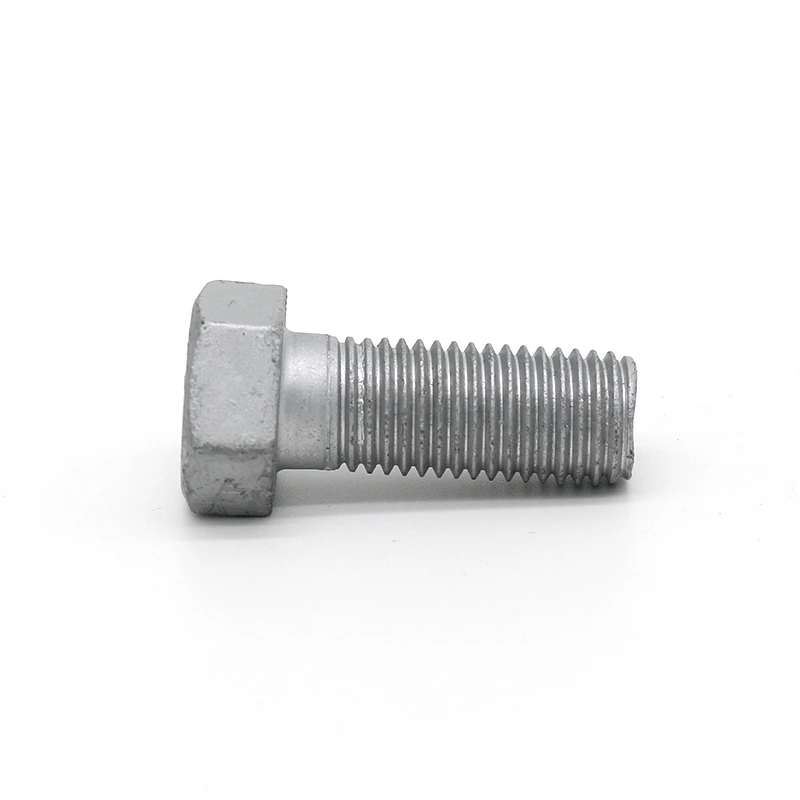
Buyers can first review Wotu’s bolt product category to identify the available fastener family. Category-level information supports discovery, but it does not define a project-specific joint.
Wotu’s hot-dip galvanized hex head bolt page lists DIN 931 half-thread, DIN 933 full-thread and GB30 naming, an M6–M48 range, lengths from 20–300 mm, nonstandard customization, hot-dip galvanizing and bulk export packaging. The page establishes a product family. It does not prove that every diameter, length, thread configuration and document option is combined in stock or suitable for a particular joint.
The quotation should resolve one exact offer: product designation, diameter and pitch, overall and threaded length, property requirement, coating basis, nut and washer scope, inspection, documents, quantity and packing. If the requested thread length is nonstandard, ask for the dimensioned drawing and manufacturing confirmation before approving the sample.
What Should a Bulk Hex Bolt RFQ Include?
- Application: connected parts, environment and installation method.
- Drawing: document number, revision and order of precedence.
- Bolt designation: requested half-thread, full-thread or drawing-controlled geometry.
- Thread: nominal diameter, pitch, tolerance and mating interface.
- Length: overall length, threaded length and controlled transition location.
- Grip: minimum and maximum clamp stack, including washers and spacers.
- Standard: governing product standard and accepted edition.
- Material or property class: ordered requirement and allowed alternatives.
- Finish: hot-dip galvanizing requirement and post-coating fit basis.
- Mating set: nut and washer designations, finish and quantity per bolt.
- Quantity: pieces or complete sets by size.
- Inspection: critical characteristics, sampling and report format.
- Documents: certificates, traceability and language requirements.
- Packing: quantity per carton, pallet protection and lot labels.
- Destination: delivery terms and market-specific requirements.
- Deviations: every proposed alternative or unconfirmed field.
Require the supplier to return each line as Confirmed, Deviation, Alternative or Buyer Review Required. This prevents two visually similar quotations from hiding different thread geometry or supply scope.
Frequently Asked Questions
Is a DIN 933-style bolt always interchangeable with a DIN 931-style bolt?
No. The thread position, unthreaded shank and usable grip differ. Interchangeability must be checked against the drawing, joint stack, mating components and engineering requirement.
Can buyers specify only bolt diameter and overall length?
No. Formal quotations and orders should also confirm thread configuration, pitch, threaded length, property requirement, finish, governing standard and mating hardware.
Does hot-dip galvanizing affect thread fit?
It can affect the threaded interface. The bolt, nut, coating requirement, thread allowance and post-coating verification should therefore be reviewed as one system.
Should nuts and washers be ordered as one set?
That depends on the project. If the assembly is procured as a set, the RFQ should state each component, finish, property requirement, quantity, packing and traceability boundary.
Make the Thread Configuration Explicit Before Ordering
Send the drawing, clamp stack, bolt diameter, overall and threaded length, governing standard, property requirement, coating, mating hardware, quantity and evidence requirements through Wotu’s bulk fastener request form. Ask Wotu to identify the offered half-thread or full-thread condition and list every deviation before sample approval or purchase-order release.