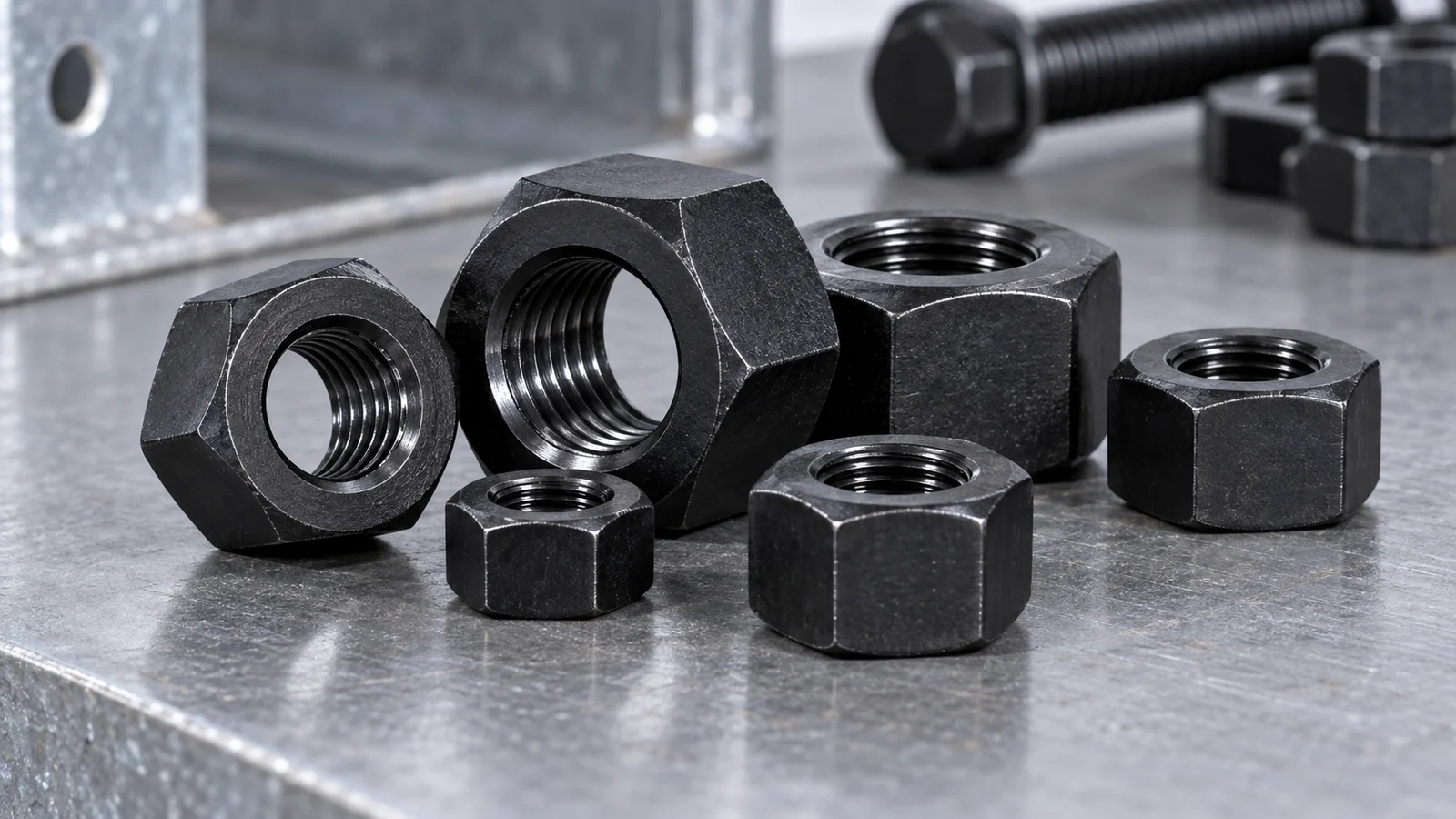
Class 8 and class 10 metric hex nuts are not interchangeable labels for bolt strength. They identify different nut property classes, while the suitability of either nut depends on the mating bolt, thread dimensions, nut style and the relevant specification. A black oxide finish adds another purchasing variable: it describes a surface treatment, not a mechanical property class or proof of outdoor corrosion resistance. For buyers specifying grade 8 or grade 10 high-strength black oxide hex nuts, the reliable starting point is a complete bolt–nut assembly specification rather than the nut grade alone. This guide explains how to distinguish mechanical classes from dimensional standards, what to verify when matching bolts and nuts, and which documents should accompany a bulk fastener order.
What Do Class 8 and Class 10 Mean for Metric Hex Nuts?
In metric fastening practice, a nut property class describes a standardized mechanical performance category under a specified product and test framework. The class marking is not the same notation used for metric bolts: bolts may carry classes such as 8.8 or 10.9, while suitable nuts are identified through the relevant nut-class system. It is therefore incorrect to interpret a class 8 nut as an “8.8 nut,” or a class 10 nut as automatically matching every bolt with a higher numeric designation.
The applicable edition of ISO 898-2 or the contractual equivalent should determine the proof-load requirements, diameter coverage and conditions for matching the assembly. Nut height and thread engagement also affect whether the full mechanical properties of a standard bolt can be developed. For unusual nut styles, nonstandard thicknesses or modified threads, the assumption that a standard-class designation describes the complete assembled performance deserves additional review.
| Specification element |
What it controls |
What the buyer should verify |
| Nut property class |
Mechanical proof-load classification |
Applicable standard, class marking and batch evidence |
| Nut size and style |
Height, wrenching dimensions and bearing surface |
Product drawing and exact dimensional standard |
| Bolt property class |
Mating fastener mechanical characteristics |
Assembly compatibility under the specified standard |
| Thread designation |
Fit between internal and external threads |
Diameter, pitch, tolerance and coating condition |
How Should a Class 8 or Class 10 Nut Be Matched to Its Bolt?
Start with the bolt and joint design
A bolt–nut assembly is specified to achieve a defined connection function, not simply to combine two components with the same nominal diameter. Begin with the engineer’s bolt designation, applicable mechanical standard, joint requirements and expected service condition. Then use the governing standard’s nut compatibility information to identify the appropriate nut class and style. In safety-critical structural connections, use the project-approved assembly requirements and inspection regime rather than a generic online grade table.
Confirm diameter, pitch and thread tolerances
For example, two M12 fasteners do not necessarily have compatible threads if their pitches differ. Internal and external thread tolerance designations, manufacturing condition and coatings can also affect fit. A nut that starts threading by hand may still fail dimensional or mechanical requirements. Confirm the specified pitch, thread class and inspection method before approving substitution.
Check nut height and effective engagement
Standard-height nuts, thickened nuts and thin nuts are not interchangeable merely because the across-flats dimension looks familiar. Thread stripping behavior is affected by engagement length, material properties and the geometry of the mating threads. Modified nut height or special threads should be supported by drawings and appropriate mechanical verification.
Does Class 10 Always Make a Better Replacement for Class 8?
Not necessarily. A higher property class does not correct an incorrect thread pitch, an unsuitable nut geometry, poor coating compatibility or a joint designed around a different standardized assembly. It may also alter purchasing requirements without providing an actual benefit. The right approach is to document the required bolt class and the allowed nut class combinations under the chosen standard. Substitutions should be approved by the responsible engineer where joint integrity matters.
Why Black Oxide Is Not the Same as Mechanical Strength
Black oxide is a surface conversion treatment used to obtain a dark appearance; corrosion behavior depends on the full finishing system, including any supplementary oil or protective process, and the environment. It does not by itself confer the proof-load properties associated with class 8 or class 10. Heat treatment and mechanical testing need separate documentation.
A black oxide nut may be appropriate where the project specifies that finish and compatible storage or exposure conditions. For aggressive outdoor or marine environments, do not assume that black oxide provides the same protection as an engineered zinc coating system. Conversely, changing to a thicker coating can create thread-fit implications that must be checked. The finishing process should be included in the purchase order rather than treated as decoration only.
| Question |
Black oxide |
Mechanical property class |
| Purpose |
Surface appearance and a defined finishing system |
Mechanical classification under its governing specification |
| Evidence |
Finish specification, appearance and corrosion-related requirements |
Proof-load or applicable mechanical inspection record |
| Can it replace the other? |
No |
No |
DIN 934, GB/T 6170 and ISO 898-2: Different Questions
Buyers often encounter products described as “DIN 934 class 10” or “GB/T 6170 class 8.” Such descriptions mix dimensional references with mechanical requirements. A dimensional standard tells the buyer about features such as nut geometry and dimensions, while the specified mechanical standard establishes the relevant property classes and tests. The exact editions matter, especially when legacy DIN documents are used in combination with later ISO or national standards.
Before asserting equivalence between DIN 934 and GB/T 6170, compare the required nut style, size, across-flats dimension, height, thread tolerance and relevant dates. A supplier’s catalog listing is a starting point for procurement, not a certificate that every nominal size meets every edition of two different standards.
Why Do Nominally Matching Nuts Sometimes Fail to Assemble?
| Observed issue |
Possible contributing factor |
Practical verification |
| Nut binds before full engagement |
Pitch or thread-form mismatch, damaged thread |
Check gauges, drawings and thread pitch |
| Loose or inconsistent fit |
Wrong tolerance, manufacturing or coating variation |
Inspect both mating thread specifications |
| Premature thread damage |
Inadequate engagement, material mismatch, assembly error |
Review joint design and mechanical records |
| Unexpected surface rust |
Finish unsuitable for storage or operating environment |
Confirm finishing system and exposure requirement |
These are diagnostic starting points, not evidence of a specific manufacturing defect. Torque alone cannot determine the correct nut property class: it depends on friction, surface condition, lubrication and the complete joint design. Avoid inventing one tightening-torque value for all grade 8 or grade 10 nuts.
How WOTU Lists Black Oxide Hex Nuts
WOTU lists Grade 8/Grade 10 high-strength black oxide hex nuts with heat-treatment and black oxide descriptions and references to DIN 934 and GB/T 6170. Its public product catalogue describes a nominal M6–M48 range and nonstandard size inquiries. These are catalogue statements; the exact chosen size, edition, nut height, proof-load documentation and surface finishing conditions should be confirmed for the purchase batch. WOTU is the stated brand for this nut listing.
In particular, a range covering multiple nominal diameters does not establish that every diameter-and-class combination is always available or has identical verification requirements. A useful technical inquiry names one size, one grade, the mating bolt and the destination environment.
A Purchase Specification for Class 8 and Class 10 Black Oxide Nuts
- Identify the complete mating bolt specification, including property class, diameter, pitch and thread tolerance.
- Specify the exact nut designation, height/style, dimensional standard and edition.
- Identify the nut mechanical class and corresponding test or proof-load evidence.
- Specify the black oxide finishing and supplementary protection requirements; state the intended exposure environment.
- Agree on inspection method, sampling, traceability and any required batch documents.
- Confirm quantity, packing, marking and whether an engineering-approved sample is needed before bulk supply.
Proof Load Is the Critical Mechanical Verification
The designation on a purchase order is not itself evidence of performance. For a standard-height metric nut, the relevant mechanical-property specification determines the proof-load requirement for the nominated property class, nominal diameter and thread pitch. In a proof-load test the nut is assembled on an appropriate hardened, threaded test mandrel and subjected to the specified axial load under the prescribed procedure. Passing the applicable test means satisfying that standard’s acceptance criteria; it does not establish an allowable service load for an arbitrary bolted joint.
This distinction matters when comparing class 8 and class 10. The latter denotes a different mechanical-property requirement within the relevant nut standard, but the final joint is governed by the bolt, nut, engagement geometry, connected parts and designed preload. A nut that meets a higher proof-load requirement cannot repair an undersized bolt, poor thread engagement, an inadequate bearing surface or an incorrectly designed connection. Ask the supplier for the standard edition, applicable class and size, inspection method, lot identity and supporting test results.
| Document or parameter |
What it establishes |
What it does not establish |
| Nut dimensions to a specified dimensional standard |
Nominal geometry and relevant tolerances |
Property class or proof-load compliance |
| Nut property class under the stated mechanical standard |
Target mechanical requirements for its defined scope |
Complete bolted-joint design adequacy |
| Batch test record |
Evidence for identified inspected material and testing |
Performance of a different batch or size |
| Black oxide finish description |
Nominal surface treatment |
Corrosion-resistance performance in every environment |
Nut Height, Stripping and the Limits of a Simple Class Comparison
Thread stripping can occur before the intended bolt tensile-failure mode if there is insufficient effective engagement or the wrong nut geometry. Nut height, tolerance, material response and thread profile must be considered together. A reduced-height nut is not mechanically interchangeable with a standard-height nut merely because the diameter, pitch and property-class description appear similar. When a catalog uses the words thickened nut, request a dimensional drawing rather than assuming the geometry of a particular current DIN or ISO standard.
Also distinguish thread engagement length inside a full nut from the length of exposed bolt thread beyond it. Seeing one or two threads protrude is not a substitute for confirming the prescribed engagement arrangement and compatible thread forms. In critical assemblies, the engineer responsible for the bolted connection must specify the required fastener set rather than approving a substitution based on apparent fit.
Why Coatings and Assembly Friction Need Separate Approval
Black oxide can be supplied with supplementary oil or other post-treatment, but the complete finish condition must be specified. The finish is not a substitute for a tested coating system in persistent moisture, salt exposure or aggressive chemical environments. Equally, a change from a black-oxide assembly to a zinc-coated or hot-dip-galvanized assembly may affect fit, thread tolerance and torque–tension behavior. Such changes require review of the complete fastener system rather than a superficial colour match.
Torque is not a direct measurement of clamp force: friction beneath the rotating surface and in the threads consumes much of the applied torque. Consequently, neither property class nor appearance is sufficient to publish a universal tightening torque. The project engineer should supply the approved tightening procedure, lubrication condition and verification approach.
How to Assess a Supplier’s Sample Without Overclaiming
A practical incoming inspection begins with identification: confirm size and pitch, property class, intended dimensional standard, finish code, lot/heat reference and packaging labels. Check across-flats dimension, nut height, visual condition, thread gauging and traceable records as specified. If a verification plan requires proof-load or hardness testing, agree on the edition, sampling regime, acceptance rules and laboratory responsibilities before ordering. Visual inspection alone cannot establish class 8 or class 10 conformity.
WOTU lists black-oxide high-strength hex nuts in its nut product range. The catalog’s listed M6–M48 range and references to DIN 934 and GB/T 6170 are useful starting points for an enquiry, not independently verified stock or mechanical certificates for every configuration.
Frequently Asked Questions
Is a class 10 nut automatically interchangeable with class 8?
No. Confirm the intended assembly, standards, dimensions and permissible mechanical-class combinations. Higher classification alone is insufficient.
Does DIN 934 define class 8 or class 10 strength?
DIN 934 is commonly cited for hex-nut dimensions. Mechanical properties require the separately applicable product and mechanical standards, with the relevant editions specified.
Is black oxide suitable for exposed roofing or marine steelwork?
Do not assume so. Corrosion performance depends on the complete finish, assembly and exposure. Obtain the project-required corrosion evidence before selecting a surface treatment.
Final Selection Checklist
The correct decision is based on the bolt–nut assembly, not the darkest finish or highest class number. Record the mating bolt, property class, thread pitch, nut dimensions, standard editions and finish requirements. Buyers comparing WOTU’s product options can submit their bolt and nut specifications together with required quantities and inspection documents for a model-specific quotation.