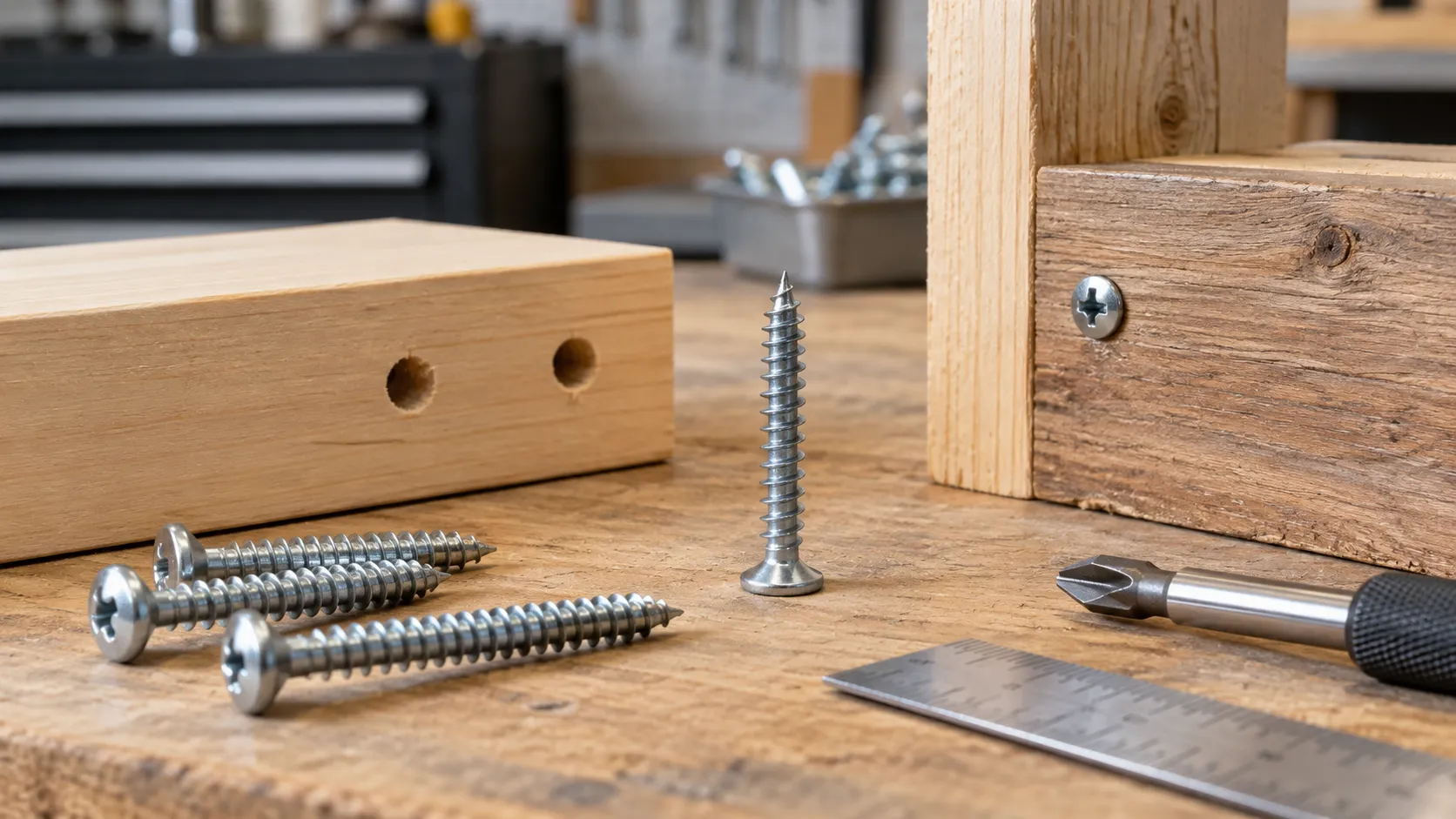
A request for “1 1/2 self tapping screws” is incomplete until the buyer confirms what the 1 1/2 dimension refers to and how the screw will engage the base material. If 1 1/2 inch is the required overall length, that is only one part of the specification. Diameter, thread, head, drive, substrate, pilot-hole condition and required engagement still determine whether the fastener fits the joint. This distinction also prevents a common search-intent error: a “1 1/2 drill bit for wood” describes a hole-making tool or hole diameter, not automatically the pilot hole for a 1 1/2-inch screw. For procurement, screw length and hole diameter must be treated as separate variables.
First Confirm What “1 1/2” Means in the Screw Request
Numeric fastener searches can be ambiguous. “1 1/2 self tapping screws” is commonly read as a length reference, but the purchase order should not depend on an unstated assumption. State whether 1 1/2 inch means the overall screw length and define the diameter or gauge separately.
Wotu Fastener’s current GB/T845-1985 pan-head self-tapping screw range is published in metric ST diameters and rod lengths from 13 mm to 80 mm, with nonstandard length customization supported. A 1 1/2-inch length is about 38.1 mm, which falls inside that published overall length range, but the exact offered length, diameter and thread still need to be confirmed in the quotation. The inch length alone does not identify one specific ST size.
This is the first procurement boundary:
length reference ≠ diameter reference ≠ pilot-hole diameter.
Why a 1 1/2 Drill Bit for Wood Is Not a Screw Pilot-Hole Specification
A search such as 1 1/2 drill bit for wood points to a very different dimensional question from selecting a self-tapping screw. A 1 1/2-inch drilling diameter describes a large hole. It should not be copied into a screw RFQ as the pilot-hole size just because the screw length is also 1 1/2 inches.
The pilot hole for a screw exists to create a controlled relationship between the thread and the substrate. Its diameter depends on the actual screw geometry and the material being engaged. Screw length, by contrast, controls how far the fastener passes through the joint and how much engagement remains in the base material.
For a buyer preparing a drawing or RFQ, the correct sequence is:
identify the screw → define the joint stack → establish the required engagement → confirm whether a pilot hole is required → define the hole from the screw and substrate.
That sequence avoids the false shortcut of selecting a drill bit from screw length alone.
Self-Tapping Screws and Hexagonal Wood Screws Do Not Use the Same Hole Logic
Wotu Fastener’s product data provides a useful example of why the installation method must be tied to the specific screw.
The GB/T845-1985 Phillips Pan Head Self-Tapping Screw is documented for plastic parts, density boards, solid wood, boards, appliance plastic casings and small hardware, and its product description states that the bottom hole needs to be prepared before installation.
Wotu’s Hexagonal Wood Screws, by contrast, are documented with a large-pitch coarse-thread structure for solid wood applications, and the current product description states that pre-drilling is not required for that product line.
These two documented products show why “wood screw drill bit size” cannot be answered from the word “wood” alone. One product family is specified around a prepared bottom hole; the other is described for direct installation into solid wood. The screw design and application determine the drilling logic.
| Decision |
GB/T845 Pan-Head Self-Tapping Screw |
Hexagonal Wood Screw |
| Documented base materials |
Plastic parts, density board, solid wood, boards and small hardware assemblies |
Solid wood structures and wood-based construction applications |
| Documented hole approach |
Bottom hole is prepared before use |
Current product description states no pre-drilling is required |
| Thread concept |
Full-thread self-tapping product |
Large-pitch coarse thread for wood gripping |
| Main procurement question |
Hole, thread and substrate compatibility |
Diameter, length, wood engagement and installation fit |
The table should not be generalized to every self-tapping or wood screw in the market. It reflects the two documented Wotu Fastener product families above and shows why the exact product page matters.
Thread Engagement Is More Important Than Matching a Drill Bit to the Length
For a 1 1/2-inch screw, the buyer needs to determine how much of that length is consumed by the upper component and how much remains engaged in the base material. A screw may have the desired overall length and still be unsuitable if the stack-up leaves too little effective thread engagement.
Think about the joint in layers:
- thickness of the part being fastened;
- any washer, gap, bracket or intermediate layer;
- depth available in the base material;
- required thread engagement;
- clearance or penetration limit behind the base.
Those variables determine whether 1 1/2 inches is enough, excessive or simply irrelevant to the actual design problem. A distributor or OEM buyer should therefore ask for the assembly stack-up before standardizing a length across multiple customer applications.
How the Pilot Hole Should Be Defined for a Pre-Drilled Self-Tapping Joint
Where the selected screw requires a prepared hole, the RFQ should define the method for establishing that hole. The buyer may supply a finished drawing with a hole dimension, or the supplier may be asked to return a recommendation tied to the exact offered screw and substrate.
The important point is that the hole should be based on the screw’s actual diameter and thread geometry, not the 1 1/2-inch length. The base material also matters. A hole relationship that works in one plastic or board material may not be appropriate for another substrate with different density or failure behavior.
When a pilot-hole requirement is technically important, the approval evidence can include:
- a dimensioned screw drawing;
- the approved hole diameter or drawing reference;
- the substrate description;
- the joint stack-up;
- an installation sample or trial where the project requires one.
Evidence is useful only if it confirms the relationship that matters. A drawing should show the dimensions needed to identify the screw and joint, while an approved sample can demonstrate seating and installation behavior in the actual substrate.
Diameter, Head and Drive Must Be Frozen Separately From Length
A 1 1/2-inch length does not tell the installer which tool, head clearance or thread diameter is required. The GB/T845 product uses a pan head and Phillips recess, while the hexagonal wood screw uses a hexagonal head form. Those differences change installation access and seating.
If an assembly has limited headroom, a recessed surface, a visible finished surface or automated tooling, head and drive can be as important as length. The final RFQ should therefore identify:
- required screw family;
- diameter or supplier-confirmed equivalent size;
- 1 1/2-inch length if that is the intended length;
- head style;
- drive or wrench interface;
- surface treatment;
- substrate and installation method.
Do Not Confuse “No Pre-Drill” With a Universal Wood-Screw Rule
The Wotu Hexagonal Wood Screw page states that its coarse-thread design can be installed without pre-drilling. That is a product-specific statement from the current documented line, not a rule for every screw and every timber condition.
Project geometry can still change the decision. Edge distance, thin sections, unusual wood condition, high appearance requirements or a customer drawing may lead a project engineer to define a prepared hole or another installation control. If the project specification conflicts with a general product description, the project requirement should be resolved before the PO.
This boundary is important for SEO content as well as procurement: a search for a drill-bit size should not be answered with a universal numeric table when the correct hole depends on the actual fastener and material.
How to Build a Comparable RFQ for 1 1/2 Self Tapping Screws
| RFQ Field |
What the Buyer Should State |
What the Supplier Should Confirm |
| Length |
Whether 1 1/2 inch is the required overall length |
Exact offered length |
| Diameter / size |
Required diameter, gauge or drawing reference |
Actual offered size and naming system |
| Thread |
Project requirement if fixed |
Offered thread geometry |
| Substrate |
Solid wood, board, plastic or other actual material |
Product-fit confirmation |
| Pilot hole |
Whether a prepared hole is required |
Hole basis for the offered screw if applicable |
| Head / drive |
Access, seating and tooling requirement |
Offered head and drive |
| Finish |
Required surface treatment / appearance |
Offered treatment |
| Quantity / packing |
Order quantity and packaging needs |
Commercial basis of quotation |
Wotu Fastener’s Self Tapping Screw category provides the broader product family for comparison, while the relevant product-detail pages show whether a prepared hole is part of the documented installation method.
What Should the Buyer Approve Before Ordering?
Before a 1 1/2-inch screw is released for production or repeat purchasing, the order should be tied to a clear product reference rather than a search phrase. Confirm the actual diameter, thread, length, head, drive, material or surface treatment, base material and drilling condition.
If the buyer originally reached the topic through a search for “1 1/2 drill bit for wood,” the most important correction is dimensional: a 1 1/2-inch hole is not the pilot hole for a 1 1/2-inch screw merely because the numbers match. The screw length and hole diameter solve different engineering problems.
For a project-specific quotation, send the screw length, joint drawing, substrate and installation requirement through Wotu Fastener’s Contact / RFQ page. The supplier response should identify the exact offered screw and state whether the assembly uses a prepared hole, so the buyer can compare technically equivalent quotations rather than matching only the visible length.