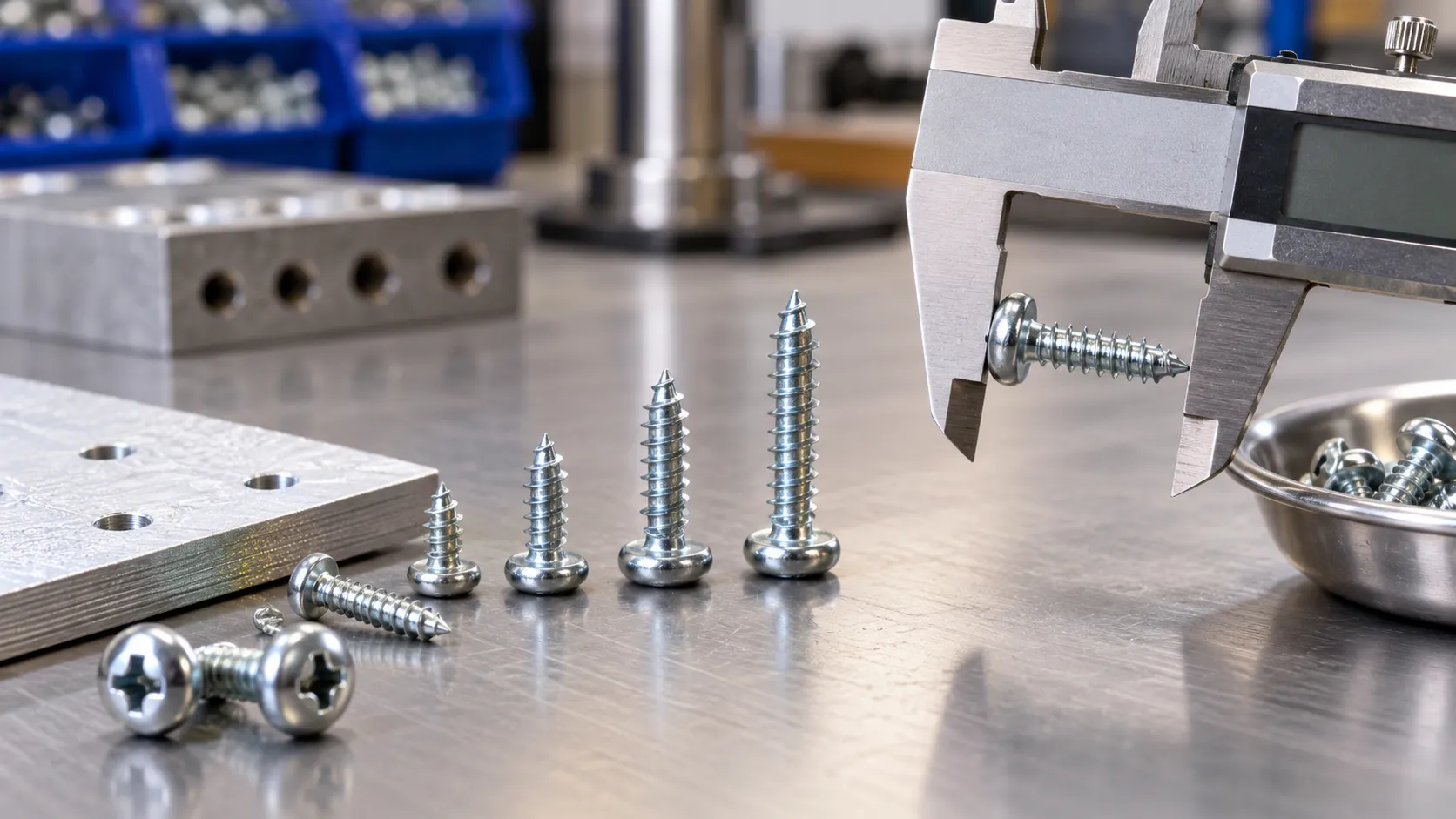
#4 self tapping screws should not be purchased from the “#4” designation alone. For a usable B2B specification, the buyer still needs the actual screw diameter, thread form or pitch, overall length, substrate, pilot-hole condition, head and drive style, material, surface finish and quantity. This matters because suppliers may use different naming systems. Wotu Fastener’s current GB/T845-1985 pan-head self-tapping screw range, for example, is published in metric ST sizes rather than an imperial “#4” designation. A buyer comparing quotations should therefore ask each supplier to return measurable dimensions instead of assuming that a familiar gauge name means the same physical screw everywhere.
What Does “#4” Tell You—and What Does It Leave Undefined?
The search term #4 self tapping screws looks specific, but it is not a complete procurement description. In many markets, “#4” is used as a nominal gauge reference. A quotation still needs to translate that reference into dimensions and installation conditions that can be checked against a drawing, sample or project requirement.
This is especially important when an international buyer is comparing an inch-based commercial description with a supplier catalogue that uses metric self-tapping designations. Wotu Fastener’s published Phillips Pan Head Self-Tapping Screw (GB/T845-1985) range lists ST2.9, ST3.5, ST4.2, ST4.8, ST5.5 and ST6.3, with rod lengths from 13 mm to 80 mm and support for nonstandard length customization. The page does not state that “#4” is automatically equal to any one of those ST sizes.
Procurement rule: use “#4” as the search or reference designation, but freeze the order by measurable screw dimensions and the required joint condition.
Separate Diameter, Thread and Overall Length in the RFQ
Three dimensions are often mixed together in informal screw requests: nominal size, thread geometry and length. They influence different parts of the joint, so they should be specified separately.
Actual screw diameter
Diameter defines the basic scale of the fastener and affects the relationship between the screw, the prepared hole and the material around the thread. If the supplier and buyer are using different naming systems, the measured or drawing-defined diameter is the safer comparison point.
Thread form and pitch
The thread is the part that develops engagement in the prepared substrate. A self-tapping screw cannot be evaluated only by its outside diameter; the thread geometry also affects how material is displaced or engaged during installation. The project drawing or supplier technical confirmation should therefore identify the actual thread specification used for the offered screw.
Overall length
Length controls whether the fastener can pass through the upper component and still achieve the required engagement in the base material. A screw that has the right diameter but the wrong length can still create a poor joint. The RFQ should therefore define the complete stack-up: the thickness of the part being fixed, any gap or intermediate layer, and the required engagement in the base material.
The decision chain is straightforward:
joint stack-up → required penetration → effective engagement → screw length.
The Substrate Determines Whether the Same Screw Specification Still Fits
Wotu Fastener’s GB/T845-1985 pan-head self-tapping screw is documented for assembly involving plastic parts, density boards, solid wood, boards, home-appliance plastic casings and small hardware. Those materials do not behave identically during installation.
A rigid plastic part, engineered board and solid wood can respond differently to the same hole and thread geometry. The buyer should therefore include the actual substrate in the RFQ rather than using a generic statement such as “for wood” or “for plastic.” Material thickness also matters because thread engagement must occur in enough material to perform the intended locking function without creating an installation conflict.
For production procurement, useful substrate information includes:
- base material type;
- material thickness or available engagement depth;
- whether the material is solid, board-based or molded;
- whether the joint is close to an edge or thin section;
- whether the screw is being installed into a prepared hole.
This information helps a supplier evaluate whether the offered self-tapping screw family actually matches the joint instead of quoting from the nominal screw name alone.
Why the Pilot Hole Is Part of the Screw Specification

The target Wotu product page explicitly states that the bottom hole needs to be prepared before use. That makes the pilot hole a functional part of the assembly, not a secondary workshop detail.
If the prepared hole is too small for the actual screw and substrate combination, installation resistance can rise and the joint may experience excessive local stress. If the hole is too large, thread engagement can be reduced. The correct value should therefore be confirmed from the screw geometry, substrate and project requirement rather than copied from an unrelated generic chart.
A professional RFQ should avoid writing only “pilot hole required.” It should clarify who defines the hole and how it will be verified. For example, the buyer may provide a drawing-defined hole; alternatively, the supplier may be asked to return the recommended hole basis for the offered screw and material combination.
| Input |
Why It Changes the Pilot-Hole Decision |
What to Verify |
| Actual screw diameter |
Sets the basic relationship between hole and thread |
Supplier-confirmed measurable diameter |
| Thread geometry |
Changes how the thread engages the prepared material |
Thread specification or drawing |
| Substrate |
Wood, board and plastic respond differently during installation |
Actual material used in the joint |
| Material thickness |
Controls available engagement depth |
Stack-up and base thickness |
| Installation method |
Tooling and torque control affect repeatability |
Production installation condition |
Head and Drive Style Affect Installation, Not Just Appearance
The Wotu GB/T845-1985 product uses an arc pan head with a Phillips recess. Those features should be treated as part of the functional specification.
The head controls how the fastener seats against the upper component. The drive defines the tool interface used during installation. Changing either can affect available clearance, tool access, seating behavior and assembly-line compatibility. A buyer who needs a pan head and Phillips recess should state those requirements directly instead of assuming that every #4 self-tapping screw quotation will use the same head and drive.
This is also where drawings and samples become useful evidence. A dimensional drawing can confirm the head geometry, thread and length, while an approved sample can help verify seating and tool access in the real component.
Material and Surface Finish Need to Match the Service Condition
Wotu Fastener’s documented GB/T845-1985 product uses carbon steel and lists blue-white zinc plating, with color zinc plating and black oxide as optional surface treatments. Those options should not be treated as interchangeable purely on appearance.
The buyer should define the intended environment and the required surface treatment in the RFQ. An indoor assembly, visible hardware component and project with a specified coating system may require different acceptance criteria. If the project has a corrosion, appearance or coating-thickness requirement, that requirement should be stated explicitly and verified against the offered finish.
Do not turn a coating name into an unsupported performance claim. The practical procurement question is whether the supplier’s offered material and finish match the project specification and whether any deviation is declared before the order is released.
How to Compare #4 Self Tapping Screw Quotations
Price comparison is meaningful only after the technical basis is aligned. If Supplier A quotes one actual diameter, one thread and one coating while Supplier B quotes another configuration, the two offers are not equivalent simply because both use the label “#4 self tapping screws.”
| RFQ Item |
Buyer Should Define |
Supplier Should Return |
| Nominal reference |
#4 self tapping screws |
Supplier naming / equivalent reference |
| Actual diameter |
Required or drawing-defined value |
Offered measurable diameter |
| Thread |
Project requirement if fixed |
Offered thread specification |
| Length |
Overall length and joint stack-up |
Offered length |
| Pilot hole |
Prepared-hole requirement |
Recommended or drawing-confirmed basis |
| Substrate |
Wood, board, plastic or actual project material |
Suitability confirmation for the offered screw |
| Head / drive |
Required seating and tool interface |
Offered head and recess |
| Material / finish |
Project material and surface requirement |
Offered material and treatment |
| Quantity / packing |
Order quantity and packing requirement |
Commercial quotation basis |
Wotu Fastener’s Self Tapping Screw category can be used to review the available product family before a buyer fixes the exact screw configuration. The category step is useful for product discovery; the product-detail and drawing step is where the final technical specification should be confirmed.
What Should Be Frozen Before the Purchase Order?
Before the PO is issued, the buyer should be able to identify the offered screw without relying on a marketing name. The final order basis should include the measurable screw geometry, length, head, drive, material, surface finish, required pilot-hole condition, substrate and packaging scope.
For higher-volume or repeated purchases, add an approval reference that can be reused: a dimensioned drawing, approved sample, supplier part reference or agreed specification revision. That reduces the risk that a later batch is quoted or produced from a different interpretation of “#4.”
If the project is still at RFQ stage, send the joint drawing, substrate information, required size reference and finish through Wotu Fastener’s Contact / RFQ page. The useful next step is not to ask for the lowest #4 screw price; it is to obtain a quotation tied to the same measurable screw and the same installation condition.