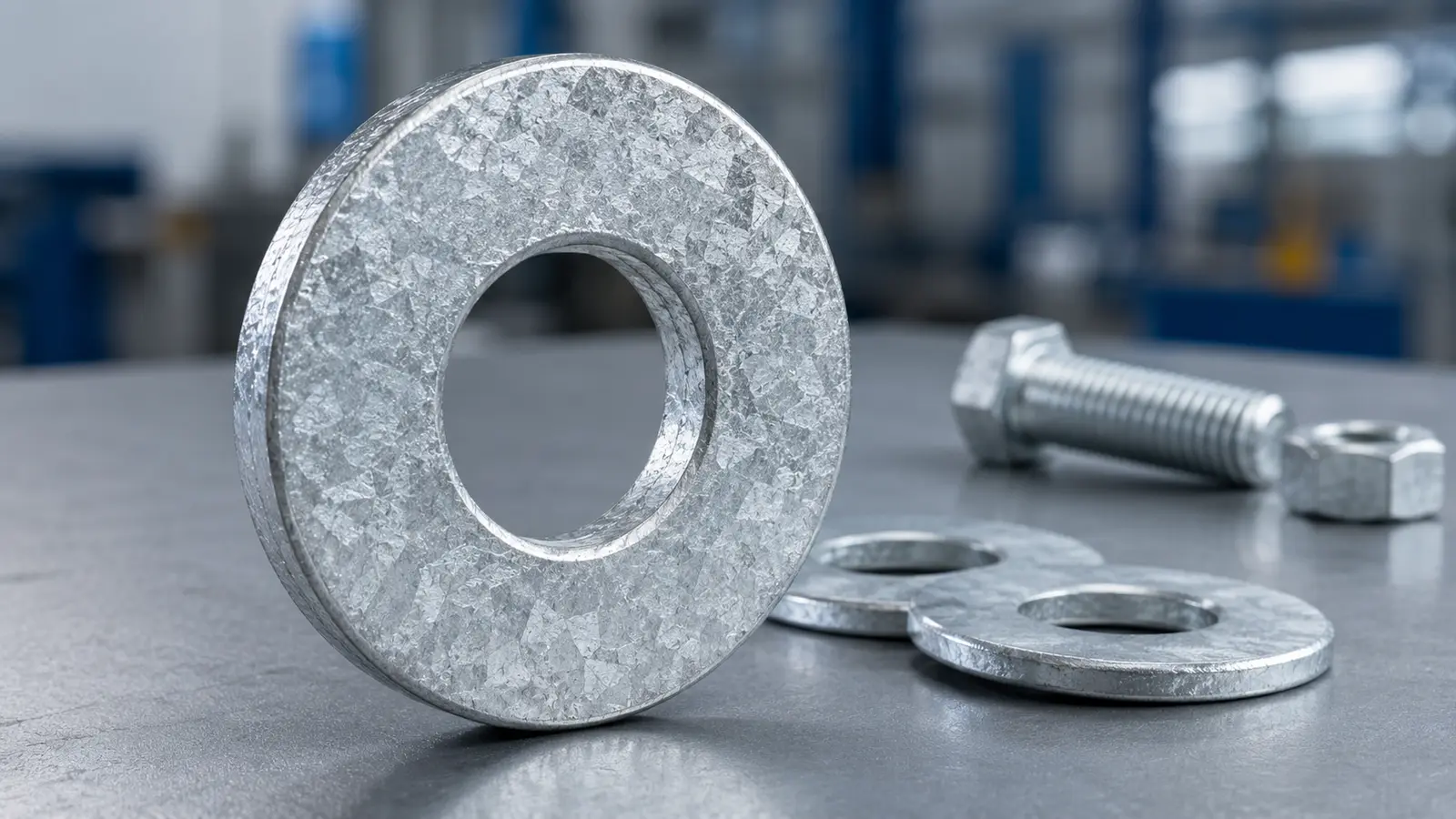
A hot-dip galvanized flat washer should be purchased as a defined joint component, not simply as an M-size metal disc. A usable specification identifies the dimensional standard and series, nominal size, inside and outside diameters, thickness, product grade, hardness or mechanical requirement, base material, coating requirement and the bolt, nut and bearing surface with which the washer will be used. The buyer should also define whether dimensions are accepted before or after coating and what inspection records must accompany the shipment. This prevents technically different washers from appearing equivalent in a quotation and reduces the risk of hole interference, washer cupping, poor bearing or inconsistent corrosion protection.
What a flat washer does in the joint
A flat washer provides a controlled bearing surface under a bolt head or nut. It can distribute contact pressure, protect the connected surface and bridge the clearance around a bolt hole. It does not automatically lock the joint, correct an unsuitable bolt length or compensate for an incorrect tightening method. Those functions depend on the complete assembly.
This distinction matters during sourcing. A buyer browsing a hot-dip galvanized flat washer range may find several products that fit the same nominal bolt diameter but differ in outside diameter, thickness, hardness, tolerance and coating. The nominal designation is only the first filter.
The connected material is equally important. A normal-series washer may be suitable on a firm, correctly sized bearing surface, yet a soft material or oversized clearance hole can require a different outside diameter or thickness. That decision belongs to the joint design; it should not be left to visual judgment during installation.
Separate dimensional, mechanical and coating requirements
Washer standards do not all control the same properties. A dimensional standard defines geometry and size relationships. A mechanical specification addresses properties such as hardness and the washer’s suitability for use with particular fastener property classes. A hot-dip galvanizing specification controls the coating process and acceptance requirements. Writing only one standard number on the RFQ may therefore leave important parts of the purchase undefined.
| Specification layer |
What it normally controls |
What the RFQ still needs to state |
| Washer dimensional standard |
Nominal series, inside diameter, outside diameter, thickness and product grade |
Exact designation, size, revision and any permitted custom dimensions |
| Mechanical requirement |
Hardness or property class and compatibility with the bolting assembly |
Bolt and nut grades, service condition and required evidence |
| Coating requirement |
Hot-dip galvanizing process, coating thickness, finish and applicable tests |
Coating standard, sampling, appearance limits and repair policy |
| Project drawing or purchase order |
Application-specific configuration and commercial scope |
Quantity, packing, documents, marking, deviations and delivery basis |
GB/T 97.1-2002 covers normal-series, product-grade-A plain washers and distinguishes hardness classes for use with different bolt, screw and nut property classes. ISO 7089 addresses the corresponding normal-series product-grade-A washer geometry in an international standard context. These references help identify a product family, but a buyer should state the exact standard required by the project rather than treating GB/T and ISO designations as automatically interchangeable.
The boundary between mechanics and corrosion is just as important. ISO 898-3 specifies mechanical and physical properties for flat washers, but it does not specify corrosion resistance. Hot-dip zinc coating requirements must therefore be defined separately. ISO 10684 primarily covers hot-dip spun coatings on threaded fasteners and allows its provisions to be applied to non-threaded parts such as washers; ASTM F2329/F2329M also expressly covers hot-dip zinc coatings on washers. The applicable project document determines which route belongs in the order.
Confirm inside diameter, outside diameter and thickness as a set
Inside diameter controls assembly clearance around the bolt shank and any coating on the mating fastener. Too little clearance can cause interference or damage during assembly. Excessive clearance reduces the washer’s effective bearing area near the hole and can be especially problematic when the workpiece already has an oversized opening.
Outside diameter sets the area over which the clamp load is transferred to the connected surface. Thickness influences the washer’s ability to remain sufficiently flat under that load. These two values interact: increasing outside diameter without considering thickness and hardness can produce a washer that bends or cups instead of providing a stable bearing surface.
This is why a request for “M16 flat washers,” for example, is incomplete. The buyer needs the standard series or exact three dimensions, the bolt-hole size in the workpiece and the material under the washer. If the project uses slotted holes, thin sheet, timber, insulation, coatings or other compressible surfaces, the responsible engineer should confirm whether the standard washer remains appropriate.
Washer hardness must suit the bolting assembly
A washer can fit dimensionally and still be unsuitable mechanically. Under a highly loaded bolt or nut, a washer that is too soft may indent, dish or embed into the connected surface. That movement can reduce the stability of the clamped joint even though the bolt itself meets its specified property class.
The washer hardness or property class should therefore be reviewed with the bolt and nut grades, not selected independently. GB/T 97.1-2002 distinguishes 200 HV and 300 HV washers for different ranges of mating fastener strength. International or project specifications may express the requirement differently, so the RFQ should identify the complete assembly and the required mechanical evidence instead of asking a supplier to infer hardness from the washer size.
A coating certificate does not prove hardness, and a hardness result does not prove coating conformity. Keeping those records separate makes quotation review and incoming inspection clearer.
Hot-dip galvanizing changes more than appearance
Hot-dip galvanizing provides a zinc coating over the steel surface, but the procurement specification must define how that coating is accepted. Coating thickness, coverage, finish, adhesion, local repair and handling of excess zinc can affect both corrosion performance and assembly. A bright or uniform-looking washer is not enough evidence by itself.
Because zinc adds material to the surfaces, dimensions and fit should be evaluated in the delivered condition. Excess zinc at the washer hole or on a bearing face may interfere with assembly or prevent full, stable contact. Centrifuging or another controlled removal method is commonly used for small hardware to remove free zinc, yet the buyer still needs an agreed inspection plan.
Coating choice must also match the rest of the assembly. A hot-dip galvanized washer paired with an incompatible fastener finish can create installation or durability concerns. The order should specify the bolt, nut and washer coating system together, including any project rules for coating compatibility and field repair.
Check the actual product scope before requesting a quotation
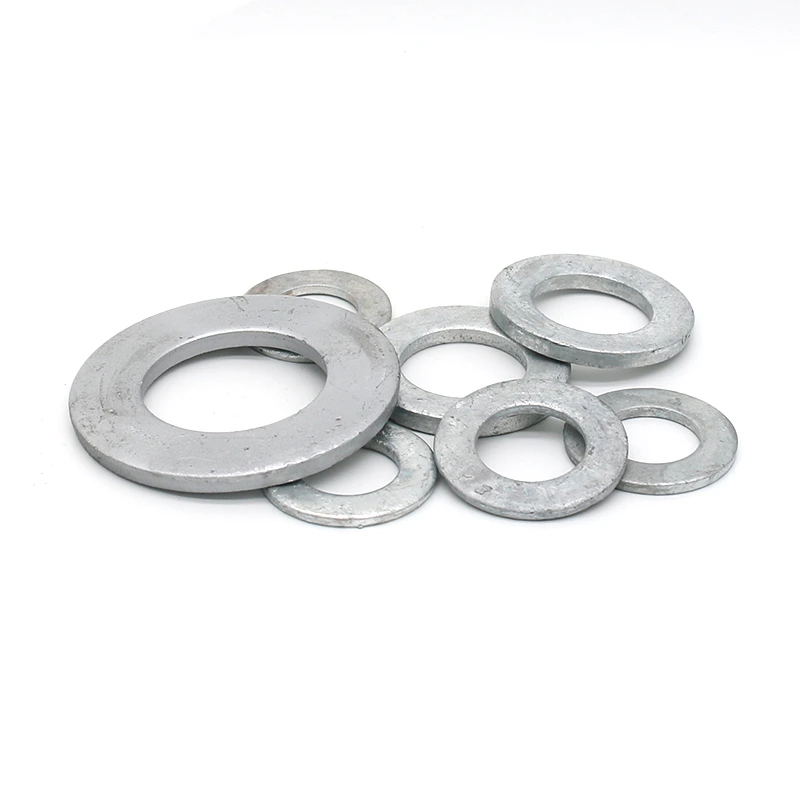
Wotu’s listed GB/T 97.1 grade-A flat washer uses an overall hot-dip galvanized finish and is offered in M6–M64 sizes. The product information also lists optional blue-white zinc plating, color zinc plating and black oxide, along with support for non-standard dimensions. Buyers should name the required finish explicitly because these alternatives are different coating systems, not interchangeable descriptions.
The same product record states 25 kg woven-bag or export-carton packing, pallet wrapping for full loads and private-label support. These details can be useful for distributor and project orders, although the final quotation should still confirm unit count or net weight per package, label content, pallet limits and lot traceability. A 25 kg package description alone does not tell the receiving team how many washers are in each container.
Inspection should connect each claim to evidence
Incoming inspection is most effective when it follows the same specification used for the quotation. Dimensional checks should cover the agreed inside diameter, outside diameter and thickness, along with flatness, burrs and any special geometry. Measurements need a stated sampling basis and should reflect the coated, delivered part when that is what the drawing requires.
Mechanical verification may include hardness results or other records required by the governing specification. Coating evidence may include coating-thickness measurements, appearance and coverage inspection, adhesion checks or other tests defined by the selected galvanizing standard. The buyer does not need every possible certificate on every order; the document package should be proportional to the application and agreed before pricing.
Traceability closes the loop. Carton, bag or pallet labels should connect the delivered washers to the purchase order, size, finish and production lot. Without that link, a correct test report can be difficult to associate with the material that reaches the site.
Compare quotations only after the technical scope is aligned
Two offers can use the same nominal washer description while pricing different products. One supplier may quote a standard-size washer with basic commercial inspection; another may include a defined hardness class, controlled post-coating dimensions, coating tests, export cartons and lot records. The lower unit price is not directly comparable until these differences are declared.
A useful quotation review separates four questions:
- Does the offered washer match the requested dimensional standard, size and product grade?
- Is its hardness or mechanical property compatible with the specified bolt and nut assembly?
- Is the galvanizing scope supported by the required coating evidence and post-coating fit?
- Are inspection, packaging, marking and documents included in the quoted price and lead time?
Any substitute standard, coating process, dimension, hardness class or document exclusion should appear in a deviation list. Silence is not confirmation. A quotation becomes useful when engineering and purchasing can see exactly what will be supplied.
Prepare a washer RFQ that suppliers can answer precisely
Include the washer standard and edition, nominal size, inside diameter, outside diameter, thickness, product grade, hardness or property class, base material, hot-dip galvanizing requirement, mating bolt and nut grades, workpiece material and hole condition. Add quantity, packing, marking, inspection, document and delivery requirements. If a custom washer is needed, attach a controlled drawing and identify which dimensions and tolerances differ from the standard.
Ask the supplier to return the offered designation, post-coating dimensions, mechanical requirement, coating standard, inspection scope, packing basis and every deviation. Submit those project inputs through Wotu’s technical fastener inquiry form. With the joint conditions and acceptance evidence fixed first, the commercial comparison can focus on genuinely equivalent supply scopes.