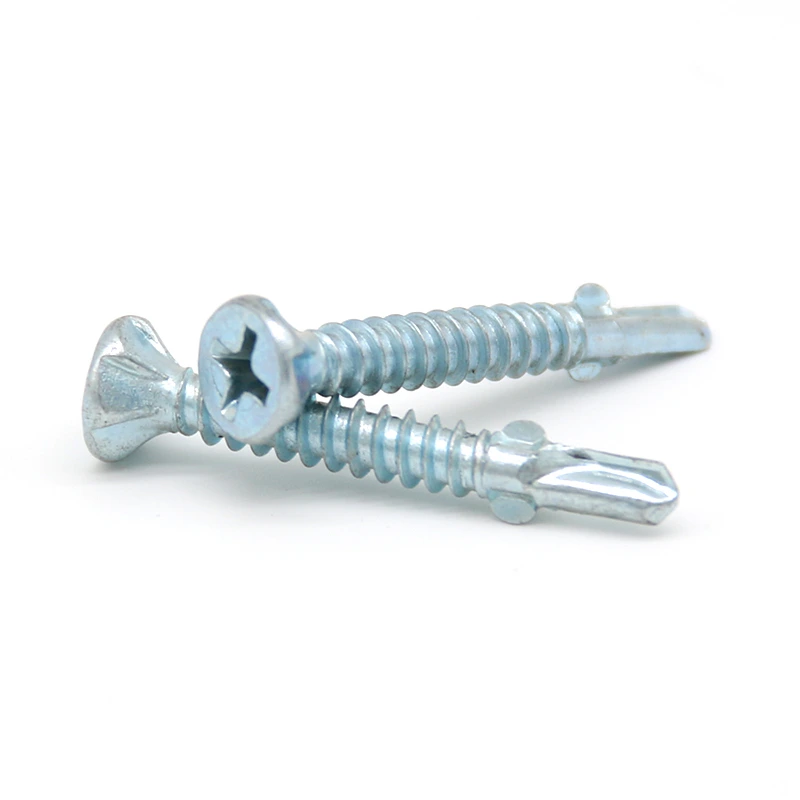
A screw is a tool that uses the physical and mathematical principles of inclined planes, circular rotation, and friction to gradually tighten objects and machine parts. A self-drilling screw is a screw with a self-tapping drill bit at its tip. Screws are a common invention of humankind throughout history, and in terms of application, they are considered one of humanity’s greatest inventions.
Self-drilling screws are a relatively recent invention, also called self-drilling screws. “Screw” is a general term for fasteners, used in everyday speech.
The tail of a self-drilling screw is shaped like a drill tip or a pointed tip. It requires no auxiliary processing and can directly drill, tap, and tighten into the material being installed or the foundation, significantly saving construction time. Compared to ordinary screws, this type of screw has higher pull-out strength and holding power, ensuring it won’t loosen even after prolonged use. It’s safe to use, as drilling and tapping are completed in one go, making operation simple.
Applications: It’s a type of screw primarily used for fixing corrugated steel sheets in steel structures, and can also be used for fixing thin sheet metal in simple buildings. It cannot be used for metal-to-metal fastening.
Materials: Available in iron and stainless steel, with stainless steel further divided into various grades.
Actuations: Φ4.2/ Φ4.8/ Φ5.5/ Φ6.3mm, specific lengths can be negotiated upon request.
Drill tip types:
Round head (Michelson/Phillips/Torch), Countersunk (flat head)/Michelson/Phillips/Torch, Hex washer, Round head washer (large flat head), Trumpet head, etc.