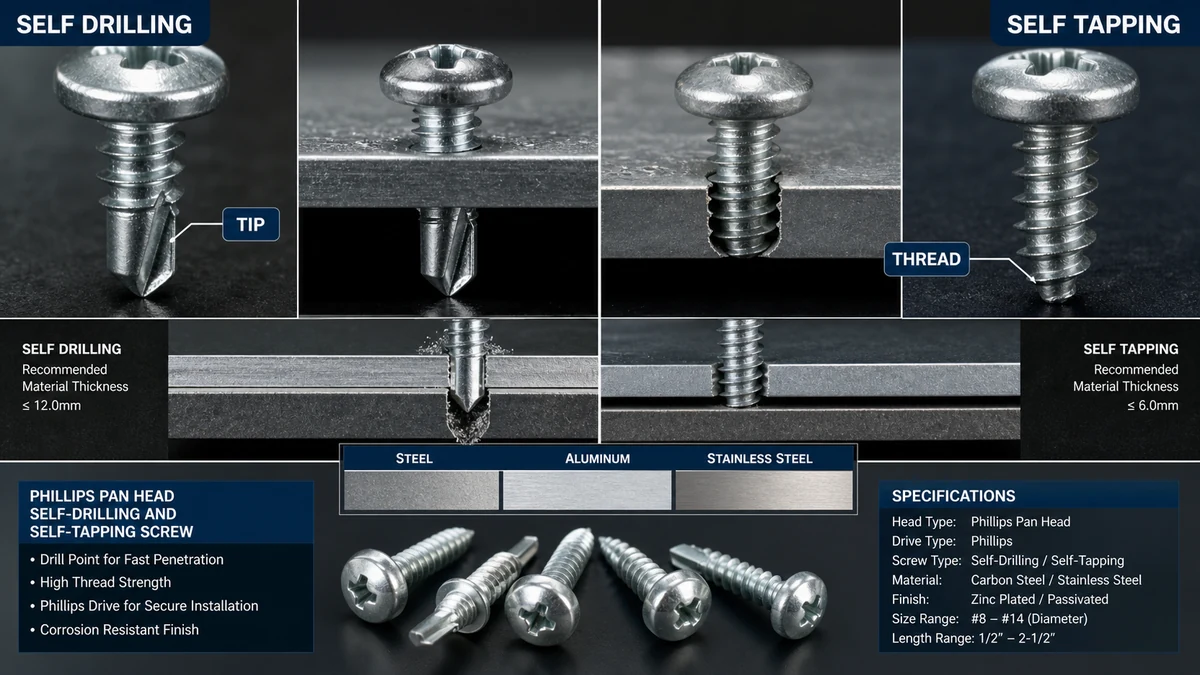
Direct answer: Choose a self-drilling screw when the fastener must create a hole through a verified metal stack before its threads engage. Choose a self-tapping screw when the assembly already has a correctly sized pilot hole or when the selected thread is intended to form or cut into the specified substrate. The decision must also match point capacity, substrate thickness, thread engagement, head, washer, coating, and installation method.
This comparison is intended for metal-building fabricators, roofing-system suppliers, steel-structure factories, photovoltaic mounting companies, equipment manufacturers, fastener distributors, contractors, and OEM buyers. The commercial question is not which screw name sounds more advanced. It is which fastening sequence produces a repeatable hole, usable thread engagement, acceptable clamp load, and the required finish in the actual assembly. Buyers can review Wotu Fastener’s self drilling screw product category and self tapping screw product category while preparing a project-specific comparison.
What Is the Practical Difference Between Self Drilling vs Self Tapping Screws?
A self-drilling screw combines drilling and thread engagement in one installation sequence. Its point must penetrate the complete metal stack before the first full thread reaches the workpiece. A self-tapping screw creates or cuts mating threads, but it does not automatically mean that the point can drill every substrate without a prepared hole.
Terminology varies between markets and product catalogs. For procurement, the functional requirement should therefore be written more precisely than the product name. The RFQ should state whether the fastener must drill a new hole, enter a prepared pilot hole, form threads, cut threads, clamp a sealing washer, or connect dissimilar materials.
| Assembly Condition |
Normally Preferred Route |
Buyer Verification |
Main Risk if Selected by Name Alone |
| Thin metal panel to verified steel support |
Self-drilling screw may reduce separate drilling operations |
Total drilling thickness, steel grade, point capacity, thread engagement, head and washer |
The point may wear or fail before the threads reach the support. |
| Metal component with an existing pilot hole |
Self-tapping screw may provide more controlled thread formation |
Pilot-hole diameter, tolerance, material hardness, thread form and installation torque |
An oversized hole reduces holding performance; an undersized hole increases torque and breakage risk. |
| Metal sheet or bracket to timber |
Use a thread and point selected for timber rather than assuming a metal drill point is suitable |
Timber density, embedment, edge distance, splitting risk, head bearing and corrosion exposure |
The screw may drill the metal but provide poor timber engagement or split the wood. |
| Roof panel with sealing requirement |
Selection depends on substrate, drilling route, washer and installation control |
Panel profile, support thickness, point length, washer construction, coating and environmental exposure |
A correct drilling function may still produce an unreliable seal. |
| Thicker steel, multiple layers or high-strength substrate |
Engineering review and representative installation trial |
Each layer’s thickness and grade, total stack, point design, tool speed and required clamp condition |
The screw can overheat, stall, break or engage threads before drilling is complete. |
How Does the Substrate Stack Change the Screw Decision?
The substrate stack is the complete path that the fastener must pass through. It may include a roof panel, flashing, clip, bracket, insulation spacer, air gap, structural support, timber layer, coating, or pre-drilled component. Buyers often state only the visible panel thickness, even though the hidden support determines the drilling and thread-engagement requirement.
For every layer, record:
- Material type and grade
- Individual thickness
- Whether the layer is separated by an air gap or compressible material
- Whether a hole already exists
- Required final clamp condition
- Required thread engagement in the load-bearing substrate
- Whether the connection must seal against water or dust
- Whether the joint will experience vibration, movement, or repeated service loads
A common specification mistake is to total all visible dimensions while ignoring point length. The drilling point and incomplete lead threads do not provide the same holding contribution as fully engaged threads. A screw may protrude through the support yet still have less effective engagement than expected.
Another procurement mistake is to combine different assemblies under one fastener line item. A screw that works for a single roof sheet over a thin steel purlin may not perform the same way through a lap, a clip, an extra bracket, or a thicker support. Separate those connection stacks in the RFQ and ask the supplier to confirm each one.
When Is a Self-Drilling Screw the Better Choice?
A self-drilling screw is commercially attractive when the buyer wants one installation step for a qualified metal-to-metal connection. It can reduce separate drilling labor, limit part handling, and support repeat production. Those benefits depend on the drill point finishing the hole before the threads begin loading the joint.
The supplier should receive the total drilling thickness and the thickness and grade of every metal layer. “Suitable for steel” is not enough. Coated sheet, high-strength steel, stacked sheets, gaps between layers, curved surfaces, and off-angle installation can all change drilling behavior.
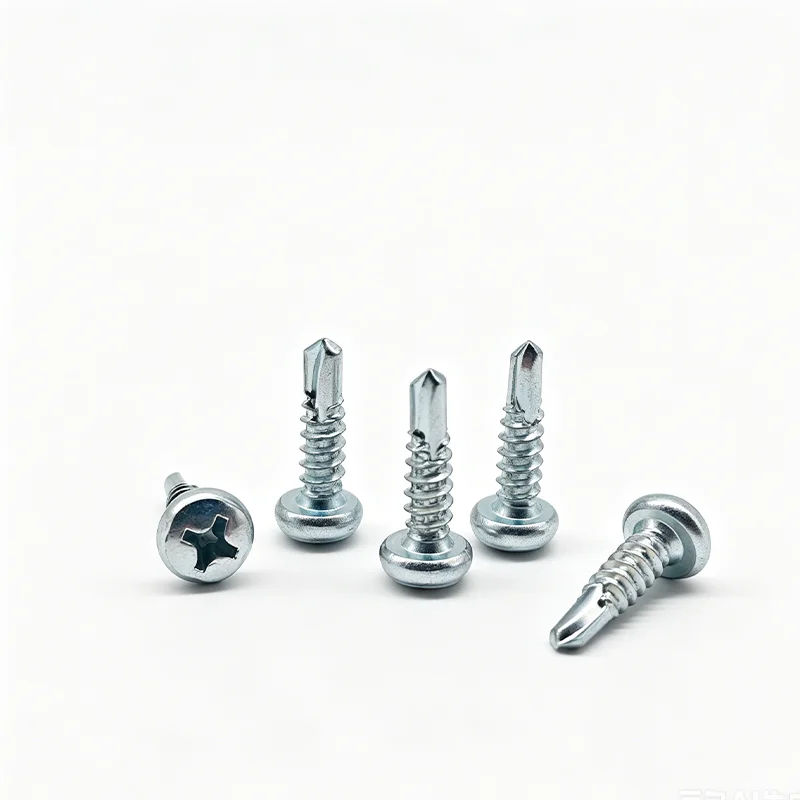
Wotu Fastener’s Phillips pan head self-drilling and self-tapping screw is listed in ST2.9, ST3.5, ST4.2, ST4.8, and ST5.5 sizes, with listed rod lengths from 13 mm to 60 mm and stated drilling suitability for 2–6 mm steel sheet. These values are product-range references; the exact combination must still be checked against the project’s stack, head requirement, coating, tool, and acceptance trial.
Experienced buyers also check the transition between the drill point and the first full thread. If the threads reach the upper layer before the point has completed the lower hole, the sheets may separate, the point may overload, or the screw may fail to pull the joint together correctly. This is one reason total stack data is more useful than quoting only the thickest layer.
When Is a Self-Tapping Screw the Better Choice?
A self-tapping screw is often the more controlled choice when the assembly already has a pilot hole, when the design requires a particular thread-forming or thread-cutting action, or when the substrate is not intended to be drilled by a metal drill point. It can be appropriate for pre-punched components, controlled sheet-metal assemblies, and selected timber or composite applications when the thread and pilot-hole design match the material.
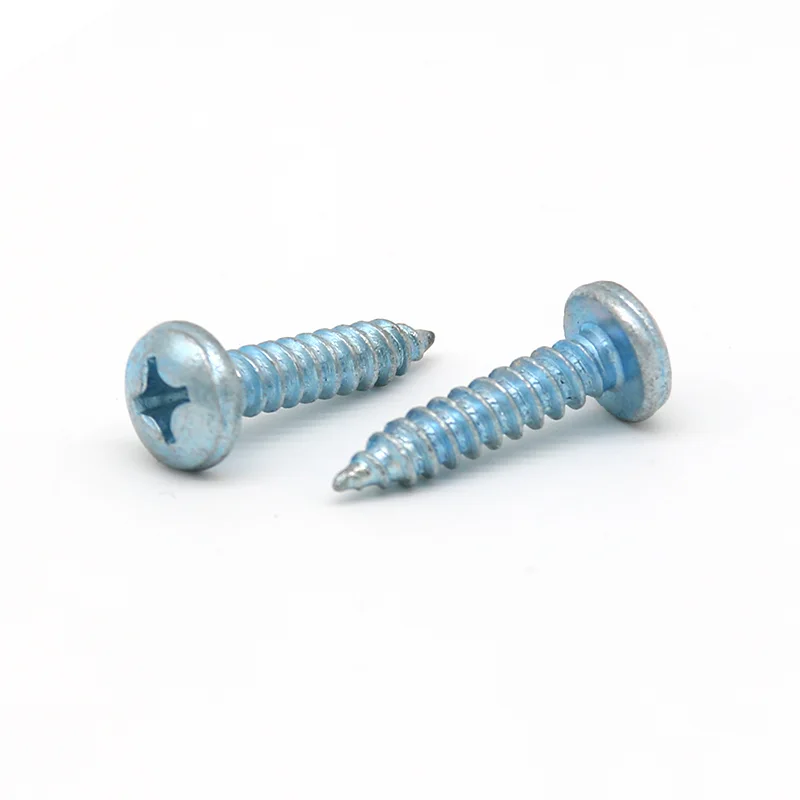
The Phillips pan head self-tapping screw is listed in ST2.9, ST3.5, ST4.2, ST4.8, ST5.5, and ST6.3 sizes, with listed rod lengths from 13 mm to 80 mm. Available surface-treatment references include blue-white zinc plating, color zinc plating, and black oxide. Final suitability still depends on the pilot hole, substrate, head bearing, corrosion environment, and required holding performance.
Pilot-hole control is one of the most important differences between a stable assembly and a high-rejection assembly. A hole that is too large can reduce thread flank engagement and allow spinning or loosening. A hole that is too small can raise installation torque, damage the thread, deform the component, split timber, or break the screw. Buyers should define a pilot-hole diameter and tolerance rather than leaving the installer to choose a drill by habit.
For metal-to-wood connections, the upper metal layer and lower timber layer should be treated as two different functions. The fastener may need clearance through the metal and controlled embedment in timber. Timber species, density, moisture condition, edge distance, grain direction, and required head bearing can matter more than whether the catalog description includes the words “self-drilling.”
How Should Buyers Choose the Drill Point, Thread, Head, and Washer?
The drill point and thread solve different parts of the installation. The point creates or enters the hole. The thread develops engagement and clamp load. The head transfers bearing force, provides tool access, and may need to sit flush or remain visible. A washer may distribute load, protect a surface, or provide sealing.
| Feature |
Procurement Question |
Typical Hidden Cost if Incorrect |
| Drill point |
Can it complete the specified material stack before thread engagement? |
Slow installation, overheated points, broken screws, incomplete holes and tool wear |
| Thread form and pitch |
Does it match the substrate, pilot hole and required engagement? |
Stripped holes, high torque, weak pull-out performance or damaged components |
| Head and drive |
Does the head provide the required bearing, clearance, finish and tool access? |
Cam-out, damaged coating, poor appearance, interference or insufficient clamp area |
| Washer |
Is load distribution or sealing required, and is the washer compatible with the head and environment? |
Leaks, surface damage, loose joints, washer extrusion or inconsistent compression |
| Surface treatment |
Does the coating match the connected materials, environment and expected installation damage? |
Premature corrosion, staining, difficult installation or inconsistent appearance |
| Length |
Does the length provide complete passage and usable thread engagement without interference? |
Insufficient holding, excess protrusion, hidden-service damage or incorrect point selection |
A frequent buyer error is to select a larger head or washer without checking the contact surface. A wider bearing area can be useful, but it can also bridge a panel profile, contact an uneven surface, or interfere with adjacent components. Similarly, a countersunk head requires a compatible countersink and sufficient material thickness; it should not be selected only for appearance.
Why Can the Correct Screw Type Still Fail During Installation?
Choosing between self drilling vs self tapping screws does not eliminate installation risk. The selected product must still work with the tool, operator, joint geometry, and production process.
- Excessive speed can overheat the drill point. A point that loses cutting efficiency may polish the surface, stall, or break before completing the hole.
- Poor alignment changes the hole and head contact. Off-angle installation can enlarge a hole, reduce thread engagement, damage a washer, or leave a countersunk head uneven.
- One torque setting cannot be copied across every assembly. Coating friction, material grade, point design, thread form, support thickness, and tool condition all affect the final clamp condition.
- Repeated removal can change the joint. A screw that performs correctly in a new hole may not deliver the same engagement after removal and reinstallation.
- Loose chips can become a quality problem. Chips beneath a head or washer can prevent full seating, damage coatings, and create corrosion or sealing issues.
- Sample appearance alone is not enough. Buyers should inspect installation time, point wear, hole quality, thread condition, seating, removal evidence, and variation across multiple samples.
Where self-drilling screws are used in production, the existing guide on installing self-drilling screws to reduce breakage can support the operator-control portion of the approval plan. Product selection and installation control should be reviewed together rather than treated as separate purchasing and production issues.
What Does a Representative Mixed-Assembly Project Look Like?
Scenario: Fastener rationalization for a prefabricated equipment enclosure. This is a representative procurement scenario based on common assembly conditions, not a claimed Wotu customer case.
Business Background: An OEM produces equipment enclosures containing thin exterior panels, internal steel brackets, pre-punched access covers, and several timber-backed packaging or mounting components. Purchasing wants to reduce the number of fastener SKUs.
Problem: The first proposal uses one “self-drilling screw” for every connection. Trial assembly shows slow drilling through a thicker bracket stack, spinning in several pre-punched holes, damaged coating on visible panels, and inconsistent holding in timber-backed positions.
Cause: The RFQ grouped four different substrate stacks under one item. It did not define the pilot holes, drilling thickness, support material, head-clearance requirements, visible finish, or required thread engagement.
Solution: The buyer separates the connections into metal-to-metal direct drilling, pre-drilled sheet metal, visible countersunk positions, and metal-to-timber positions. Each group receives its own point, thread, head, coating, sample, and acceptance criteria. The final purchase may still use a limited number of fasteners, but the reduction is based on verified compatibility rather than one generic description.
Buyer Decision Value: The revised decision balances SKU reduction against installation time, rejection, tool wear, rework, appearance, and joint reliability. A slightly broader fastener list can cost less overall than forcing one screw into incompatible assemblies.
How Should Buyers Compare Samples Before Mass Production?
A loose screw sample confirms appearance and nominal dimensions, but it does not prove installation performance. For a commercial comparison, each supplier should receive the same materials, pilot holes, stack drawings, tools, and acceptance method.
A representative sample trial should record:
- Time required to complete each installation
- Whether pre-drilling is required
- Drill-point condition after repeated installations
- Installation torque or another agreed process-control method
- Hole quality and chip condition
- Thread engagement and evidence after removal
- Head seating and visible coating damage
- Washer compression where sealing or load distribution is required
- Failure rate across multiple samples rather than one successful installation
- Repeatability between operators or production stations
Supplier claims should be converted into measurable approval items. “Fast drilling,” “high strength,” and “corrosion resistant” are not complete acceptance criteria. Ask what will be supplied, what will be measured, how the result will be recorded, and what happens when production parts fall outside the agreed limit.
What Should the RFQ Include for the Three Assembly Types?
| RFQ Item |
Metal-to-Metal Direct Drilling |
Pre-Drilled Metal Assembly |
Metal-to-Wood Assembly |
| Material data |
Grade and thickness of every metal layer |
Material, hardness, thickness and existing hole condition |
Metal thickness plus timber species, density and moisture condition |
| Hole requirement |
Point must create the hole through the complete stack |
Pilot-hole diameter, tolerance and burr condition |
Clearance through metal and required timber entry condition |
| Thread requirement |
Full engagement in the load-bearing metal layer |
Thread form matched to pilot hole and substrate |
Embedment, edge distance and splitting control |
| Head and washer |
Hex, pan, wafer, countersunk, bonded washer or other confirmed design |
Flushness, bearing area, drive access and visible finish |
Bearing area, washer need and surface protection |
| Surface and environment |
Connected metals, indoor or outdoor exposure and coating requirement |
Appearance, corrosion exposure and compatibility with the component finish |
Timber treatment, moisture exposure and connected metal compatibility |
| Approval evidence |
Drilling time, point wear, seating, engagement and repeated-installation results |
Torque, thread formation, hole damage, seating and removal evidence |
Splitting, embedment, seating, holding performance and sample variation |
The commercial section should also state quantity, forecast, required packaging, private-label needs, destination, Incoterm, sample quantity, target delivery, inspection records, and whether nonstandard dimensions or surface treatments are required. MOQ and lead time should be confirmed for the exact configuration rather than copied from a different screw type.
Frequently Asked Questions
Do self-tapping screws always require a pilot hole?
Not in every substrate or screw design, but the buyer should not assume that “self-tapping” means universal no-pilot-hole installation. Confirm the point, thread-forming or thread-cutting function, material, thickness, hardness, and recommended hole condition.
Can a self-drilling screw be used in a pre-drilled hole?
It may enter the hole, but that does not prove correct thread engagement or seating. The existing hole diameter, point geometry, thread form, and required clamp condition should be checked. A dedicated self-tapping option may provide more controlled results.
How is drill-point capacity different from screw length?
Screw length determines how far the fastener extends through the assembly. Drill-point capacity concerns whether the point can create a hole through the specified metal stack. A long screw can still have an unsuitable drill point.
Which screw is better for metal roofing?
The choice depends on whether the support must be drilled, whether a pilot hole exists, panel and support thickness, point capacity, thread engagement, head, sealing washer, coating, roof profile, and installation control. Roofing selection cannot be made from the product name alone.
Can one screw be used for both metal-to-metal and metal-to-wood assemblies?
Only after both assemblies pass representative trials. A point that drills metal efficiently may not provide the required timber engagement, edge-distance performance, or head bearing. Separate specifications are often more reliable.
What is the biggest RFQ mistake when comparing these screws?
The most common mistake is omitting the full substrate stack and describing only diameter and length. Suppliers need each material, thickness, pilot-hole condition, required thread engagement, head, washer, coating, quantity, and acceptance method.
What should buyers approve before a bulk order?
Approve the exact screw installed in representative components. Record drilling or tapping behavior, hole quality, point wear, thread engagement, head seating, washer condition, coating damage, variation across samples, packaging, and the final inspection method.
Request an Assembly-Specific Fastener Review
Provide the assembly drawings, material grades, layer thicknesses, pilot-hole dimensions, required thread engagement, head and washer requirements, corrosion environment, quantities, packaging, destination, and sample acceptance plan through Wotu Fastener’s contact and quotation page. The team can compare available self-drilling and self-tapping configurations, identify missing RFQ data, discuss samples and nonstandard options, and prepare a quotation with the proposed scope, assumptions, packaging, and delivery basis.