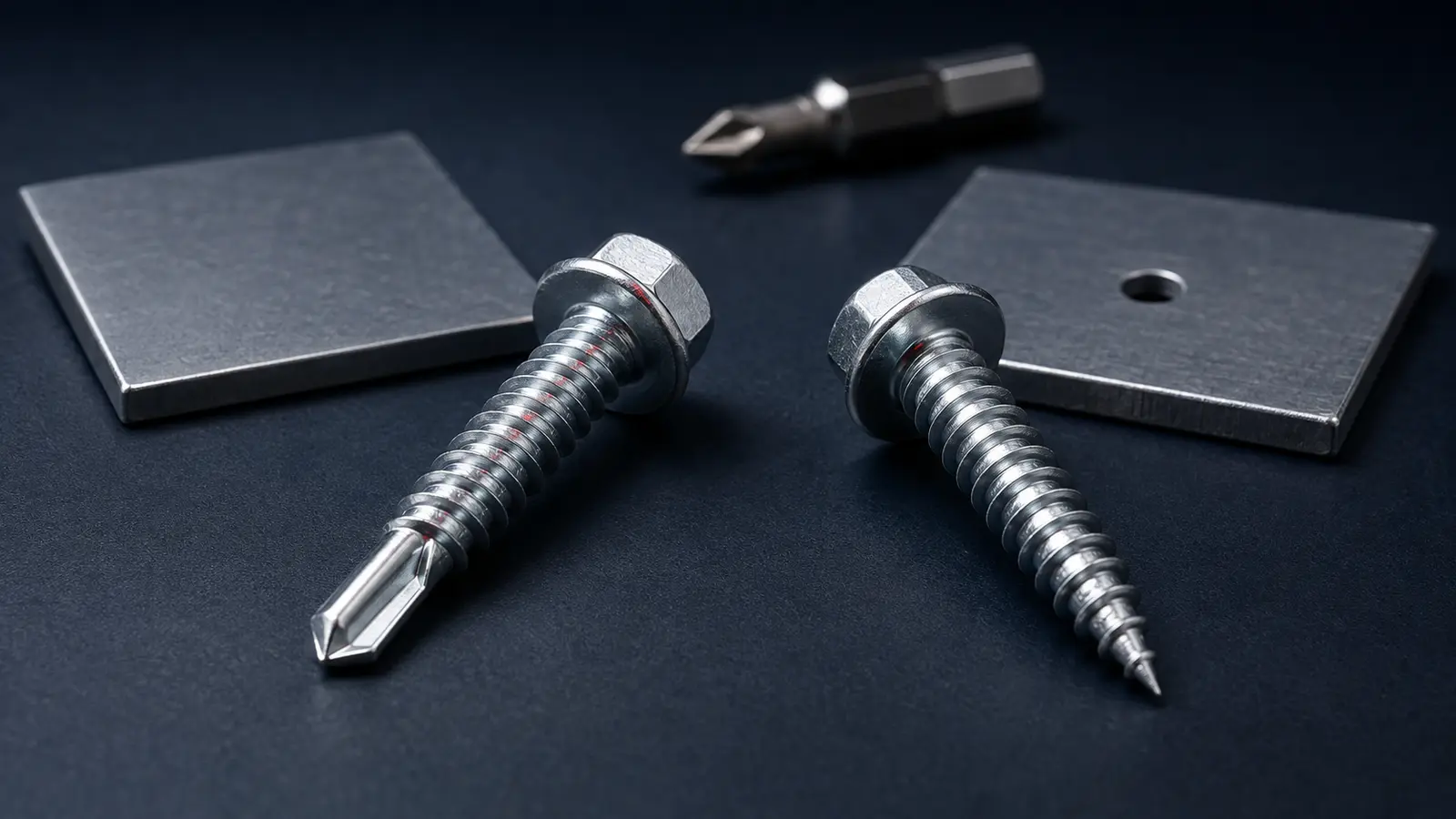
Direct Answer: A self-drilling screw has a drill-shaped point that creates a hole and then forms mating threads in a suitable material. A self-tapping screw forms or cuts mating threads but may require a correctly sized pilot hole. Selection depends on substrate type and thickness, joint stack, point geometry, installation tool, finish and application testing—not the product name alone.
The commercial difference appears simple, but the purchasing difference is not. Buyers often compare two screws by diameter and length while leaving the hole-making step undefined. That omission can produce slow installation, broken points, stripped threads, poor seating or inconsistent clamp behavior. A reliable RFQ describes the material stack and installation process first, then chooses the screw family.
What Does Each Screw Actually Do During Installation?
A self-drilling screw combines hole creation and thread formation in one fastener. The drill point penetrates an approved substrate range; the threaded portion then engages the material. This can remove a separate drilling operation where the point geometry, material thickness and installation settings are compatible.
A self-tapping screw creates mating threads as it enters. In sheet metal, a prepared hole may be needed, and the hole diameter is a functional part of the joint. Some designs form material; others cut it. The correct pilot hole is not a universal percentage of screw diameter. It depends on screw thread form, material strength, sheet thickness and the joint configuration, so the supplier’s recommendation should be validated in the buyer’s actual material.
Buyers can compare Wotu’s self-drilling screw range with its self-tapping screw range once the intended hole-making route is clear. The categories overlap in visible head and thread features, but the point and installation boundary serve different process needs.
Which Project Variables Decide Between the Two?
Substrate type and hardness: Identify every layer the point must pass through and the layer that must retain the thread. A screw suitable for one steel sheet thickness may not drill a harder grade, a thicker stack or a nonmetal facing in the same way. Material names such as “steel panel” are too broad for selection.
Total drilling thickness: For a self-drilling screw, the drill point must complete the hole before the full thread begins to engage. The relevant thickness is the material stack encountered during drilling, not merely the top sheet. Gaps, overlaps and multiple layers can change behavior.
Pilot-hole condition: For a self-tapping route, hole diameter, tolerance, burr direction and alignment influence thread formation and seating. A hole that is too small can raise installation torque; one that is too large can reduce engagement. Punched and drilled holes may also behave differently at the edge.
Joint access and production flow: One-step installation can reduce operations, but only if the operator can hold the screw square and the tool can control speed and depth. A controlled pre-drilled process may be preferable where alignment, access or material variation makes direct drilling inconsistent.
Head, recess and seating surface: Hex, pan and countersunk heads solve different access and finish requirements. A countersunk head needs an appropriate seat; a washer-bearing head changes the contact area. The drive must match the installation equipment without cam-out or overdriving.
Service environment: Base material, coating system, dissimilar-material contact, moisture exposure and any sealing washer should be reviewed as a joint. A finish name or color by itself does not establish corrosion life in a particular environment.
How Do the Options Compare for Procurement?
| Decision criterion |
Self-drilling screw |
Self-tapping screw |
Buyer check |
| Hole preparation |
Drill point makes the hole in a suitable substrate |
Often uses a specified pilot or prepared hole |
Define who controls hole creation |
| Critical geometry |
Drill-point length and form, thread start, head and washer |
Thread form, point style, pilot-hole relationship and head |
Approve a drawing or exact standard |
| Main process risk |
Point fails to penetrate before threads engage |
Pilot hole produces excessive or insufficient engagement |
Run installation trials in production material |
| Tool control |
Speed, axial pressure, alignment and seating depth matter |
Starting alignment and tightening control matter |
Record tool and setting window |
| Best procurement evidence |
Point dimensions, drilling trial and installation result |
Pilot-hole recommendation, drive trial and thread result |
Agree the sample method before mass production |
| Typical process rationale |
Combine drilling and fastening when the material range is suitable |
Use a controlled existing hole or separate hole-making process |
Compare total installed process, not piece price |
This matrix is a screening tool, not an engineering approval. Withdrawal, shear, clamp behavior, sealing and fatigue requirements depend on the complete joint. The responsible engineer should define the required tests and acceptance limits for the intended application.
Why Do “Equivalent” Screws Behave Differently on the Line?
The point does not match the stack. A self-drilling point can look sharp yet be too short or otherwise unsuitable for the material stack. If the thread reaches the top sheet before drilling is complete, installation torque can rise abruptly and the fastener may stall or damage the hole.
The pilot hole is treated as a secondary dimension. For a self-tapping screw, the hole is part of the fastening system. Production variation in hole diameter, coating, burrs and sheet thickness can move the process away from the approved condition even when the screw lot is unchanged.
The operator compensates with speed or force. Excess speed can create heat; poor alignment can load the point or recess unevenly; excessive seating torque can strip the formed thread or damage a washer. Installation instructions need a verified operating window rather than a single uncontrolled tool setting.
Length is measured but grip is not considered. Overall length does not reveal whether the point clears the drilling stack before thread engagement or whether sufficient thread remains in the retaining material. Buyers should review the dimensional relationship on a section drawing.
A sample succeeds in a different material. Trial installation in a soft coupon does not validate a harder production sheet, a coated panel, a multilayer overlap or a different support member. The sample setup should record material grade, thickness and layer sequence.
Two lots are mixed under one generic description. Similar heads can hide different points or threads in bulk bins. Part numbers, labels and incoming inspection should distinguish self-drilling and self-tapping configurations before material reaches the line.
When Is a Self-Drilling Screw the Better Route?
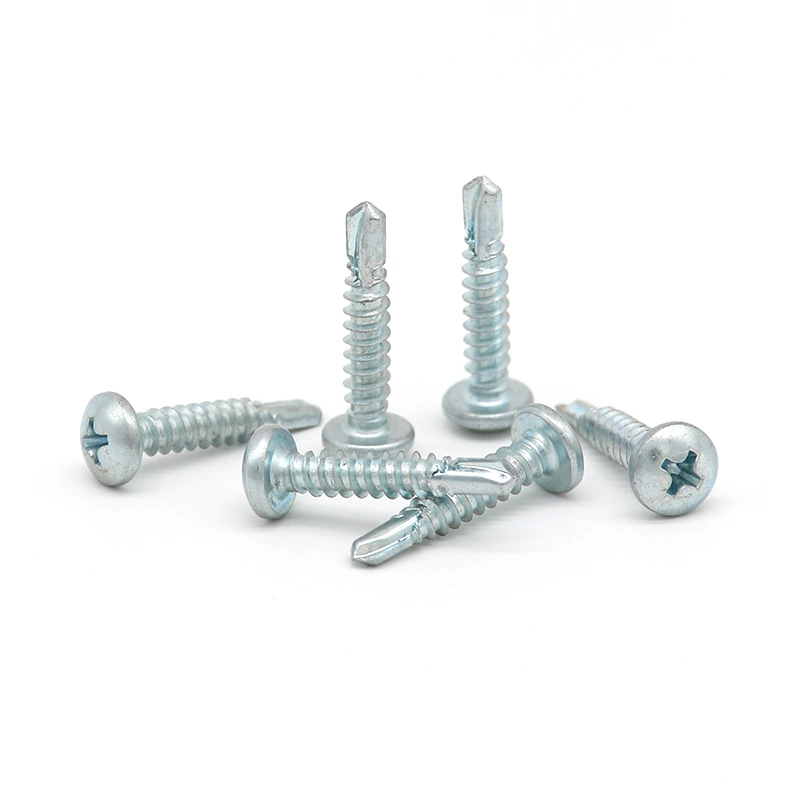
A self-drilling screw is a strong candidate when the substrate and total drilling thickness fall within a validated capability window, direct access is available, and reducing a separate drilling operation has process value. Metal roofing, cladding and suitable metal-to-metal assemblies are common contexts, but each joint still needs its own confirmation.
For example, the Phillips pan head self-drilling and self-tapping screw represents a defined head and point route. A buyer should still specify diameter, length, finish, material stack and required test evidence. The product description does not prove suitability for every sheet thickness or support material.
A direct-drilling route is less attractive when the material is outside the point’s capability, hole position must be tightly controlled before assembly, the fastener cannot be held square, or the joint needs a feature that the chosen drill-point design cannot provide. In those cases, a planned hole-making step may create a more stable process.
When Is a Self-Tapping Screw the Better Route?
A self-tapping screw is a practical choice when a pilot hole already exists or can be produced under controlled conditions, and the chosen thread form is validated for the retaining material. Separate hole preparation may also support accurate positioning, thicker or harder material outside a self-drilling point’s range, or production cells where drilling and fastening are intentionally separated.
The GB/T 845 Phillips pan head self-tapping screw is one catalog-supported option. Buyers should not infer the pilot-hole size from the product name. Hole recommendations must be matched to the selected screw, material and thickness, then confirmed through a controlled trial.
Self-tapping is also not synonymous with wood screw. Thread form, point style and substrate response differ across metal, wood, plastics and composite materials. The RFQ should name the actual substrate instead of relying on a broad market label.
Representative Scenario: Converting a Two-Step Panel Assembly
Representative scenario — not a claimed customer case.
Business Background: A fabricator uses pre-drilled metal brackets and self-tapping screws. The production team asks purchasing to source a self-drilling alternative to remove the drilling station.
Problem: The first sample drills the top sheet, but some screws stall at a two-layer overlap and others seat inconsistently.
Cause: The RFQ stated only screw diameter and overall length. It did not define the combined drilling thickness, steel grade, overlap condition, point length, installation angle or tool settings.
Solution: Engineering records the full material stack and identifies the maximum overlap. Purchasing requests a controlled self-drilling configuration and sample lot. The team runs trials in the thinnest and thickest approved stacks, records drilling and seating behavior, and compares the one-step process with the existing pilot-hole method.
Buyer Decision Value: The team bases the change on process capability and total installed cost. If the self-drilling route cannot cover the full stack reliably, the controlled self-tapping process remains the safer production choice.
What Evidence Should Buyers Request Before Approval?
Start with a drawing or product specification that identifies the standard where applicable, diameter, length measurement method, thread form, point type, head and recess, washer arrangement, material and finish. For a self-drilling screw, include point dimensions and the declared drilling application boundary. For a self-tapping screw, include the recommended pilot-hole conditions.
Next, agree how the sample will be evaluated. A useful installation trial records material grade, thickness or stack, hole method where relevant, tool type, bit or socket, speed or setting, axial alignment, seating condition and failure observations. If project performance depends on pull-out, shear, leak resistance or another functional property, the application owner should define the method, sample count and acceptance limit.
Incoming inspection can then focus on characteristics that protect the validated process: part identity, critical dimensions, point or thread form, finish condition, drive fit, functional installation and lot traceability. Wotu’s introduction to how self-tapping screws form mating threads provides useful background; the present checklist turns that principle into a controlled RFQ and acceptance plan.
What Should the RFQ State?
- Self-drilling or self-tapping route, with the reason for the choice
- Applicable standard or controlled drawing and revision
- Diameter, length, thread form, point type, head, recess and washer configuration
- Every substrate layer, material grade, thickness range, coating and gap or overlap condition
- Pilot-hole diameter and method for self-tapping applications, if already defined
- Installation tool, bit or socket, access direction and any verified setting window
- Surface finish and the real service environment
- Functional tests, inspection plan, required documents and sample approval method
- Order quantity, packing unit, label fields and pallet or private-label needs
Send the stack drawing and the most demanding installation condition, not just a reference photo. Wotu supplies screws and other industrial fasteners by specification, coating, size and packaging. The project fastener inquiry channel can be used to submit the information required for configuration review and quotation.
Frequently Asked Questions About Self-Drilling and Self-Tapping Screws
Do all self-tapping screws need a pilot hole?
Not in every material or design, but many self-tapping applications use a controlled pilot hole. The requirement and diameter depend on thread form, point, substrate, thickness and assembly method.
Can a self-drilling screw be used in any metal thickness?
No. Drill-point capability is limited by geometry, screw design and substrate conditions. Confirm the full material stack and validate the selected point in representative production material.
Is a self-drilling screw also self-tapping?
A self-drilling screw normally creates its own hole and forms mating threads during installation. In purchasing language, however, “self-drilling” identifies the drill-point function and should be stated explicitly.
Why does a self-drilling screw spin without seating?
Possible causes include an unsuitable point-to-stack relationship, excessive speed, poor alignment, a stripped formed thread or incorrect length. Inspect the failed hole and reproduce the actual installation before changing the screw.
What happens if a self-tapping pilot hole is too large?
Thread engagement can be reduced, which may cause low resistance to turning or pull-out. The correct response is to verify the specified hole range and joint test, not simply increase tightening torque.
Should buyers compare screw price or installed cost?
Compare installed cost. Include hole preparation, tool time, consumables, rework, inspection and line stoppage risk. A one-step screw is economical only when the process is stable in the actual assembly.
What sample information should be recorded?
Record screw identity, substrate material and stack, hole condition, tool and bit, operating setting, alignment, seating result and any defined functional test. Without the setup, a successful sample cannot be reproduced reliably.