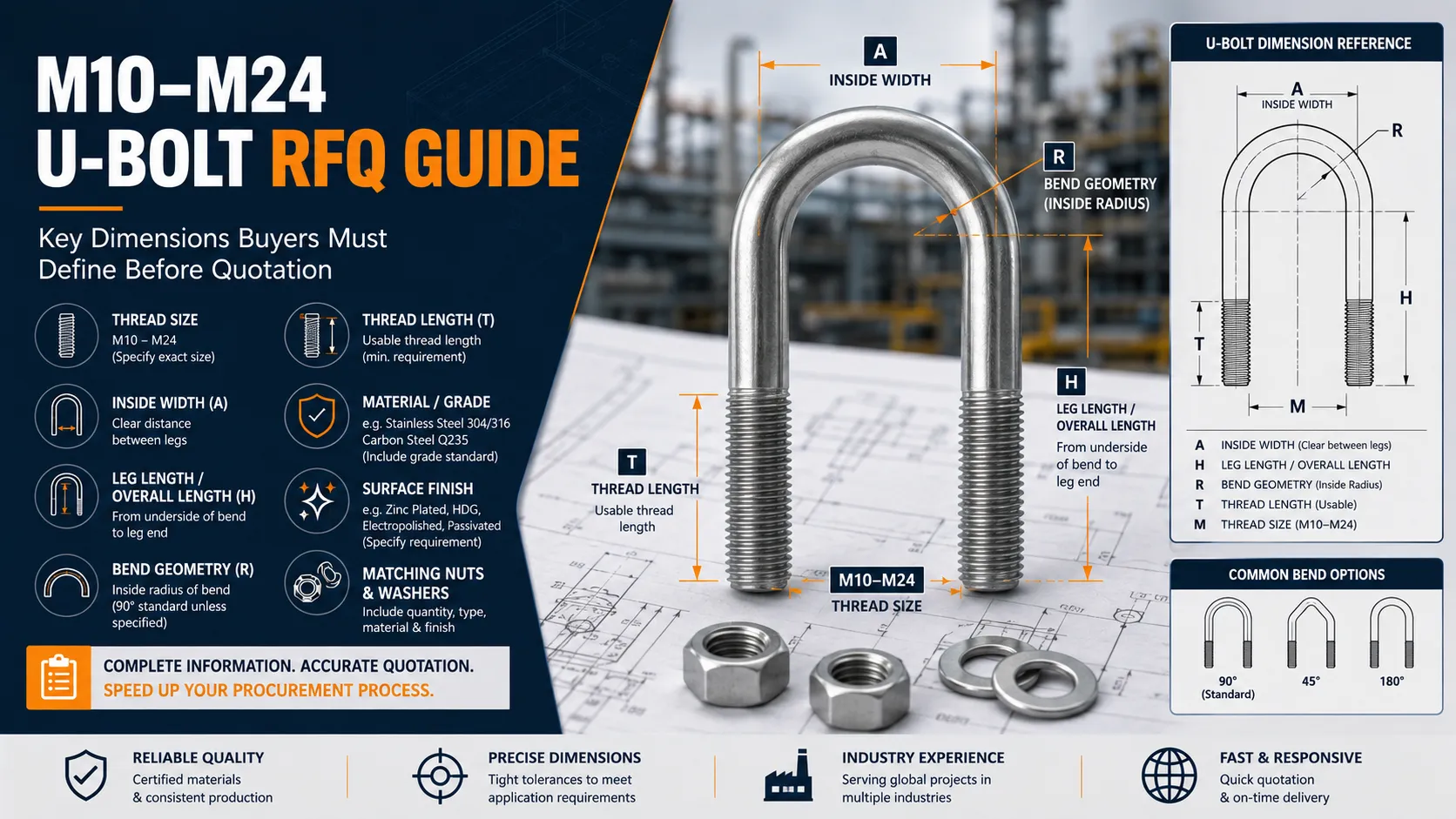
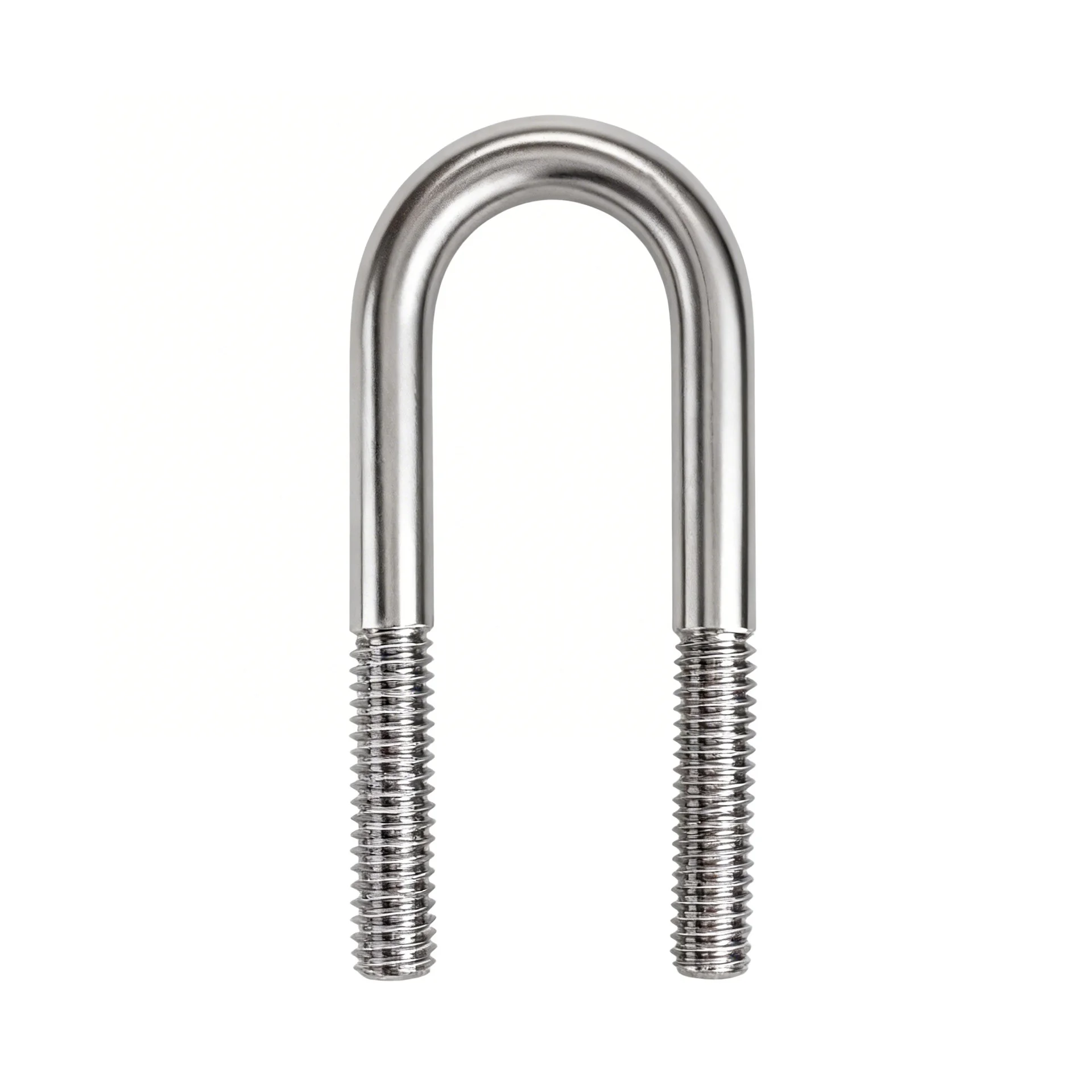
Direct Answer: For an M10–M24 U-bolt RFQ, buyers should send a dimensioned drawing that defines thread diameter, inside width, leg or overall length, bend geometry, thread length, application diameter, material or grade requirement, surface finish, matching nuts/washers, quantity, and packing needs. Nominal thread size alone is not enough because different measurement datums can produce U-bolts that look similar on paper but do not fit the assembly.
U-bolts are simple parts only until they have to fit a real pipe, frame, bracket, axle, support, or fabricated assembly. For distributors, steel-structure buyers, contractors, OEM purchasers, and maintenance teams, the main RFQ risk is rarely the absence of an M10, M12, M16, M20, or M24 option. The risk is that the buyer and supplier use different reference dimensions for the same bent part.
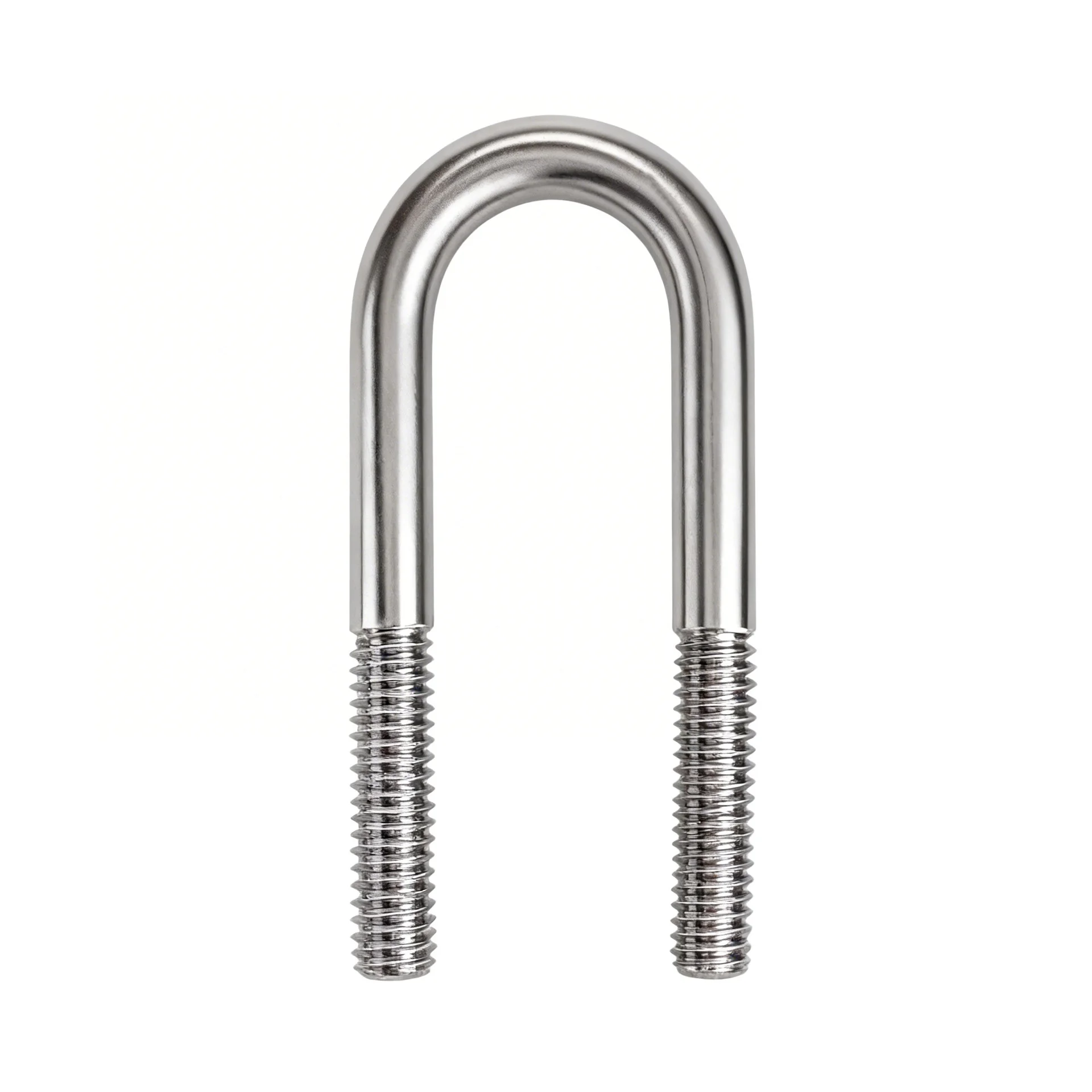
Wotu Fastener supplies U-Bolts for project and industrial procurement. Its listed multi-specification U-bolt range covers M10, M12, M16, M20, and M24 thread sizes, with multiple surface options and non-standard customization available for order-specific requirements. The quotation should still be controlled by the buyer’s drawing rather than by a nominal thread size or a product photo.
Why Is “M16 U-Bolt” Not a Complete Purchasing Specification?
“M16” identifies the nominal thread diameter, but it does not define what the U-bolt has to wrap around or where the threaded legs must finish. Two M16 U-bolts can have different inside widths, leg lengths, bend radii, thread lengths, finishes, and matching hardware.
This is one of the most common fastener RFQ mistakes: a buyer sends the nominal diameter and total quantity, while the supplier must infer the geometry from a photo, an old sample, or a pipe size. The quote may be fast, but the risk moves downstream into sample approval, installation, or batch replacement.
For a broader view of the company’s fastening range, buyers can also use the industrial fastener product categories as a reference when U-bolts must be supplied together with bolts, nuts, or washers.
Which Measurement Datum Should the Drawing Use?
Before discussing individual dimensions, both parties need to agree on the measurement datum. U-bolt dimensions may be taken from the inside faces, outside faces, centerlines, bend tangent points, or overall extremities. If the drawing does not show where a dimension starts and ends, the same number can be interpreted differently.
| RFQ Dimension |
What the Drawing Should Show |
Procurement Risk if Unclear |
| Thread diameter |
Nominal metric size such as M10, M12, M16, M20, or M24 |
The buyer may receive the correct thread size with the wrong geometry. |
| Inside width |
Clear distance between the inner faces of the two legs, with datum shown |
The U-bolt may not pass around the pipe, bracket, or supported member. |
| Leg / overall length |
Whether length is measured from inside crown, centerline, outside crown, or overall end |
Threads may finish too high or too low for the plate and nuts. |
| Bend geometry |
Round, square, or other required shape plus radius or mating geometry where needed |
The bend may not seat correctly against the supported component. |
| Thread length |
Usable threaded length on each leg and whether both legs are equal |
Nuts and washers may not achieve the required assembly position. |
| Application diameter |
Actual pipe, tube, axle, beam, or mating-part outside dimension |
A nominal pipe description can be mistaken for the real outside dimension. |
Industry experience point: When two suppliers return different U-bolt dimensions from the same verbal RFQ, the disagreement is often caused by the measurement datum rather than by manufacturing capability.
How Should Buyers Specify Inside Width for Pipe or Round-Section Applications?
For a U-bolt wrapped around a pipe or other round section, inside width should be tied to the actual mating outside dimension and the required assembly clearance. The buyer should avoid relying on a trade pipe description alone unless the actual outside diameter is also stated on the drawing.
Wotu Fastener’s listed M10–M24 multiple-specification U-bolt product information references applications for pipe diameters from 25 mm to 139.7 mm and supports non-standard length customization. For a specific project, the buyer should still send the real mating dimension, because fit depends on the complete assembly rather than on the catalog range alone.
A good RFQ drawing therefore shows both the U-bolt inside width and the mating component dimension. If clearance, coating build-up, insulation, a saddle, or another interface changes the fit, that should also be shown instead of being left for the supplier to assume.
Why Does Leg Length Need More Detail Than One “Overall Length” Number?
The useful length is the length that positions the threaded end correctly after the U-bolt passes around the supported part and through the clamping plate, bracket, or base. Buyers should show the plate thickness, washer stack, nut position, and any required thread projection when those interfaces control assembly.
Different drawings use different conventions for leg length. Some measure from the inside of the crown; others use the outermost bend surface or a centerline. A single number without a datum can therefore create a systematic dimensional error across an entire batch.
Industry experience point: A U-bolt that is only slightly too short can be unusable because there is no practical way to recover missing thread engagement at installation. An overly long leg may still assemble, but can interfere with adjacent equipment or create unnecessary cutting work on site.
How Much Thread Length Should Be Defined?
Thread length should be treated separately from total leg length. The drawing should show where the thread starts, the usable thread length, and whether both legs require the same threaded portion. If the clamping plate or bracket thickness is already fixed, include it in the RFQ package so the supplier can understand the assembly stack.
Also state whether the U-bolt will ship as the bent fastener only or as a matched set. Wotu’s product data indicates that matching nuts, flat washers, and spring washers of corresponding specifications can be supplied together. If these components are required, include them as explicit line items rather than assuming they are automatically part of every quotation.
What Should Buyers Define About Bend Shape and Radius?
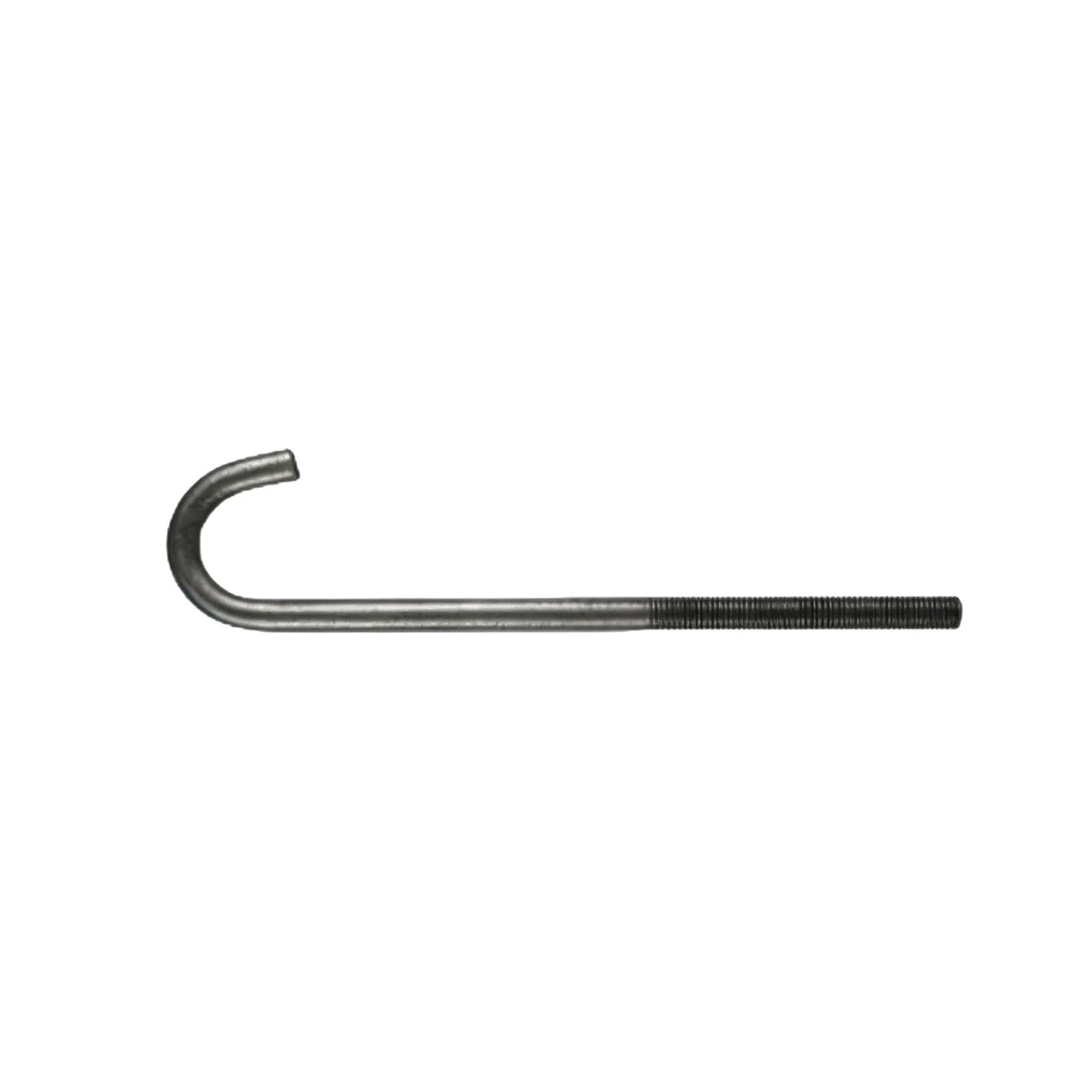
Not every U-bolt is a simple semicircle. The required geometry may be round, square, or another bent form depending on the supported member and bracket design. The drawing should show the shape, internal dimensions, and any bend-radius requirement that controls the fit.
The bend area deserves attention because it links geometry to manufacturing. If the requested inside width is very close to the material diameter or the bend is unusually tight, the supplier needs to evaluate whether the geometry is practical for the requested material and size. The buyer should not assume that a bend used on an M10 U-bolt scales directly to M20 or M24 without review.
Industry experience point: Scaling a smaller U-bolt drawing by percentage is risky. Thread size, bar diameter, bend radius, inside width, and tooling relationships do not necessarily scale in the same proportion.
How Should Material, Grade, and Surface Finish Be Written Into the RFQ?
Geometry alone is not enough for a production order. The RFQ should identify the material or mechanical-grade requirement where the project has one, together with the required surface finish. Wotu’s current U-bolt product record lists natural black oxide, hot-dip galvanized, and blue-white zinc-plated surface options.
Buyers should not request “galvanized U-bolt” as the only surface description when the project needs a specific finish. The quotation should name the required surface process and any project-specific inspection or documentation requirements.
| Buyer Input |
What to State |
Why It Matters |
| Material / grade |
Approved material or grade requirement from the drawing/specification |
Prevents suppliers from quoting different material bases. |
| Surface finish |
Natural black oxide, hot-dip galvanized, zinc-plated, or another confirmed requirement |
Changes corrosion protection, processing, and commercial scope. |
| Matching hardware |
Nuts, flat washers, spring washers, quantities per U-bolt |
Avoids incomplete assembly sets at delivery. |
| Inspection |
Dimensions, thread checks, finish checks, or order-specific records required by the buyer |
Defines what evidence is needed before shipment. |
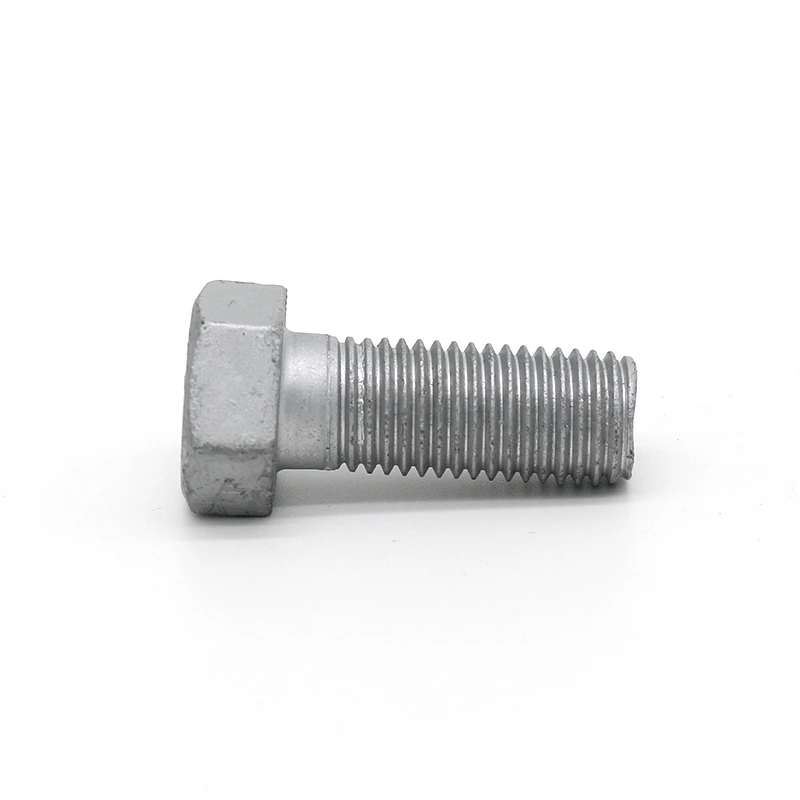
For buyers sourcing U-bolts together with other threaded fasteners, the Bolts category can help structure the broader fastener package, but each U-bolt drawing should remain individually controlled.
What Drawing Information Prevents Sample-to-Mass-Production Mismatch?
The most reliable RFQ uses one controlled drawing revision for quotation, sample approval, purchase order, inspection, and production. The drawing should carry a revision number or date so both parties can identify which geometry was approved.
If a physical sample is sent, the buyer should state whether the sample is the controlling standard or only a reference. Old field samples may already be worn, bent, coated, or modified. Measuring them without understanding the original drawing can transfer an installation problem into the new batch.
Industry experience point: Sample approval is valuable for custom bent fasteners, but only if the approved sample is tied back to the drawing. “Make it like this sample” is not enough for repeatable batch control.
Scenario: One M16 U-Bolt RFQ Produces Two Different Quotations
Representative scenario — not a claimed customer case.
Business Background: A maintenance contractor needs replacement M16 U-bolts for a pipe-support assembly. The purchasing team sends suppliers a photo, “M16,” the pipe description, and the required quantity.
Problem: Supplier A interprets the width as the clear inside dimension. Supplier B measures from leg centerline to leg centerline. Both quotations appear to meet the request, but the drawings are not dimensionally equivalent.
Cause: The RFQ does not define the measurement datum, actual pipe outside diameter, leg-length convention, thread length, plate thickness, or required finish.
Solution: The buyer issues a revised drawing showing the actual mating diameter, inside width, overall/leg-length datum, bend geometry, thread length, plate stack, finish, matching hardware, and drawing revision. Both suppliers re-quote from the same controlled geometry.
Buyer Decision Value: The buyer can compare price, process, and delivery on an equivalent specification instead of discovering a fit mismatch after batch production.
Which Hidden Costs Come From an Incomplete U-Bolt RFQ?
The direct cost of the fastener is often smaller than the cost of correcting an incorrect batch. A geometry mistake can create rework at the supplier, sorting and measurement at receiving, emergency local fabrication, installation delay, or replacement freight.
Five purchasing risks deserve particular attention:
- Specification mistake: nominal thread size is provided without the full geometry.
- Compatibility risk: actual pipe or supported-member dimensions are not shown.
- Quality risk: the drawing revision used for production differs from the approved sample.
- Hidden cost: matching nuts, washers, finish, or packing are missing from one supplier’s quote.
- Supplier comparison risk: two suppliers price different measurement conventions under the same RFQ title.
Industry experience point: The lowest U-bolt unit price is not meaningful until the buyer confirms that geometry, material/grade, finish, matching hardware, packing, and inspection scope are identical.
What Should the Final M10–M24 U-Bolt RFQ Contain?
| RFQ Field |
Information to Provide |
| Application |
Pipe support, frame clamp, equipment bracket, axle/support assembly, or other end use |
| Nominal thread size |
M10, M12, M16, M20, M24, or other required size |
| Mating component |
Actual outside width/diameter and interface drawing |
| Inside width |
Dimension plus clear measurement datum |
| Leg / overall length |
Dimension plus exact start/end datum |
| Bend geometry |
Round, square, or other form; bend radius or profile where required |
| Thread length |
Usable thread length on each leg |
| Material / grade |
Buyer-approved requirement from the project drawing or specification |
| Surface finish |
Required treatment such as black oxide, hot-dip galvanized, or zinc-plated where applicable |
| Matched components |
Nuts, flat washers, spring washers, and quantity per assembly |
| Quantity |
Sample quantity, trial quantity, and mass-production quantity where applicable |
| Drawing control |
Drawing number, revision, units, tolerances, and approval status |
| Packing |
Carton/pallet, labeling, private-label, or project packing requirements |
Frequently Asked Questions
What does M10, M12, M16, M20, or M24 mean on a U-bolt?
It identifies the nominal metric thread diameter. It does not define the inside width, leg length, bend radius, thread length, or mating-component size, so it cannot serve as the complete RFQ specification.
Should U-bolt width be measured inside-to-inside or center-to-center?
Either convention can appear on drawings. The important point is to show the datum clearly so the supplier does not have to infer which convention the buyer intended.
What pipe dimension should be sent to the supplier?
Send the actual outside diameter or outside width of the part the U-bolt must fit, together with any clearance, coating, insulation, saddle, or bracket that affects the assembly.
Is overall length the same as leg length?
Not always. Different drawings use different start points for length measurement. Define the datum on the drawing and show the required thread position relative to the plate or bracket.
Can matching nuts and washers be included with the U-bolts?
Wotu’s current product data states that corresponding nuts, flat washers, and spring washers can be supplied as matched sets. Buyers should specify the required hardware and quantity in the RFQ.
Which surface finishes are listed for Wotu U-bolts?
The current product record lists natural black oxide, hot-dip galvanized, and blue-white zinc-plated options. The required finish should be confirmed for the specific order.
What should be approved before mass production?
Approve the controlled drawing, measurement datums, material/grade requirement, finish, matching hardware, packing, inspection requirements, and any sample that forms part of the purchase approval.
Send a Dimensioned Drawing Before Asking for the Final Price
For an M10–M24 U-bolt quotation, send Wotu Fastener the application, actual mating dimensions, nominal thread size, inside width, leg/overall-length datum, bend geometry, thread length, material or grade requirement, surface finish, matching nuts/washers, quantity, drawing revision, inspection needs, and packing requirements through the Contact Us page. Wotu can review the requested geometry, available surface options, matched fastener components, customization requirements, and export packing scope against the controlled RFQ before production is confirmed.