Steel Roof Sheets Selection Guide | Hebei Wotu Fastener Manufacturing Co., Ltd.

Steel Roof Sheets for Complete Roofing Systems

Steel roof sheets are selected as part of a complete roofing system, not as a panel alone. The important decisions are the sheet profile, base material and coating, panel thickness, roof geometry, and the fasteners that will hold the sheets to steel or timber without creating unnecessary leak points.

For a purchase enquiry, match the sheets and fasteners to the building environment and support structure first. A coastal, agricultural, industrial or high-moisture building may need different corrosion protection from a dry warehouse, while the roof pitch and lap arrangement affect drainage and sealing.

Related Products

Dacromet Hex Head Self-Drilling Screw

Dacromet Hex Head Self-Drilling Screw

Brand: Hengzuan Surface: Dacromet anti-corrosion coating Specifications: in stock ST5.5/ST6.3 mainstream caliber, rod length 50mm~150mm, extended full range of specifications, supports nonstandard extra long customized, suitable for drilling steel sheet thickness 2~6mm Packaging: 25kg export cartons, full pallets wrapped with film, supports neutral export packaging, private-label customization

Read More
Chinese-standard Color Nylon Head Hex Self-Drilling Screw

Chinese-standard Color Nylon Head Hex Self-Drilling Screw

Brand: Hengzuan Surface: screw color zinc plated, head color nylon protective cap, multiple colors available Specifications: Chinese national standard ST5.5, ST6.3 mainstream caliber, rod length 25mm~125mm full range of specifications in stock, supports nonstandard length customization, suitable for drilling steel sheet thickness 2~6mm Packaging: 25kg cartons, full pallets packed on wooden pallets, support neutral packaging, private-label customization

Read More
Hex Head Self-Drilling Screw With Cup Washer

Hex Head Self-Drilling Screw With Cup Washer

Brand: Hengzuan Surface: color zinc plated Specifications: in stock ST5.5/ST6.3 regular diameter, rod length 19mm~75mm in stock, supports nonstandard customized, suitable for drilling steel sheet thickness 2~5mm Packaging: carton packaging, full pallets wooden pallet packaging, support neutral packaging, private-label customization

Read More
Hex Head Self-Drilling Screw

Hex Head Self-Drilling Screw

Brand: Hengzuan Surface: color zinc plated Specifications: ST4.2/ST4.6/ST4.8/ST5.5/ST6.3, length 80mm~165mm in stock Packaging: 25kg cartons, packed in whole pallets, supports neutral private-label

Read More
Hex Head Self-Drilling Screw With Bonded Washer

Hex Head Self-Drilling Screw With Bonded Washer

Brand: Hengzuan Surface: blue and white zinc plated, color zinc plated can be customized on request Specifications: in stock 4.2/4.8/5.5/6.3mm mainstream wire diameter, length 20mm~165mm full range of specifications, nonstandard rod length, drill point size can be customized Packaging: 25kg export cartons, full pallets wrapped with film, supports neutral export packaging, customer private-label customization

Read More
White Zinc Plated Hex Head Self-Drilling Screw

White Zinc Plated Hex Head Self-Drilling Screw

Brand: Hengzuan Surface: blue and white zinc plated, optional black oxide, color zinc plated coating Specifications: in stock 4.2/4.8/5.5/6.3mm wire diameter, length 16mm~165mm full size range, supports nonstandard customized rod length Packaging: 25kg export cartons, full-container wooden pallets wrapped with film, supports neutral packaging, private-label customization

Read More

Match the roof sheet to the building and support structure

Steel roof sheet selection criteria

When comparing steel roof sheet options, focus on profile and cover width, base material, coating, thickness, roof pitch, lap details and support spacing. Then check that the proposed screws, washers and accessories suit both the sheet and the supporting steel or timber. Product availability and compatibility should be confirmed against the project drawing rather than assumed from a general product description.

Criterion What To Check Why It Matters Buyer Tip
Roof sheet profile and rib shape Compare the sheet drawing or sample with the planned fixing point on the rib or valley. The profile controls where screws can clamp properly and how water moves around the fixing. Ask: Will the screws be fixed through the rib or the valley, and what washer shape suits that contact area?
Steel thickness and supporting frame material Confirm the roof sheet gauge and whether the purlins are steel or timber. Sheet thickness and substrate decide the screw point type, drilling performance, thread engagement and required length. Ask: What sheet thickness and purlin material should the fastener be matched to?
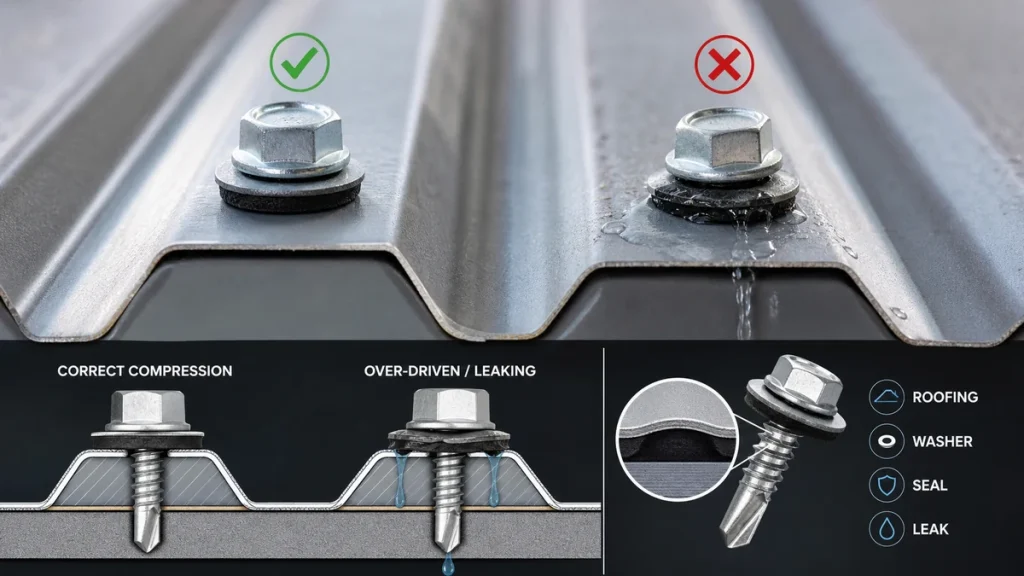
Fastener sealing method Review the washer material, washer diameter and how the screw is installed against the sheet surface. Leaks often come from poor sealing, over-driving, under-driving or a washer that does not sit flat on the roof sheet. Ask: Which washer is recommended for this sheet profile and installation method?
Corrosion compatibility Match the screw coating and washer material to the roof sheet coating and the site environment. Mismatched metals or unsuitable coatings can shorten service life, especially on exposed roofs. Ask: Is the fastener coating suitable for the roof sheet finish and the expected outdoor exposure?
Installation access and screw length Check the roof build-up, including sheet height, insulation, spacer components and purlin depth. A screw can look long enough but still fail to clamp correctly if the roof build-up is not considered. Ask: What total build-up must the screw pass through before it achieves secure engagement?

Choose the sheet, coating and fastener system together

The main practical distinction is between exposed-fastener metal roofing and systems that conceal the fixings. Exposed-fastener steel sheets are often straightforward to install and inspect, but every screw penetration depends on correct placement, washer compression and compatible sealing. Concealed-fixing systems can reduce visible penetrations, but they require matching panels, clips and installation details.

Fastener length alone does not determine whether a roof will remain watertight. The screw must suit the supporting material, sheet profile and combined material thickness, while the washer and sealing method must remain properly seated. For background on these choices, see selecting self-tapping roofing screws for steel or timber supports and common causes of leaks around roofing screws.

Start with the roof application. A residential extension, farm building, factory, warehouse or temporary structure may place different demands on appearance, condensation control, maintenance and corrosion resistance. Confirm the roof pitch, panel span, support spacing and whether insulation or an underlay is part of the assembly before finalising the sheet profile.

Compare the base metal and coating for the actual environment rather than choosing by colour alone. Check how the sheet, cut edges, laps and fasteners will resist moisture exposure, and ask whether the proposed finish is suitable near chemicals, animal housing, salt air or industrial emissions. A visually similar coating may not offer the same service suitability.

Coordinate the fasteners with the sheets and substrate. Screws for steel purlins are not automatically suitable for timber, and a screw that reaches the support may still be unsuitable if its drilling point, thread, head, washer or corrosion protection does not match the assembly. Avoid mixing fasteners and sealing washers from unconfirmed sources, or over-tightening until the washer is distorted.

Before requesting a quotation, send the roof use and environment, the support material and thickness, and the sheet profile or drawing. Ask which fastener type and sealing arrangement are recommended for that assembly, whether samples or installation guidance are available, and what information is needed to confirm compatibility. If the enquiry is for fasteners rather than complete sheets, clarify whether Hebei Wotu Fastener Manufacturing Co., Ltd. can supply the required roofing screw configuration.


Criteria Importance Description Example Options
Exposed fasteners or concealed fixing Important for appearance, inspection, installation method and leak-point management. Exposed-fastener systems are generally easier to install and inspect, but each penetration needs compatible sealing. Concealed systems reduce visible fixings but depend on matching panels, clips and installation details. A utility building may favour accessible exposed fixings, while a design-led project may consider concealed fixing to reduce visible penetrations.
Sheet profile and roof geometry Critical because profile, roof pitch, laps and support spacing affect drainage, span and fastening locations. The panel shape and cover arrangement must suit the roof layout and support structure. A profile selected without checking the drawing can create fitting, lap or drainage problems. A roof with closer supports and a different pitch may require a different panel profile or lap arrangement from a large warehouse roof.
Base material and coating Important for corrosion resistance and service suitability in the actual building environment. Compare the substrate and protective finish against moisture, salt air, animal housing, chemicals and industrial emissions. Colour alone does not identify equivalent environmental performance. A dry warehouse and a damp agricultural building may need different coating considerations even if both use similarly coloured sheets.
Fastener and washer compatibility Critical for secure attachment and reducing leakage around penetrations. Match the screw type to the support material and combined sheet thickness, then check the head, washer, seal and corrosion protection as part of the same assembly. Do not assume that a screw with the correct apparent length is suitable. A fastener for a steel purlin should be checked separately from one intended for timber, even when the roof sheet is unchanged.
Repair or replacement versus new roof system Important because the existing roof may limit profile, fixing position and sealing choices. A repair may prioritise matching existing sheets and sealing around current penetrations, while a new roof allows the panel, support layout and fasteners to be coordinated from the start. Replacing a damaged panel may require an accurate profile and lap match, whereas a new building can be designed around a complete sheet-and-fastener system.

Product Selection

Related Options

For a warehouse or prefabricated steel building, the key priority is a coordinated sheet-and-fastener system that fits the purlin material, roof profile and exposure conditions. For a smaller roof or repair, ease of replacement and reliable sealing at existing penetrations may matter more than selecting a new panel system. Compare options by the demands of the actual roof, not by appearance alone.

Blog Articles / Reviews

Which Self-Tapping Roofing Screw Specification Fits Metal Panels on Steel or Timber?

Which Self-Tapping Roofing Screw Specification Fits Metal Panels on Steel or Timber?

The correct self-tapping roofing screw depends on the complete panel-and-substrate stack-up. Steel supports typically require a point and thread matched to the support thickness and any pilot-hole requirement; timber supports require a wood-appropriate thread and sufficient embedment. In both cases, buyers must define diameter, length, head, sealing washer, material or coating, environment, pull-out requirements, and […]

Why Do Self-Tapping Roofing Screws Leak Even When the Screw Length Looks Correct?

Why Do Self-Tapping Roofing Screws Leak Even When the Screw Length Looks Correct?

Direct answer: Correct screw length does not guarantee a watertight metal-roof connection. Self tapping roofing screws can leak because of incorrect washer compression, enlarged or stripped holes, insufficient thread engagement, panel movement, or an unsuitable coating-and-washer system. Buyers should diagnose the complete installed connection—including panel profile, support thickness, point type, washer condition, and exposure—rather than […]

What is the Importance of High-Quality Self-Drilling Screws in Prefabricated Steel Structure Projects?

What is the Importance of High-Quality Self-Drilling Screws in Prefabricated Steel Structure Projects?

While the quantity of self-drilling screws used in prefabricated steel structure projects isn’t large, the quality requirements are still very high. Why are high-quality self-drilling screws necessary? High-quality self-drilling screws are absolutely essential. The function of self-drilling screws in prefabricated steel structure projects is to secure and lock the prefabricated steel panels to prevent them […]

Frequently Asked Questions

Are exposed-fastener panels suitable for every building?

They can suit warehouses, agricultural buildings, workshops and other applications where straightforward installation and inspection are useful. In highly visible projects or roofs where reducing exposed penetrations is a priority, a concealed-fixing system may be preferable, although it requires compatible panels, clips and installation details.

Is a thicker or more heavily coated sheet always the better choice?

Not necessarily. Sheet selection also depends on the roof span, support spacing, profile, exposure and required handling, so a heavier option may add cost or installation difficulty without solving the actual design need. Match the material and coating to the building environment rather than choosing by colour or thickness alone.

If the screw reaches the support, will the roof stay watertight?

Correct length is only one part of the connection. The screw must suit the steel or timber support, and the washer, sealing method, placement and tightening must work with the sheet profile; excessive tightening can damage the seal instead of improving it.

What information should accompany a quotation request?

Provide the building use, exposure conditions, roof pitch, support material and thickness, panel profile or drawing, approximate quantity and any insulation or underlay details. Ask which sheet, fastener and washer combination is suitable for that assembly, and confirm whether Hebei Wotu Fastener Manufacturing Co., Ltd. can supply the required roofing screw configuration.

Can screws intended for steel supports be used in timber?

They should not be treated as interchangeable. Steel and timber require different thread and drilling characteristics, so confirm the fastener design against the support material, sheet thickness and total assembly before ordering.

Leave Your Message

Please share the roof application and environment, the support material and thickness, and the sheet profile or drawing so we can identify suitable steel roof sheet and fastener requirements.