Tek Screws for Roofing | Hebei Wotu Fastener Manufacturing Co., Ltd.

Tek Screws for Roofing

A tek screw for roofing fastens metal roof sheets without a separate pilot hole, so the main decision is not only screw length. The drill point, thread type, head style, washer, coating, and base material all affect installation speed and leak resistance.

For a roofing project, the screw must drill cleanly, clamp the sheet without crushing it, and keep a reliable seal around the fixing point. The right choice depends on the roof panel profile, sheet thickness, purlin material, exposure conditions, and the installer’s fixing method.

Related Products

Chinese-standard Color Nylon Head Hex Self-Drilling Screw

Chinese-standard Color Nylon Head Hex Self-Drilling Screw

Brand: Hengzuan Surface: screw color zinc plated, head color nylon protective cap, multiple colors available Specifications: Chinese national standard ST5.5, ST6.3 mainstream caliber, rod length 25mm~125mm full range of specifications in stock, supports nonstandard length customization, suitable for drilling steel sheet thickness 2~6mm Packaging: 25kg cartons, full pallets packed on wooden pallets, support neutral packaging, private-label customization

Read More
Hex Head Self-Drilling Screw With Cup Washer

Hex Head Self-Drilling Screw With Cup Washer

Brand: Hengzuan Surface: color zinc plated Specifications: in stock ST5.5/ST6.3 regular diameter, rod length 19mm~75mm in stock, supports nonstandard customized, suitable for drilling steel sheet thickness 2~5mm Packaging: carton packaging, full pallets wooden pallet packaging, support neutral packaging, private-label customization

Read More
Hex Head Self-Drilling Screw With Bonded Washer

Hex Head Self-Drilling Screw With Bonded Washer

Brand: Hengzuan Surface: blue and white zinc plated, color zinc plated can be customized on request Specifications: in stock 4.2/4.8/5.5/6.3mm mainstream wire diameter, length 20mm~165mm full range of specifications, nonstandard rod length, drill point size can be customized Packaging: 25kg export cartons, full pallets wrapped with film, supports neutral export packaging, customer private-label customization

Read More
Painted Hex Head Self-Drilling Screw

Painted Hex Head Self-Drilling Screw

Brand: Hengzuan Surface: screw color zinc plated + hex head outdoor paint Specifications: ST5.5, ST6.3, rod length 25mm~120mm in stock, supports nonstandard customization, suitable for drilling steel sheets 2~5mm Packaging: 25kg cartons, whole wooden pallets

Read More
Countersunk Head Cross Blue-White Zinc Plated Drywall Screw

Countersunk Head Cross Blue-White Zinc Plated Drywall Screw

Brand: Hengzuan Surface: blue and white zinc plated Specifications: in stock 3.5/3.9/4.2 mainstream wire diameter, rod length 16mm~80mm full size range in stock, supports nonstandard length customization; fine/coarse tooth types are available Packaging: 25kg export cartons, full pallets wrapped with film, supports neutral export packaging, private-label customization

Read More

Selecting the Right Roofing Tek Screw for the Roof Build-Up

Roofing screw selection

When comparing roofing tek screws, focus on the functional details that change performance: drill point type, thread form, screw length, head style, sealing washer, coating, and the material being fastened into. These choices are more useful than selecting by name alone because roofing screws with similar appearances can behave differently on steel, timber, or layered roof assemblies.

Criterion What To Check Why It Matters Buyer Tip
Drill point matched to roof structure Confirm the Tek point type against the base material, such as light-gauge steel purlin, thicker steel member, or timber support if applicable. The wrong point can skate on the panel, fail to drill cleanly, or leave a weak thread engagement even if the screw looks correct. Ask: What roof panel thickness and support material is this screw expected to drill through in one operation?
Screw length and thread engagement Compare the full stack-up: roofing sheet, washer, insulation or spacer if used, and the required embedment into the support. A screw that is too short may not hold; one that is too long can add cost, slow installation, or protrude where it should not. Ask: Can you recommend a length after reviewing the panel profile, lap condition, and support thickness?
Washer and sealing face Review the washer material, diameter, and how it seats on the roofing panel crown or valley specified by the roof system. Roof leaks often come from poor sealing pressure, a damaged washer, or a washer that does not sit flat on the panel profile. Ask: Is the washer suitable for the panel profile and outdoor exposure, and should installation be on the crown or valley?
Head style and drive compatibility Confirm the head shape, hex size or drive type, and whether it matches the installer’s tools and the required finished appearance. A compatible head reduces cam-out, over-driving, and inconsistent washer compression during repetitive roof installation. Ask: Which driver socket or bit should be used, and is torque control recommended for this screw and washer combination?
Corrosion protection for the roof environment Match the coating or material choice to the exposure: inland, coastal, industrial, high humidity, or contact with dissimilar metals. Roof fasteners face water, UV exposure, and temperature movement; poor corrosion resistance can shorten service life and stain panels. Ask: What coating or material options are available for this roof environment, and are they compatible with the roof sheet finish?

Key Roofing Screw Details to Confirm Before Ordering

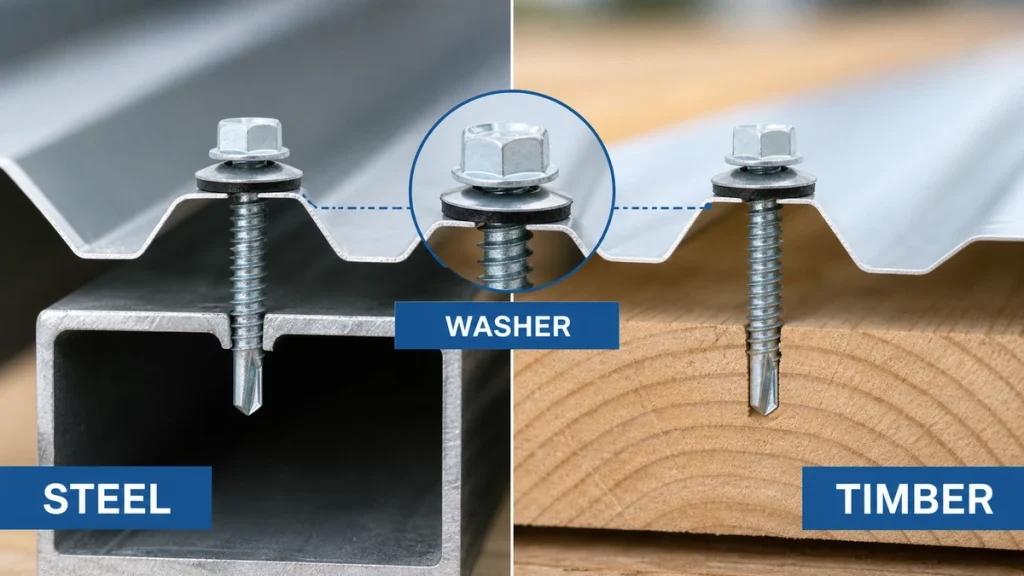
The key distinction is between screws for fixing metal sheets to steel and screws for fixing metal sheets to timber. A screw used into steel needs a drill point matched to the steel thickness, while a screw used into timber relies more on thread bite and pull-out resistance. Using the wrong style can cause slow drilling, stripped holes, weak holding, or poor washer compression.

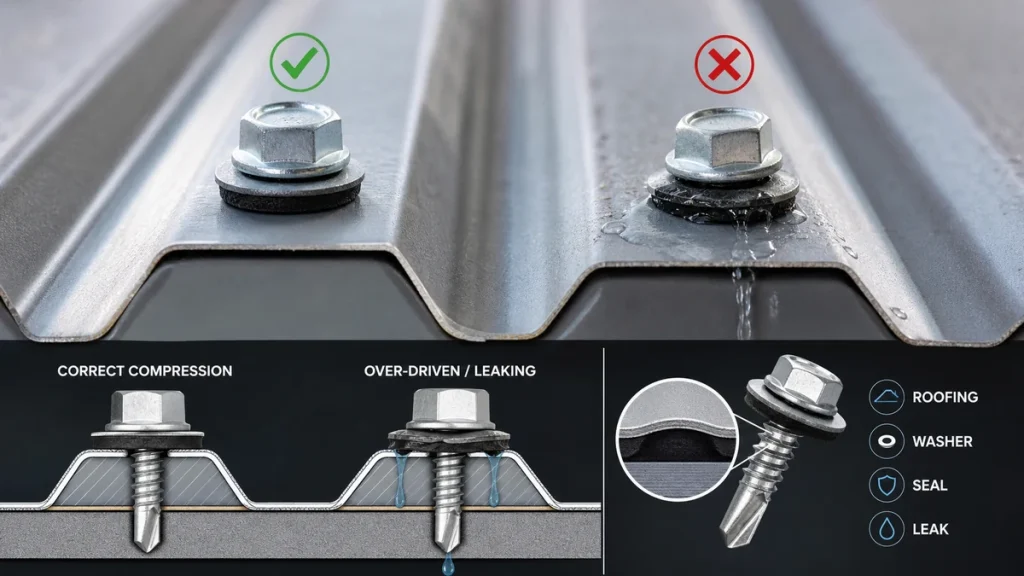
Washer choice also matters. Roofing screws usually need a sealing washer that compresses evenly under the head. Too little compression can allow water entry; too much can deform the washer or roof sheet. Buyers should confirm the head style, washer material, coating, and compatible substrate before approving a roofing screw order.

Start with the roof build-up: panel material, panel thickness, insulation or spacer layers, and the supporting member below. A screw that looks long enough may still fail if it does not achieve proper engagement in the steel purlin or timber batten. If the project uses overlapping sheets or high-profile panels, include the full stack-up, not just the top sheet thickness.

Match the drill point to the substrate. A light drill point may work quickly on thin sheet but struggle with heavier steel. A more aggressive point may drill well but can be unnecessary for timber or thin supports. The practical question is: what material will the screw actually bite into after it passes through the roof sheet?

Do not treat coating as an afterthought. Roof fasteners face rain, condensation, temperature changes, and sometimes salt or industrial exposure. Ask which coating or surface treatment is suitable for the installation environment, and whether the washer material is compatible with the panel and expected weather exposure.

Before placing an inquiry with Hebei Wotu Fastener Manufacturing Co., Ltd., prepare a simple fixing description: roof sheet material and thickness, support material, required head and washer style, coating preference, and any drawing or current screw sample. A photo of the existing fastener and roof profile can prevent mistakes in length, head size, and washer selection.

Criteria Importance Description Example Options
Support material Critical because it determines how the screw drills and holds The screw must suit the material below the roof sheet, such as steel purlin or timber batten. A mismatch can lead to slow installation, stripped holes, or weak pull-out resistance. A screw intended for thin steel support may not be the right choice for a timber batten roof.
Drill point and thread style High impact on installation speed and fastening reliability The drill point creates the hole, while the thread provides holding force. These features should match the substrate thickness and roof build-up. A heavier steel support may need a different point style than a light sheet-over-timber application.
Washer and head combination Important for leak resistance and consistent clamping The head must seat properly, and the washer must compress enough to seal without being crushed. Poor washer fit is a common cause of roof leaks even when screw length looks acceptable. A hex head with a bonded sealing washer is commonly considered for exposed metal roof fixings.
Coating or surface treatment Important where fasteners face moisture, condensation, or aggressive environments Roof screws are exposed to weather and temperature changes. The coating should be discussed alongside the roof panel material and project environment. A general indoor fastener finish may not be suitable for an exposed roof application.
Installed length through the roof assembly Necessary for proper engagement, but not the only selection factor The selected length should account for sheet profile, overlaps, insulation or spacer layers, and the depth needed in the support. Length alone cannot compensate for the wrong point, thread, washer, or coating. A high-profile metal panel may require a different screw length than a flat lap fixing on the same building.

Product Selection

Related Options

For metal roofing, the best fit is usually the screw that installs cleanly and seals consistently on the actual roof profile. A warehouse roof fixed to steel purlins, a farm building fixed to timber, and a coastal cladding project may all need different drill points, coatings, or washer choices even if the fastener is generally described as a roofing tek screw.

Blog Articles / Reviews

How to Specify Countersunk Head Cross Thick Thread Fiberboard Screws for Furniture Assembly Projects

How to Specify Countersunk Head Cross Thick Thread Fiberboard Screws for Furniture Assembly Projects

Fiberboard screws are selected based on more than screw size alone. For furniture assembly and board-based applications, buyers need to match the screw structure with the characteristics of fiberboard, MDF, and similar engineered wood materials. A suitable specification should consider thread design, head style, screw length, diameter, installation method, and application requirements. For buyers sourcing […]

How Should Buyers Evaluate Self Tapping Screws for Project Procurement?

How Should Buyers Evaluate Self Tapping Screws for Project Procurement?

#4 self tapping screws should not be purchased from the “#4” designation alone. For a usable B2B specification, the buyer still needs the actual screw diameter, thread form or pitch, overall length, substrate, pilot-hole condition, head and drive style, material, surface finish and quantity. This matters because suppliers may use different naming systems. Wotu Fastener’s […]

Which Self-Tapping Roofing Screw Specification Fits Metal Panels on Steel or Timber?

Which Self-Tapping Roofing Screw Specification Fits Metal Panels on Steel or Timber?

The correct self-tapping roofing screw depends on the complete panel-and-substrate stack-up. Steel supports typically require a point and thread matched to the support thickness and any pilot-hole requirement; timber supports require a wood-appropriate thread and sufficient embedment. In both cases, buyers must define diameter, length, head, sealing washer, material or coating, environment, pull-out requirements, and […]

Why Do Self-Tapping Roofing Screws Leak Even When the Screw Length Looks Correct?

Why Do Self-Tapping Roofing Screws Leak Even When the Screw Length Looks Correct?

Direct answer: Correct screw length does not guarantee a watertight metal-roof connection. Self tapping roofing screws can leak because of incorrect washer compression, enlarged or stripped holes, insufficient thread engagement, panel movement, or an unsuitable coating-and-washer system. Buyers should diagnose the complete installed connection—including panel profile, support thickness, point type, washer condition, and exposure—rather than […]

Which Hexagonal Wood Screw Specifications Should Buyers Freeze Before Production?

Which Hexagonal Wood Screw Specifications Should Buyers Freeze Before Production?

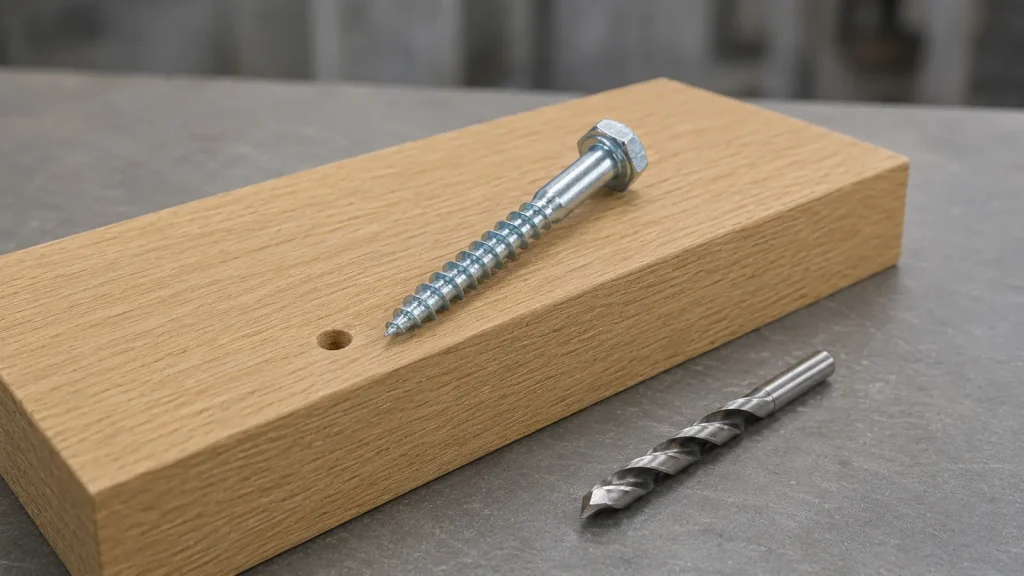
A hexagonal wood screw order should not be released from a gauge number and length alone. Before production, the buyer and supplier need one approved specification that fixes the screw diameter, length basis, thread geometry, point, hex-head dimensions, material, finish, installation method, substrate and acceptance evidence. The pilot hole belongs in the application specification as […]

Rust Prevention Tips for Self-Drilling Screws

Rust Prevention Tips for Self-Drilling Screws

As we all know, the simplest way to prevent self-drilling screws from rusting is to properly isolate the screws from moisture-containing and humid environments. This can be achieved through selective application of protective coatings and sealants, or by purchasing specially formulated rust-resistant or rust-proof screws. This is why many businesses and households have rust prevention […]

Frequently Asked Questions

Can the same screw be used for both steel purlins and timber battens?

Not always. Steel support usually requires a drill point that can cut through the purlin thickness, while timber needs thread engagement that grips without splitting or stripping. Confirm the support material before choosing the point and thread style.

Is a longer screw automatically better for roofing?

No. Extra length does not fix the wrong drill point, poor washer compression, or insufficient thread engagement in the support. The useful length depends on the full roof stack-up, including sheet profile, overlaps, insulation, spacers, and the base material.

What is the trade-off between fast drilling and strong sealing?

A screw that drills quickly still needs to clamp the sheet correctly and compress the washer evenly. If installers drive too hard, the washer can deform; if they stop too early, the seal may not seat. The screw, washer, and installation method need to work together.

What information should be sent with an inquiry?

Send the roof sheet material and thickness, the support material, the roof profile or fixing position, preferred head type, washer requirement, coating preference, and expected exposure conditions. A drawing, photo, or current sample helps avoid mistakes in length, washer size, and point selection.

Do roofing tek screws always need a sealing washer?

For exposed roof fixings, a sealing washer is usually required because the fastener penetrates the weather surface. The washer material and size should suit the roof panel, head style, and exposure conditions rather than being treated as a minor accessory.

Leave Your Message

Send the roof sheet material and thickness, the support material such as steel or timber, and the preferred head, washer, and coating requirements. A drawing, photo, or current screw sample also helps confirm the correct roofing tek screw.