Roof Exhaust Fan Fasteners | Hebei Wotu Fastener Manufacturing Co., Ltd.

Roof exhaust fan mounting fasteners

A roof exhaust fan is only as reliable as the roof opening, curb, flashing and fasteners that hold it in place. For a buyer planning a fan installation on a metal roof, the key decision is not just fan size or airflow; it is how the unit will be fixed without creating leaks, vibration loosening or panel damage.

Hebei Wotu Fastener Manufacturing Co., Ltd. can discuss the fastening side of this application: screw type, drilling point, washer choice, corrosion exposure and substrate. If you are selecting hardware for a roof-mounted exhaust fan, the roof build-up and fixing method should be confirmed before choosing screws.

Related Products

7-letter, 9-letter L-shaped anchor bolt (Chinese national standard GB/T799-1988 embedded anchor screw)

7-letter, 9-letter L-shaped anchor bolt (Chinese national standard GB/T799-1988 embedded anchor screw)

Brand: Wotu Surface: Natural black oxide treatment, customized hot-dip galvanized, zinc plated as required Specifications: Follow Chinese national standard GB/T799-1988, in stock M12-M48, total length 120mm~1500mm, nonstandard customized diameter, bending length, total screw length available Matching: Nuts, flat washers and spring washers of the same specification can be supplied in complete sets. Packaging: Bundling and packaging, using wooden pallets and film-wrapped export packaging in large quantities

Read More


Dacromet Hex Head Self-Drilling Screw

Dacromet Hex Head Self-Drilling Screw

Brand: Hengzuan Surface: Dacromet anti-corrosion coating Specifications: in stock ST5.5/ST6.3 mainstream caliber, rod length 50mm~150mm, extended full range of specifications, supports nonstandard extra long customized, suitable for drilling steel sheet thickness 2~6mm Packaging: 25kg export cartons, full pallets wrapped with film, supports neutral export packaging, private-label customization

Read More
Painted Hex Head Self-Drilling Screw

Painted Hex Head Self-Drilling Screw

Brand: Hengzuan Surface: screw color zinc plated + hex head outdoor paint Specifications: ST5.5, ST6.3, rod length 25mm~120mm in stock, supports nonstandard customization, suitable for drilling steel sheets 2~5mm Packaging: 25kg cartons, whole wooden pallets

Read More
Color Zinc Plated Hex Flange Wood Screw With Washer

Color Zinc Plated Hex Flange Wood Screw With Washer

Brand: Hengzuan Surface: color zinc plated, can be customizedblue-white zinc plated Specifications: in stock 4.8/5.5 common wire diameter, rod length 16~125mm full range of specifications, supports nonstandard customized Packaging: 25kg cartons, whole wooden pallets, support neutral packaging, private-label customization

Read More
Chinese-standard Color Nylon Head Hex Self-Drilling Screw

Chinese-standard Color Nylon Head Hex Self-Drilling Screw

Brand: Hengzuan Surface: screw color zinc plated, head color nylon protective cap, multiple colors available Specifications: Chinese national standard ST5.5, ST6.3 mainstream caliber, rod length 25mm~125mm full range of specifications in stock, supports nonstandard length customization, suitable for drilling steel sheet thickness 2~6mm Packaging: 25kg cartons, full pallets packed on wooden pallets, support neutral packaging, private-label customization

Read More
Hex Head Self-Drilling Screw With Cup Washer

Hex Head Self-Drilling Screw With Cup Washer

Brand: Hengzuan Surface: color zinc plated Specifications: in stock ST5.5/ST6.3 regular diameter, rod length 19mm~75mm in stock, supports nonstandard customized, suitable for drilling steel sheet thickness 2~5mm Packaging: carton packaging, full pallets wooden pallet packaging, support neutral packaging, private-label customization

Read More

Fastener choices for roof exhaust fan mounting

Roof fan fixing criteria

Relevant fastener selection for a roof exhaust fan should compare substrate, screw point, thread form, head style, washer material, coating and required sealing method. The best option depends on the actual roof assembly rather than the fan name alone.

Criterion What To Check Why It Matters Buyer Tip
Required airflow and static pressure Compare the fan curve with the building’s required airflow and duct resistance, not just the motor label. A fan can move less air than expected if roof ducts, filters or dampers create high resistance. Can you provide the operating point at the required airflow and static pressure?
Roof curb and flashing fit Confirm the fan base dimensions, curb profile, roof slope range and flashing arrangement against the roof opening. A mismatch can cause installation delays, poor drainage or a weak weather seal. Which curb and flashing details are required for this roof construction?
Roof covering and substrate Identify whether the roof uses metal panels, membrane, tile or another covering, and confirm the supporting substrate below it. The roof material and support determine the fastening method, penetration risk and mounting stability. What fastener and support detail is specified for this roof covering and substrate?
Weather sealing and water drainage Review the base seal, flashing overlap, fastener sealing method and how water drains away from the opening. Poor sealing around the curb or fasteners can allow leaks even when the fan itself operates correctly. What installation detail keeps water away from the curb, fastener penetrations and roof joints?
Power supply and control arrangement Match the fan voltage, phase, motor controls and switching method with the building’s available power and control system. An electrical mismatch can require changes to the installation or prevent the fan from operating as intended. What power and control information should be confirmed before selecting the fan?

What to confirm before fixing a roof exhaust fan to a metal roof

The main difference is between fastening a fan or curb into structural support and fastening only through a thin roof sheet. A roof exhaust fan usually creates load, vibration and weather exposure around a penetration, so the screw must engage the correct base material, not just clamp the surface panel.

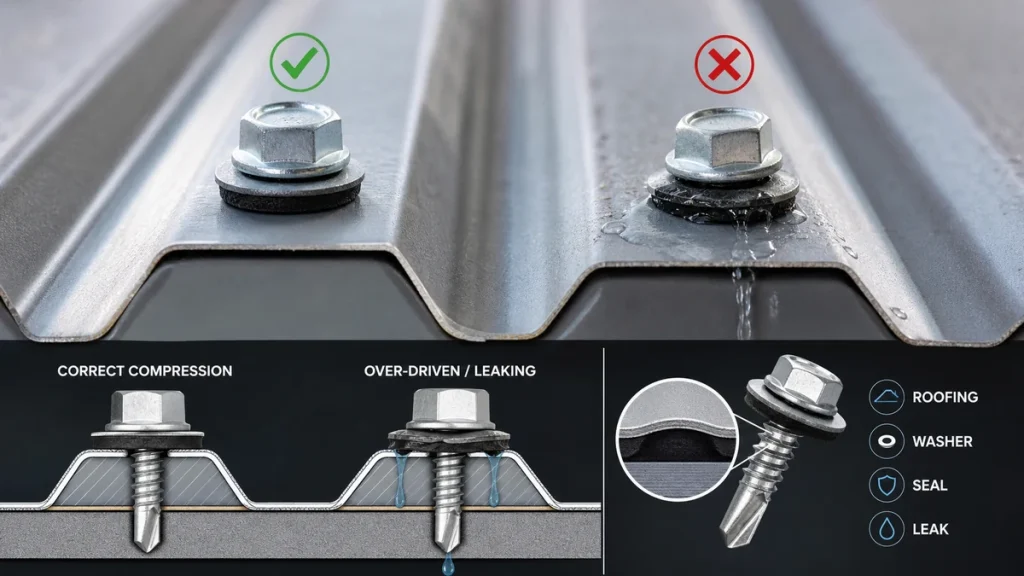
For metal roofing, self-drilling or self-tapping roofing screws are often considered, but the correct choice depends on whether the fixing goes into steel purlins, timber, a curb frame or a lighter sheet. Washer sealing also matters: an over-compressed washer can split or deform, while an under-seated washer can allow water to track along the screw.

Start with the mounting condition. A fan mounted on a prefabricated curb, a sheet-metal upstand and a flat roof frame may each need a different fastener. Confirm the roof panel material, the support below it and whether the screw must drill its own hole or enter a prepared pilot hole.

Match the screw point and thread to the substrate. A point intended for thin sheet may not suit heavier steel, and a metal-to-metal screw is not the same as a screw intended to bite into timber. Choosing only by visible screw length is a common mistake; engagement, head style and washer seating are just as important.

Think about sealing and movement. Roof exhaust fans can vibrate during operation, and roof panels move with temperature changes. A suitable washer, correct installation pressure and compatible flashing detail help reduce leaks around the fixing. Fasteners should not be used to compensate for poor curb alignment or an unsupported opening.

For an inquiry, prepare the roof panel type, substrate material, approximate fixing stack-up and exposure conditions. A photo or section drawing of the fan curb and roof build-up is often more useful than a generic request for “roof exhaust fan screws.”

Criteria Importance Description Example Options
Substrate engagement Critical because the support material determines thread form, point style and holding method. Separate fixings that engage timber or structural steel from those intended only for thin sheet. A panel-only connection may not provide the support required by a curb or vibrating fan assembly. A timber support, steel purlin and thin metal panel may each require a different fastening approach.
Drilling and thread method Important for fit, installation control and avoiding damage to the roof assembly. Choose between self-drilling, self-tapping and prepared-pilot-hole installation according to the material thickness and access available. The visible screw length does not determine whether the point and threads are suitable. A fastener for light sheet-metal work is not automatically suitable for a thicker steel support or a timber frame.
Sealing and washer arrangement Critical around roof penetrations because a sound mechanical fixing does not by itself create a watertight detail. Check washer material, diameter, head compatibility and seating pressure together with the flashing or curb design. Avoid relying on excessive tightening to compensate for poor alignment or an unsuitable seal. A washer may need to seal a metal panel while remaining compatible with the screw coating and the surrounding flashing material.
Load and vibration path Important where the fan operates regularly or the curb transfers load to the roof structure. Determine whether the fixing holds a light trim piece, a curb, or a frame carrying the operating assembly. Structural support and fixing spacing should be considered before choosing a panel fastener. A trim attachment and a curb-to-support connection are different tasks even when both are located on the same roof.
Exposure and material compatibility Important for maintaining the connection and seal in the intended environment. Consider moisture, condensation, agricultural air, coastal exposure and contact between dissimilar metals. The appropriate coating or washer material depends on the complete roof and fixing assembly. A dry indoor workshop and a humid coastal building may call for different material-compatibility checks.

Blog Articles / Reviews

Which Self-Tapping Roofing Screw Specification Fits Metal Panels on Steel or Timber?

Which Self-Tapping Roofing Screw Specification Fits Metal Panels on Steel or Timber?

The correct self-tapping roofing screw depends on the complete panel-and-substrate stack-up. Steel supports typically require a point and thread matched to the support thickness and any pilot-hole requirement; timber supports require a wood-appropriate thread and sufficient embedment. In both cases, buyers must define diameter, length, head, sealing washer, material or coating, environment, pull-out requirements, and […]

Why Do Self-Tapping Roofing Screws Leak Even When the Screw Length Looks Correct?

Why Do Self-Tapping Roofing Screws Leak Even When the Screw Length Looks Correct?

Direct answer: Correct screw length does not guarantee a watertight metal-roof connection. Self tapping roofing screws can leak because of incorrect washer compression, enlarged or stripped holes, insufficient thread engagement, panel movement, or an unsuitable coating-and-washer system. Buyers should diagnose the complete installed connection—including panel profile, support thickness, point type, washer condition, and exposure—rather than […]

Frequently Asked Questions

Can one screw type attach both the fan curb and the roof panel?

Not necessarily. The curb or supporting frame may require a fixing that engages timber or structural steel, while the panel itself may use a different thread, drilling point or washer arrangement. Confirm the load-bearing support instead of selecting one screw based only on the visible roof sheet.

When might bolts or other fixing methods be preferable to roofing screws?

A bolted connection may be appropriate where the mounting frame has accessible structural members and the design allows a through-connection. Rivets or panel fasteners may suit lighter sheet-metal attachments, but they should not be treated as a substitute for a structural fixing when the fan and curb impose significant load or vibration.

Does choosing a longer screw make the installation more secure?

No. The screw needs useful engagement in the intended substrate, but excessive length can interfere with services, damage concealed components or leave an unsuitable penetration path. Check the complete stack-up, including the curb, flashing, panel, washer and supporting material.

What information should accompany a purchasing inquiry?

Provide the roof panel material, the support below the fixing point, the curb or frame material, the approximate material thicknesses and whether the hole is drilled during installation or prepared in advance. Photos or a section drawing are also useful, along with exposure details such as rain, coastal air or regular fan vibration.

How do washer and coating choices affect the fastening decision?

The washer must suit the screw head, roofing material and sealing detail, and it should seat without being split or excessively compressed. Coating and material compatibility also matter in humid, agricultural or coastal environments; confirm the expected exposure and any contact between dissimilar metals before ordering.

Leave Your Message

Send the roof panel material, the substrate below the fixing point and a photo or drawing of the fan curb. Also note whether the installation is exposed to rain, coastal air or regular vibration.