Self-Tapping and Self-Drilling Screws | Hebei Wotu Fastener Manufacturing Co., Ltd.

Self-Tapping and Self-Drilling Screws

Self screws are usually chosen as either self-tapping screws, which form or cut threads in a prepared hole, or self-drilling screws, which can pierce certain metal sections with their drill point. The right choice depends first on the joined materials and whether a pilot hole is already available.

For a reliable fit, define the substrate, material thickness, required screw length, head style, drive, and exposure to moisture or corrosion. These details affect installation time, thread engagement, pull-out performance, and the risk of leaks or damaged threads.

Related Products

Dacromet Hex Head Self-Drilling Screw

Dacromet Hex Head Self-Drilling Screw

Brand: Hengzuan Surface: Dacromet anti-corrosion coating Specifications: in stock ST5.5/ST6.3 mainstream caliber, rod length 50mm~150mm, extended full range of specifications, supports nonstandard extra long customized, suitable for drilling steel sheet thickness 2~6mm Packaging: 25kg export cartons, full pallets wrapped with film, supports neutral export packaging, private-label customization

Read More
Black Phosphated Winged Countersunk Head Self-Drilling Screw

Black Phosphated Winged Countersunk Head Self-Drilling Screw

Brand: Hengzuan Surface: high temperature black phosphated anti-rust treatment, blue zinc, color zinc plated coating can be replaced as needed Specifications: in stock ST3.5/ST4.2/ST4.8 common specifications, rod length 16mm~50mm, complete, supports nonstandard size customization, suitable for drilling steel sheets 2~5mm Packaging: 25kg cartons, whole wooden pallets, support neutral packaging, private-label customization

Read More
Chinese-standard Color Nylon Head Hex Self-Drilling Screw

Chinese-standard Color Nylon Head Hex Self-Drilling Screw

Brand: Hengzuan Surface: screw color zinc plated, head color nylon protective cap, multiple colors available Specifications: Chinese national standard ST5.5, ST6.3 mainstream caliber, rod length 25mm~125mm full range of specifications in stock, supports nonstandard length customization, suitable for drilling steel sheet thickness 2~6mm Packaging: 25kg cartons, full pallets packed on wooden pallets, support neutral packaging, private-label customization

Read More
Hex Head Self-Drilling Screw With Bonded Washer

Hex Head Self-Drilling Screw With Bonded Washer

Brand: Hengzuan Surface: blue and white zinc plated, color zinc plated can be customized on request Specifications: in stock 4.2/4.8/5.5/6.3mm mainstream wire diameter, length 20mm~165mm full range of specifications, nonstandard rod length, drill point size can be customized Packaging: 25kg export cartons, full pallets wrapped with film, supports neutral export packaging, customer private-label customization

Read More

Compare point, thread, head and finish options

Self screw selection criteria

Compare self screws by point type, thread geometry, diameter and length, head and drive style, washer or sealing arrangement, base material, surface finish, and compatibility with the installation method. The correct combination depends on the joined materials and the required thread engagement, not on the label alone.

Criterion What To Check Why It Matters Buyer Tip
Material pair and base material thickness State whether the screw joins metal to metal, metal to wood, or a pre-drilled assembly, along with the material thicknesses. The thread form and point must create or engage threads without splitting the substrate, stripping the hole, or leaving insufficient engagement. Ask: Which screw design is recommended for our exact materials and thickness range?
Self-tapping or self-drilling point Confirm whether a pilot hole is required and compare the point design with the target material. A self-drilling point can make its own entry hole in suitable sheet metal, while a self-tapping screw generally relies on a correctly sized pilot hole or existing hole. Ask for the required pilot-hole size, or for the material range the drilling point is intended to handle.
Thread engagement and screw length Compare the usable thread length with the combined thickness of the parts, including any washer or fixture under the head. Too little engagement can weaken the joint; excessive length may protrude, interfere with components, or complicate installation. Provide a cross-section drawing and ask the supplier to confirm the appropriate length and thread engagement.
Head style and driving recess Match the head shape, bearing surface, clearance, and drive recess to the joint and installation tool. The head transfers clamping force and controls access to the fastener; a poor match can cause interference, slipping, or uneven seating. Ask whether the proposed head and drive are suitable for the available tool and the required finished surface.
Coating and exposure conditions Describe indoor, outdoor, damp, or chemically exposed service conditions and request the proposed material or coating details. The fastener environment affects corrosion risk and can also create compatibility concerns with the joined materials. Ask what corrosion-resistance information is documented for the intended exposure and whether the coating is compatible with the substrate.

Choose the screw type for your joint and installation method

The practical distinction is the point design. A self-drilling screw is suited to applications where the screw must make its own starting hole in compatible metal, while a self-tapping screw is normally used with a pilot hole or a material that can accept its forming or cutting thread.

Choosing the wrong type can cause excessive installation force, poor thread engagement, material cracking, or an incomplete joint. For metal-to-metal work, check whether the screw point can pass through the combined material thickness; for metal-to-wood or pre-drilled assemblies, check thread form and holding length instead.

Start with the joint, not the screw name. State whether the application is metal-to-metal, metal-to-wood, roofing, cladding, or a pre-drilled assembly. Identify the thickness and hardness of each layer. A drill point may be useful for unpierced sheet metal, while a tapping point can be more appropriate when the hole has already been made. See the comparison of self-drilling and self-tapping screws for this distinction.

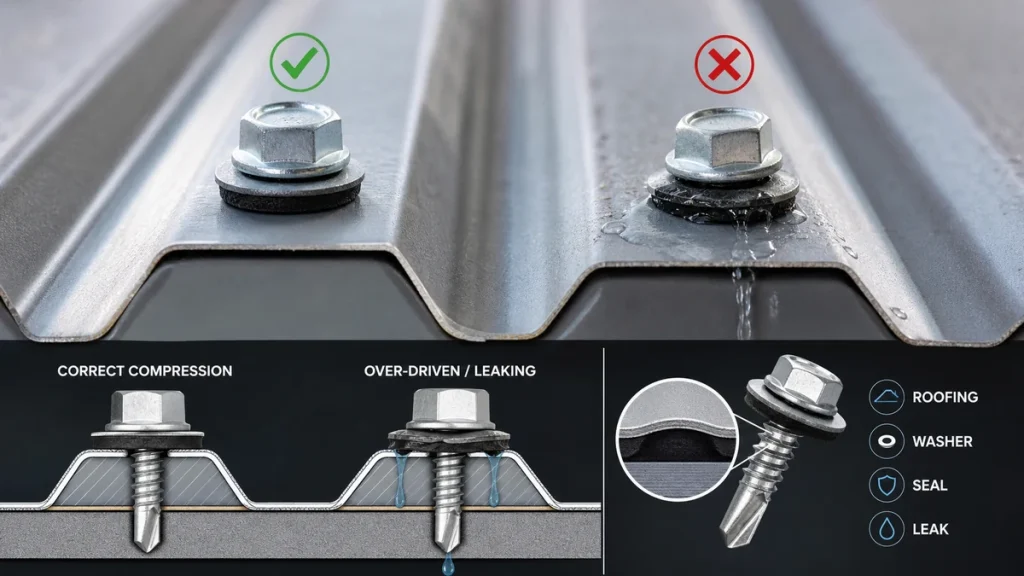
Set length by engagement, not appearance. The screw must pass through the attached material and leave enough thread in the supporting material without protruding into an unwanted space. For roofing or cladding, also consider the washer, sealing surface, panel profile, and support material; a screw that looks long enough can still create a poor seal if it is placed or matched incorrectly.

Match the finish and head to the environment and tool. Indoor dry use, outdoor exposure, and contact with dissimilar metals can require different corrosion considerations. The head should suit the load distribution and clearance, while the drive should match the installation equipment. Confirm the coating, substrate compatibility, washer material, and any required colour or surface treatment rather than selecting by appearance alone.

Prevent avoidable installation problems. Confirm the pilot-hole approach, thread engagement, torque or driving method, and acceptable head seating with the installer before placing a volume order. For a quotation, send a drawing or photo, the joined material and thickness, the required length and diameter, the head and drive style, the finish or coating, and the expected quantity. You can also review the information to include in a self-drilling screw enquiry.


Criteria Importance Description Example Options
Point type Usually the first decision The point determines whether the screw drills its own entry hole or works in a prepared hole. A mismatch can cause high driving force, incomplete penetration, or weak thread formation. A drill-point screw for compatible unpierced sheet metal; a tapping screw for a prepared hole.
Joined materials and thickness Critical for fit and holding strength Metal-to-metal, metal-to-wood, and roofing assemblies load the screw differently. Combined thickness and support material affect point selection, thread engagement, and required length. A thin metal panel fixed to steel needs different checks from a pre-drilled bracket fastened into timber.
Head, drive, and washer arrangement Important for installation and joint finish The head spreads load and sets the finished appearance, while the drive must suit the installation tool. Washers matter where sealing, vibration, or surface protection is part of the joint design. A roofing application may need a sealing washer; an internal bracket may prioritize clearance and tool access.
Surface finish or coating Important where exposure or corrosion is expected Finish selection should match the environment and the materials being joined. Buyers should confirm coating requirements rather than assuming that any plated or coated screw suits outdoor use. An indoor dry assembly may not need the same corrosion consideration as an exposed cladding fastener.
Installation method Practical for repeatable assembly Tool speed, torque control, pilot-hole practice, and installer technique influence seating, thread quality, and washer compression. The screw should be selected with the actual assembly process in mind. A production line using powered drivers may need clearer drive and seating requirements than a small repair job.

Product Selection

Related Options

For a metal panel fixed to steel, point design and sealing arrangement may take priority because the screw must enter the support and protect the joint from water entry. For a pre-drilled metal-to-wood or repair assembly, thread engagement, length, and corrosion resistance may matter more. Confirm the application details before comparing individual options.

Blog Articles / Reviews

What Should an RFQ Include When Sourcing Dacromet Hex Head Self-Drilling Screw?

What Should an RFQ Include When Sourcing Dacromet Hex Head Self-Drilling Screw?

When sourcing dacromet hex head self drilling screw, a complete RFQ should define the application, screw configuration, coating requirement, dimensions, and supplier confirmation requirements. Buyers often receive different quotations because suppliers may interpret coating, size, drilling capability, or packaging scope differently. Before preparing a project inquiry, buyers can review the available fastener product categories to […]

How Should Buyers Evaluate Self Tapping Screws for Project Procurement?

How Should Buyers Evaluate Self Tapping Screws for Project Procurement?

#4 self tapping screws should not be purchased from the “#4” designation alone. For a usable B2B specification, the buyer still needs the actual screw diameter, thread form or pitch, overall length, substrate, pilot-hole condition, head and drive style, material, surface finish and quantity. This matters because suppliers may use different naming systems. Wotu Fastener’s […]

Which Self-Tapping Roofing Screw Specification Fits Metal Panels on Steel or Timber?

Which Self-Tapping Roofing Screw Specification Fits Metal Panels on Steel or Timber?

The correct self-tapping roofing screw depends on the complete panel-and-substrate stack-up. Steel supports typically require a point and thread matched to the support thickness and any pilot-hole requirement; timber supports require a wood-appropriate thread and sufficient embedment. In both cases, buyers must define diameter, length, head, sealing washer, material or coating, environment, pull-out requirements, and […]

Why Do Self-Tapping Roofing Screws Leak Even When the Screw Length Looks Correct?

Why Do Self-Tapping Roofing Screws Leak Even When the Screw Length Looks Correct?

Direct answer: Correct screw length does not guarantee a watertight metal-roof connection. Self tapping roofing screws can leak because of incorrect washer compression, enlarged or stripped holes, insufficient thread engagement, panel movement, or an unsuitable coating-and-washer system. Buyers should diagnose the complete installed connection—including panel profile, support thickness, point type, washer condition, and exposure—rather than […]

Frequently Asked Questions

Should I choose a self-tapping or self-drilling screw for metal sheet?

Use a self-drilling screw when the screw needs to pierce compatible sheet metal and form the thread in one operation. Use a self-tapping screw when a pilot hole is already prepared or when the material needs controlled thread forming or cutting rather than drilling.

Why can the correct-looking length still fail in roofing or cladding?

Length alone does not confirm sealing or holding performance. The screw must suit the panel profile, washer compression, support material, and thread engagement; poor seating or the wrong washer arrangement can still allow leakage even when the screw reaches the support.

Is a pilot hole always unnecessary with these screws?

No. A self-drilling screw may remove the need for a separate drilling step in suitable metal, but a self-tapping screw often needs a pilot hole or prepared opening. The need depends on material thickness, hardness, thread type, and the installation equipment.

What information should I send before requesting a quotation?

Provide the joined materials, thickness of each layer, application type, required diameter and length if known, head style, drive type, finish or coating, washer requirement, and quantity. A drawing, photo, or current sample also helps avoid confusion over point type and head shape.

What is the main trade-off between faster installation and joint control?

Self-drilling screws can reduce installation steps where drilling and fastening can happen together, but they must match the material stack and drill capacity. Pre-drilled or self-tapping assemblies can add preparation time, yet they may give better control in repair work, wood substrates, or materials that can crack or deform.

Leave Your Message

Please provide the joined materials and their thickness, the required screw length or diameter, and the application environment or finish needed so the enquiry can be assessed accurately.