Self Tapping Metal Screws Selection Guide | Hebei Wotu Fastener Manufacturing Co., Ltd.

Self tapping metal screws for metal assemblies

Self tapping metal screws are chosen for assemblies where the screw must form its own mating thread in metal, often after a pilot hole has been made. The main purchase decision is not only diameter and length; it is whether the screw point, thread form, head style and finish suit the metal thickness, joint load and installation method.

For sheet metal, brackets, panels, enclosures and light steel assemblies, the right screw can reduce loose joints, stripped holes and installation delays. The wrong one may drive in quickly at first but fail by thread stripping, head damage, poor seating or corrosion at the joint.

Related Products

Countersunk Head Blue-White Zinc Plated Self-Drilling Screw (Chinese National Standard: Phillips Countersunk Head Self-Drilling And Self-Tapping Screw GB/T15856.2-2002)

Countersunk Head Blue-White Zinc Plated Self-Drilling Screw (Chinese National Standard: Phillips Countersunk Head Self-Drilling And Self-Tapping Screw GB/T15856.2-2002)

Brand: Hengzuan Surface: blue and white zinc plated, can be customized color zinc plated, black oxide plated Specifications: Comply with GB/T15856.2-2002 Chinese national standard, in stock ST4.2/ST4.8/ST5.5 full range of specifications, length 13mm~75mm optional, supports customized nonstandard rod lengths; drilling adaptation plate thickness 0.7~6mm Packaging: 25kg export cartons, full pallets wrapped with film, supports neutral export packaging, customer private-label customization

Read More
Countersunk Head Self-Tapping Screw

Countersunk Head Self-Tapping Screw

Brand: Hengzuan Surface: blue and white zinc plated, optional color zinc plated, black oxide treatment Specifications: Follow GB/T846-1985 Chinese national standard, in stock ST4.2/ST4.8/ST5.5 full range of specifications Packaging: 25kg export cartons, full pallets wrapped with film, supports neutral export packaging, private-label customization

Read More
Blue-White Zinc Plated Pan Head With Pad Self-Tapping Screw

Blue-White Zinc Plated Pan Head With Pad Self-Tapping Screw

Brand: Hengzuan Surface: blue and white zinc plated Specifications: in stock ST4.2/ST4.8full range of specifications, length 13~50mm in stock, support nonstandard length customization Packaging: 25kg cartons, solid wood packaging, support neutral packaging, private-label customization

Read More
Wafer Head Self-Drilling Screw

Wafer Head Self-Drilling Screw

Brand: Hengzuan Surface: blue and white zinc plated, can be customized color zinc plated, black oxide plated Specifications: Comply with GB/T15856.2 Chinese national standard, in stock ST3.5/ST4.2/ST4.8/ST5.5 mainstream wire diameter, rod length 13mm~50mm full range of specifications, nonstandard length customization on demand, drilling applicable plate thickness 2~5mm Packaging: 25kg export cartons, full pallets wrapped with film, supports neutral export packaging, private-label customization

Read More

Selecting self tapping metal screws for the joint

Selection criteria

Useful selection criteria for self tapping metal screws include the metal thickness, pilot hole requirement, thread engagement, point type, head style, drive recess, coating and the tool used for installation. If you are comparing options from Hebei Wotu Fastener Manufacturing Co., Ltd., confirm which screw types, finishes and packaging formats are available for your drawing or application.

Criterion What To Check Why It Matters Buyer Tip
Base metal and material stack Confirm whether the screw joins thin sheet metal to metal, metal to wood, or a pre-drilled assembly. The mating materials affect thread formation, holding strength, installation method, and the risk of stripping or damaging the joint. Ask: What are the material types and thicknesses on both sides of the joint?
Thread form and pilot-hole requirement Compare the thread design with the metal thickness and confirm the recommended pilot-hole approach for the assembly. A self-tapping screw forms threads in a prepared hole or material; the wrong fit can cause poor engagement, excessive installation force, or thread damage. Ask for the suitable pilot-hole guidance for your exact material and thickness rather than assuming the screw drills its own hole.
Screw length and thread engagement Check the length against the total material stack, required embedment, and any washer or seal thickness. Too little engagement can weaken the joint, while excessive length may protrude, interfere with parts, or create a safety issue. Provide the material-stack thickness and ask which portion of the screw should remain engaged after installation.
Head style, drive, and bearing surface Match the head shape and drive to the clearance, tool access, clamping surface, and appearance of the finished assembly. Head geometry affects seating, load distribution, installation access, and the chance of damaging the mating surface. Ask whether the proposed head and drive suit your tool, clearance limits, and any washer or sealing requirement.
Finish and corrosion compatibility Compare the screw finish with the service environment and the materials it will contact, including coated or dissimilar metals. Corrosion compatibility influences joint life and can affect the appearance and removability of the fastener. Describe the indoor or outdoor exposure and the mating materials, then ask which finish is appropriate and what compatibility information is available.

Key choices before specifying the screw

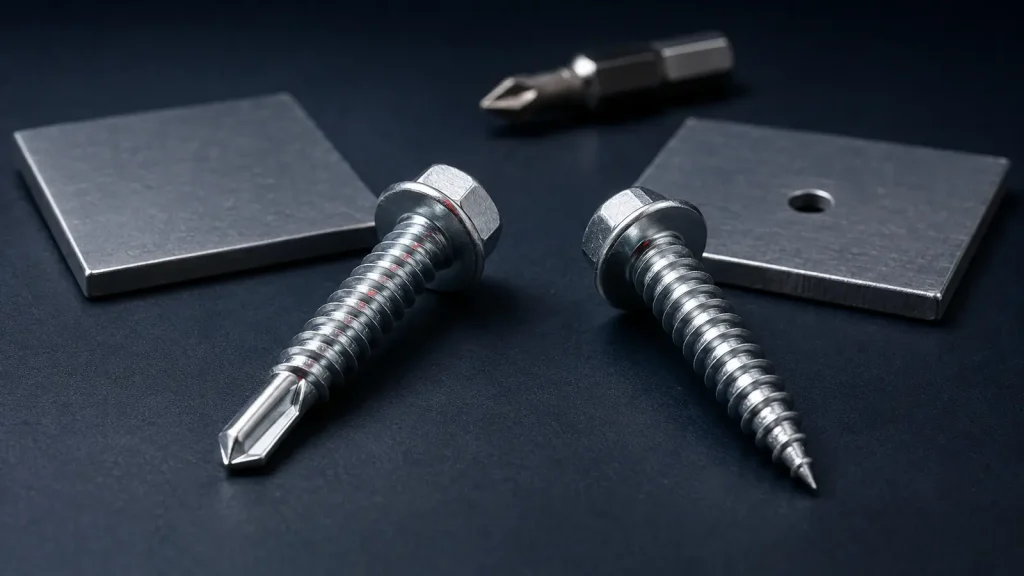
The practical distinction buyers often need is self tapping versus self drilling. A self tapping screw cuts or forms threads in the base material, but it normally relies on a pilot hole in metal. A self drilling screw has a drill point that creates the hole and then forms the thread in one operation. That difference affects tool setup, hole accuracy, production speed and the range of metal thicknesses the fastener can handle.

For controlled factory assembly, a pilot hole can improve alignment and thread engagement. For field installation or repetitive fastening into suitable sheet metal, a drilling point may save time. The decision should be based on the base metal, total clamped thickness, access for tools, required appearance and how much variation installers will face on site.

Start with the joint, not the screw size. Identify the top material, the base metal, the total thickness being clamped and whether the screw is fastening metal to metal, metal to timber, or metal to a pre-punched component. A screw that works in thin sheet may not give enough thread engagement in a thicker bracket, while a longer screw may bottom out, interfere with another component or create an exposed sharp point.

Point style and pilot hole control drive much of the performance. If the application uses a separate pilot hole, confirm the recommended hole size for the screw diameter and material hardness. Too small a hole can cause high driving torque, broken screws or damaged heads; too large a hole can reduce pull-out strength and make the screw feel tight without actually holding well.

Match the head and drive to the assembly method. Pan, wafer, hex washer and countersunk heads solve different seating and clearance problems. A drive that is convenient for hand tools may not suit automated or high-volume installation. If the screw will clamp a panel, washer, slotted part or painted surface, check whether the head bearing area and seating style protect the part rather than digging in or deforming it.

Do not treat coating as an afterthought. Indoor dry assemblies, painted parts, roofing panels and outdoor metalwork can need different corrosion protection and contact-material compatibility. A useful next step is to send the drawing or joint description, base metal, thickness range, head preference, finish requirement and installation method so the screw type can be checked against the actual application.


Criteria Importance Description Example Options
Pilot hole control Often critical for thread holding strength and installation consistency The hole must be small enough for the screw to form a secure thread but large enough to avoid excessive driving torque or broken screws. A pre-punched sheet metal part may need a different hole size than a field-drilled bracket using the same screw diameter.
Self tapping versus self drilling Affects installation speed, tool setup and suitability for the metal thickness Self tapping screws form threads in an existing hole, while self drilling screws add a drill point to create the hole first. A factory assembly with accurate punched holes may suit self tapping screws; repetitive panel fixing without pre-drilling may call for a drilling point.
Head style and seating Important for clamp load, clearance, appearance and surface protection Different heads spread load differently and sit at different heights. The wrong head can deform thin panels, interfere with nearby parts or fail to seat cleanly. A countersunk head may suit a flush surface, while a washer-style head may be better where a broader bearing area is needed.
Thread engagement in the base metal Central to pull-out resistance and resistance to loosening Enough thread must engage with the metal to hold the joint without stripping. Metal thickness and thread pitch both influence the result. A screw that works well in a folded sheet edge may not hold the same way in a single thin sheet.
Finish and exposure conditions Important when the joint faces moisture, outdoor exposure or contact with coated materials The coating should match the service environment and the materials being fastened. Appearance, corrosion resistance and compatibility should be checked before purchase. An indoor enclosure and an exterior panel may need different finish choices even if the screw size is similar.

Product Selection

Related Options

For a sheet metal enclosure, the priority may be clean seating and repeatable torque; for a roof or exterior panel, sealing and corrosion resistance may matter more; for a bracket fixed to steel, thread engagement and pull-out resistance become central. The best-fit screw is the one matched to the joint conditions, not simply the longest or hardest-looking fastener.

Blog Articles / Reviews

How Should Buyers Evaluate Self Tapping Screws for Project Procurement?

How Should Buyers Evaluate Self Tapping Screws for Project Procurement?

#4 self tapping screws should not be purchased from the “#4” designation alone. For a usable B2B specification, the buyer still needs the actual screw diameter, thread form or pitch, overall length, substrate, pilot-hole condition, head and drive style, material, surface finish and quantity. This matters because suppliers may use different naming systems. Wotu Fastener’s […]

Which Self-Tapping Roofing Screw Specification Fits Metal Panels on Steel or Timber?

Which Self-Tapping Roofing Screw Specification Fits Metal Panels on Steel or Timber?

The correct self-tapping roofing screw depends on the complete panel-and-substrate stack-up. Steel supports typically require a point and thread matched to the support thickness and any pilot-hole requirement; timber supports require a wood-appropriate thread and sufficient embedment. In both cases, buyers must define diameter, length, head, sealing washer, material or coating, environment, pull-out requirements, and […]

Why Do Self-Tapping Roofing Screws Leak Even When the Screw Length Looks Correct?

Why Do Self-Tapping Roofing Screws Leak Even When the Screw Length Looks Correct?

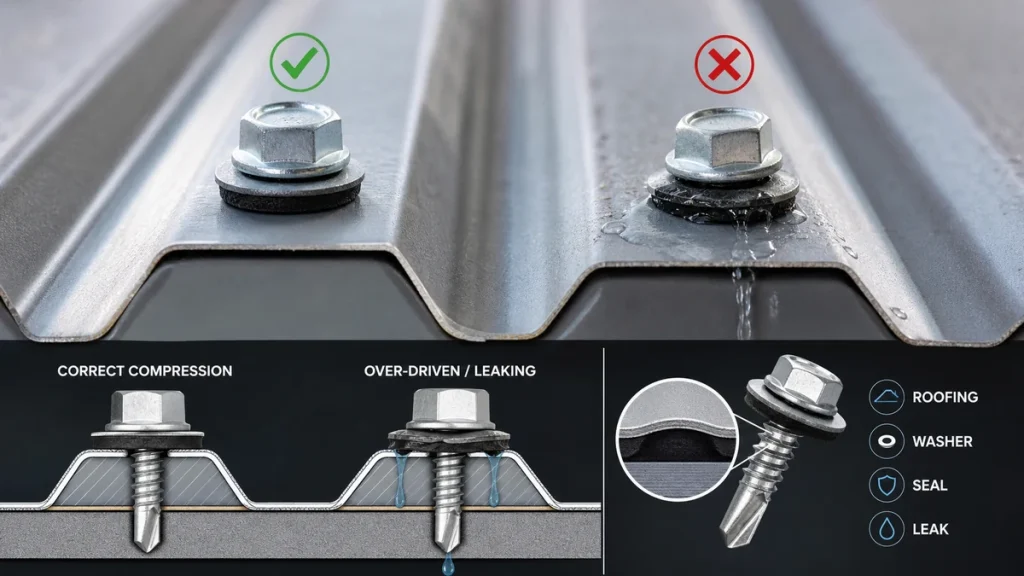
Direct answer: Correct screw length does not guarantee a watertight metal-roof connection. Self tapping roofing screws can leak because of incorrect washer compression, enlarged or stripped holes, insufficient thread engagement, panel movement, or an unsuitable coating-and-washer system. Buyers should diagnose the complete installed connection—including panel profile, support thickness, point type, washer condition, and exposure—rather than […]

What Is the Difference Between Self Drilling and Self Tapping Screws?

What Is the Difference Between Self Drilling and Self Tapping Screws?

Direct Answer: A self-drilling screw has a drill-shaped point that creates a hole and then forms mating threads in a suitable material. A self-tapping screw forms or cuts mating threads but may require a correctly sized pilot hole. Selection depends on substrate type and thickness, joint stack, point geometry, installation tool, finish and application testing—not […]

Frequently Asked Questions

Do these screws always need a pilot hole in metal?

In many metal applications, a self tapping screw is installed into a pilot hole so the thread can form correctly without excessive torque. The pilot hole size depends on screw diameter, thread type, base metal thickness and material hardness, so it should be confirmed for the actual joint rather than guessed from length alone.

Should I use a self tapping screw or a self drilling screw?

Choose a self tapping screw when the hole is already punched, drilled or otherwise controlled before installation. Choose a self drilling screw when the fastener must create the hole and thread in one operation, provided the metal thickness and installation conditions suit the drill point.

Is a longer screw automatically stronger?

No. Strength depends on thread engagement, base metal thickness, hole size, head seating and the load direction. A screw that is too long can create clearance problems, leave an exposed sharp point or bottom out before the joint is properly clamped.

What causes stripped holes or loose joints in sheet metal?

Common causes include an oversized pilot hole, too little thread engagement, over-driving, using the wrong thread form or fastening into metal that is too thin for the selected screw. Tool torque settings also matter because a screw can feel tight briefly and then strip the formed thread.

Which details should I provide before asking for a quotation?

Provide the screw diameter and length if known, or share the drawing and joint description if not. Include base metal type, thickness range, pilot hole condition, head and drive preference, finish requirement, application environment and packaging needs.

Leave Your Message

Send the base material and thickness, the joint type and head style needed, plus any coating or installation requirements. A drawing or photo of the assembly is also helpful.