Pan Head Bolt Selection | Hebei Wotu Fastener Manufacturing Co., Ltd.

Pan Head Bolt Selection for Assembly Fit

A pan head bolt is often chosen where the head must sit proud of the surface but still present a broad, neat bearing face. It suits assemblies where the fastener remains visible, where a washer-like contact area helps spread load, or where a low-profile rounded head is preferred over a hex head.

The main decision is not only thread size. Buyers usually need to confirm the head style, drive or socket form, material, finish, mating nut or tapped hole, and the surface being clamped before a supplier can match the bolt to the assembly.

Related Products

Hot-Dip Galvanized Hex Head Bolt (DIN931 Half Thread / DIN933 Full Thread / GB30 Chinese National Standard Bolt, Can Be Equipped With Nut And Washer Set)

Hot-Dip Galvanized Hex Head Bolt (DIN931 Half Thread / DIN933 Full Thread / GB30 Chinese National Standard Bolt, Can Be Equipped With Nut And Washer Set)

Brand: Wotu Surface: overall hot-dip zinc plating treatment Specifications: Comply with DIN and GB standards, in stock M6-M48 full range of specifications, length 20mm-300mm, supports nonstandard customized. Packaging: woven bag inside / 25kg export carton, film-wrapped wooden pallet; supports neutral packaging and customer private-label customization.

Read More
Blue-White Zinc Plated Pan Head With Pad Self-Tapping Screw

Blue-White Zinc Plated Pan Head With Pad Self-Tapping Screw

Brand: Hengzuan Surface: blue and white zinc plated Specifications: in stock ST4.2/ST4.8full range of specifications, length 13~50mm in stock, support nonstandard length customization Packaging: 25kg cartons, solid wood packaging, support neutral packaging, private-label customization

Read More

Pan Head Bolt Details That Affect Fit and Assembly

Selection criteria

Relevant pan head bolt selection criteria include thread form, diameter, length, head dimensions, drive type, material, coating, and the way the bolt bears against the assembled parts. If your drawing already controls these details, the purchase discussion can focus on manufacturability, finish, inspection, and packing requirements.

Criterion What To Check Why It Matters Buyer Tip
Head shape and bearing face Confirm the pan head profile, head diameter and underside style against your drawing or mating part. A pan head bolt spreads load over a wider area than some head styles, but excess head height or diameter can interfere with covers, slots or moving parts. Can you match our drawing for head diameter, head height and underside bearing surface?
Thread type and engagement length Specify diameter, pitch, thread length and whether the bolt is fully or partially threaded. Thread length affects clamp load, assembly stack-up and whether the unthreaded shank sits correctly through the joint. Should the thread run to the head, or do you need a plain shank through part of the assembly?
Drive or tightening method Identify the required drive style, such as cross recess, hex socket or another specified form, and confirm tool access. The drive choice affects installation speed, torque control and the risk of cam-out or damage during repeated assembly. What tool will the operator or assembly line use to tighten the pan head bolt?
Material and surface finish State the base material and coating requirement, and ask which finishes are available for the intended environment. Material and finish influence corrosion resistance, appearance, galling risk and compatibility with the parts being joined. Is the bolt used indoors, outdoors, with treated timber, or against another metal that may affect corrosion?
Fit with washer, nut or tapped hole Confirm the mating nut grade, tapped-hole depth, washer use and any clearance-hole dimensions. A correct bolt alone does not guarantee a sound joint; poor thread engagement or an oversized clearance hole can reduce clamp stability. Can we review the full joint stack, including washer, nut or tapped part, before ordering?

Specifying a Pan Head Bolt for Your Joint

The practical difference between a pan head bolt and a countersunk or hex head fastener is how the clamping load is applied and how the head fits the part. A countersunk head needs a prepared recess and sits flush; a hex head needs tool clearance around the head; a pan head gives a rounded top with a flat bearing underside, so it can work well on sheet metal, brackets, covers, light machinery guards, and general assemblies where appearance and contact area both matter.

That head shape also affects tightening. If the application needs high tightening torque or frequent maintenance, confirm the drive style and tool access early. A pan head with a smaller drive may not suit the same tightening conditions as a hex head bolt, even if the thread diameter is identical.

Start with the joint, not the bolt name. Note whether the bolt threads into a nut, a tapped hole, or an insert, and check the total grip thickness of the parts being clamped. Thread length matters because an overlong unthreaded shank can stop the joint from tightening, while a fully threaded bolt may not give the bearing or shear condition the design expects.

Choose the head and drive around access. A pan head can be useful when side clearance is limited, but the tool must still engage cleanly from above. If the head will be exposed, ask about the expected head diameter, head height, and drive recess compatibility so the assembled part looks right and can be serviced without cam-out or damage.

Match material and surface finish to the environment. Plain steel, zinc-plated steel, stainless steel, and coated fasteners behave differently in corrosion resistance, appearance, cost, and compatibility with mating parts. Avoid mixing finishes or materials without checking galvanic corrosion risk, coating thickness in threads, and whether the finish changes fit in tapped holes.

Avoid the common mistake of sending only “pan head bolt” plus a diameter. A useful inquiry should include thread standard or drawing, diameter and length, material or grade requirement, finish, head and drive preference, quantity, mating part details, and any inspection or packaging needs. If the part must match an existing fastener, share a drawing or clear photos with key measurements.


Criteria Importance Description Example Options
Head style High for fit, appearance, and bearing area The head shape determines whether the fastener sits proud, flush, or needs side tool clearance. It also affects how the head contacts the clamped surface. A pan head may suit a visible equipment cover, while a countersunk head may be chosen for a flush panel surface.
Drive access High when assembly space is limited or maintenance is expected The drive recess must match available tools and allow clean engagement from the correct angle. Poor access can damage the recess or prevent proper tightening. A top-access drive can work where side clearance for a wrench is not available.
Thread and length Critical for correct clamping Diameter alone does not define the part. Thread pitch, total length, threaded length, and grip thickness all affect whether the joint tightens correctly. A bolt that is too long may bottom out in a tapped hole before clamping the parts.
Material and finish Important for corrosion resistance, appearance, and compatibility Steel, stainless steel, and coated options can behave differently in service. The finish can also affect thread fit and the look of exposed fasteners. An exposed outdoor assembly may need a different material or coating than an indoor bracket.
Mating part condition Important for avoiding rework during assembly The bolt must match the nut, tapped hole, insert, or base material. Surface hardness, hole preparation, and coating buildup can change how the fastener seats and tightens. A plated bolt used in a tight tapped hole may need thread-fit confirmation before bulk ordering.

Product Selection

Related Options

For equipment covers, brackets, enclosures, and light-duty assemblies, the priority is usually a clean head profile with reliable clamping and repeatable tool engagement. Confirm the required head and drive details before comparing options, because two bolts with the same thread size can behave very differently during assembly.

Blog Articles / Reviews

How to Specify Countersunk Head Cross Thick Thread Fiberboard Screws for Furniture Assembly Projects

How to Specify Countersunk Head Cross Thick Thread Fiberboard Screws for Furniture Assembly Projects

Fiberboard screws are selected based on more than screw size alone. For furniture assembly and board-based applications, buyers need to match the screw structure with the characteristics of fiberboard, MDF, and similar engineered wood materials. A suitable specification should consider thread design, head style, screw length, diameter, installation method, and application requirements. For buyers sourcing […]

What Should an RFQ Include When Sourcing Dacromet Hex Head Self-Drilling Screw?

What Should an RFQ Include When Sourcing Dacromet Hex Head Self-Drilling Screw?

When sourcing dacromet hex head self drilling screw, a complete RFQ should define the application, screw configuration, coating requirement, dimensions, and supplier confirmation requirements. Buyers often receive different quotations because suppliers may interpret coating, size, drilling capability, or packaging scope differently. Before preparing a project inquiry, buyers can review the available fastener product categories to […]

Anchor Bolts: 7 Ordering Errors That Cause Site Rework

Anchor Bolts: 7 Ordering Errors That Cause Site Rework

ost anchor bolt ordering errors come from incomplete drawings, unclear dimensions, unsuitable material or coating choices, undefined tolerances, and mismatched nuts or washers. These mistakes affect steel fabricators, EPC contractors, equipment installers, importers, and distributors because anchor bolts are usually embedded before the connected structure arrives on site. Once concrete has cured, even a small […]

Why Do U Bolts Loosen in Pipe Supports? 6 Causes and Prevention Methods

Why Do U Bolts Loosen in Pipe Supports? 6 Causes and Prevention Methods

U bolts usually loosen in pipe supports because the connection loses clamping force, receives continuous vibration, restricts thermal pipe movement, uses an incorrectly sized U bolt, experiences surface settlement, or suffers from corrosion and inadequate inspection. This issue affects EPC contractors, pipe installers, industrial maintenance teams, equipment manufacturers and fastener distributors working with water, oil […]

Which Self-Tapping Roofing Screw Specification Fits Metal Panels on Steel or Timber?

Which Self-Tapping Roofing Screw Specification Fits Metal Panels on Steel or Timber?

The correct self-tapping roofing screw depends on the complete panel-and-substrate stack-up. Steel supports typically require a point and thread matched to the support thickness and any pilot-hole requirement; timber supports require a wood-appropriate thread and sufficient embedment. In both cases, buyers must define diameter, length, head, sealing washer, material or coating, environment, pull-out requirements, and […]

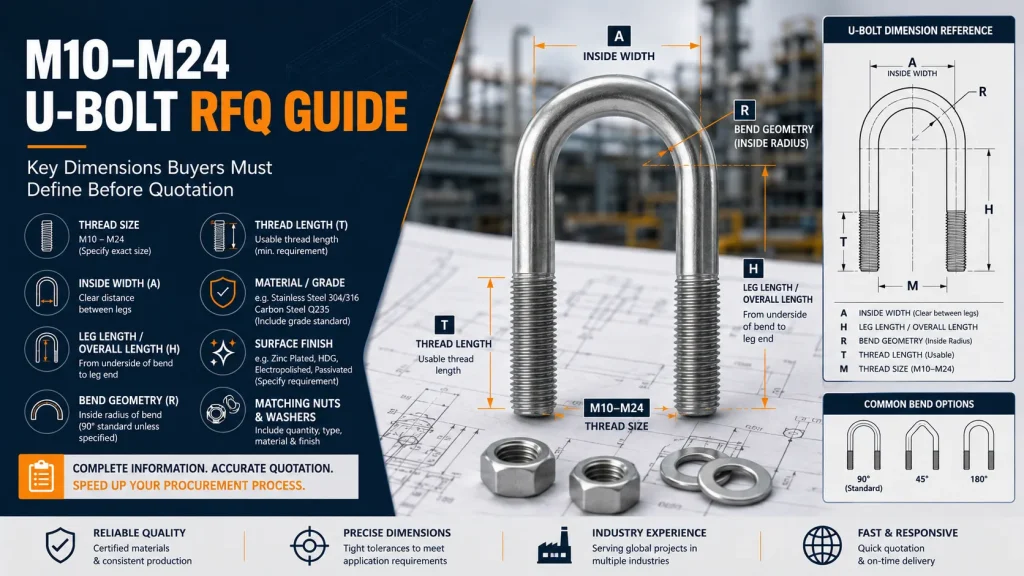
Which M10–M24 U-Bolt Measurements Must Buyers Send Before an RFQ?

Which M10–M24 U-Bolt Measurements Must Buyers Send Before an RFQ?

Direct Answer: For an M10–M24 U-bolt RFQ, buyers should send a dimensioned drawing that defines thread diameter, inside width, leg or overall length, bend geometry, thread length, application diameter, material or grade requirement, surface finish, matching nuts/washers, quantity, and packing needs. Nominal thread size alone is not enough because different measurement datums can produce U-bolts […]

Frequently Asked Questions

Where does this head style make sense in an assembly?

It is useful where the head remains visible and a rounded, low-profile shape is preferred over a hex head. It can suit covers, brackets, enclosures, guards, and light mechanical assemblies, provided the drive style and tightening torque match the joint.

Should I choose a pan head or a countersunk head?

Choose a pan head when the head can sit above the surface and you want a flat bearing underside. Choose a countersunk head when the surface must be flush, but remember that the part needs a matching countersink and the contact area and load path will differ.

Is thread diameter enough to identify the correct bolt?

No. Two bolts with the same thread diameter can have different lengths, pitches, head dimensions, drive recesses, materials, and finishes. A drawing, sample, or complete specification helps avoid parts that thread correctly but do not seat, tighten, or look as intended.

What drive type should be checked before ordering?

Confirm whether the assembly uses a cross recess, hex socket, slot, or another drive form, and check that the tool can reach the head squarely. Drive choice affects tightening reliability, serviceability, and the risk of cam-out or head damage.

What information should I send with an inquiry?

Send the thread standard, diameter, length, material, finish, head and drive style, quantity, and how the bolt mates with the part. If the fastener must replace an existing item, include a drawing or clear photos with head diameter, head height, thread length, and any marking or packaging requirements.

Leave Your Message

Send the thread size and length, required material and finish, and a drawing or photo showing the head and drive style you need. Include quantity and how the bolt will be used if you need help checking the specification.