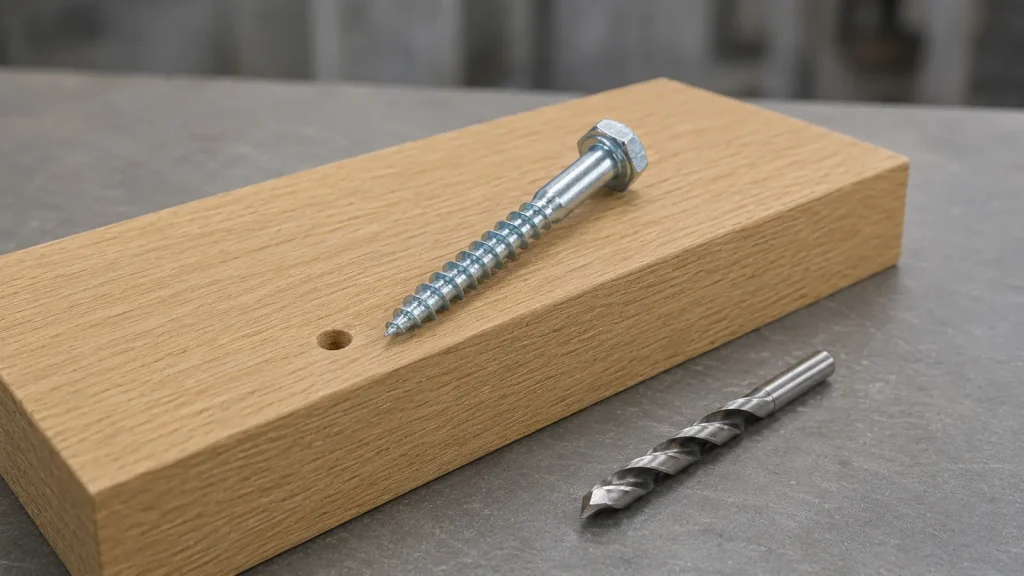
The most important distinction is between drilling a clearance hole, a pilot hole, and a counterbore or countersink. A clearance hole lets the screw pass through the top part without gripping it. A pilot hole guides the thread into the receiving wood. A counterbore or countersink gives the screw head or washer a controlled seat.
That difference matters because one “hole size” can create several assembly outcomes. A pilot hole that is too small can split hardwood or raise driving torque. A hole that is too large can reduce thread bite. A rough or wandering hole can also make fastener alignment look like a screw problem when the root cause is the drilling setup.
Start with the assembly, not the bit name. Confirm the screw diameter, thread form, head style, and whether the hole is for guidance, clearance, seating, or a through-hole. If the bit is being selected for use with wood screws or self-tapping screws, check the required pilot-hole relationship with the actual fastener rather than assuming one size fits all wood species.
Match the bit geometry to the material and finish requirement. Brad-point bits help start accurately in wood and reduce wandering. Spade bits can remove material quickly but may leave a rougher hole. Auger bits suit deeper holes and chip removal. For visible furniture or finished panels, cleaner entry and exit may matter more than drilling speed.
Think about the tool and process. A hand drill, drill press, CNC router, or production fixture can each change the best shank type, bit length, and cutting style. Long bits solve reach problems but can flex more easily. Short, rigid bits improve control but may not clear chips well in deep holes.
Avoid treating drill diameter as the only specification. Ask for the intended wood species or density range, hole depth, hole tolerance if critical, surface finish expectation, and the fastener that will be installed afterward. If Hebei Wotu Fastener Manufacturing Co., Ltd. is helping with a fastener assembly, provide the screw drawing or sample so the hole and thread engagement can be checked together.