Antique Screws Selection Guide | Hebei Wotu Fastener Manufacturing Co., Ltd.

Antique screws for restoration and period-style hardware

Antique screws are usually chosen for visible restoration, period-style furniture, cabinetry, doors, boxes, and decorative hardware where the fastener must support the assembly without looking modern. The first decision is whether you need new reproduction screws with an aged appearance or genuinely reclaimed screws with original wear and variation.

Match the head shape, drive style, thread form, length, diameter, material, and surface treatment to the surrounding hardware. A convincing appearance is useful only if the screw also fits the existing hole and provides dependable engagement.

Related Products

Hexagonal Wood Screws

Hexagonal Wood Screws

Brand: Wotu Surface: blue and white zinc plated Specifications: Chinese national standard 6#/8#/10#/12#/16#/20#, rod length 35mm~250mm full range of specifications in stock, supports nonstandard length customization Packaging: 25kg cartons, full pallets packed on wooden pallets, support neutral packaging, private-label customization

Read More
Hex nut DIN934-1987 (A/B accuracy classification)

Hex nut DIN934-1987 (A/B accuracy classification)

Brand: Wotu Standard basis: German standard DIN934-1987, metric coarse thread/fine thread universal thread Surface: 304 stainless steel Specifications: M6~M24 full range of specifications Supporting equipment: same specification bolts, flat washer, spring washer complete set of shipment Packaging: 25kg standard carton, whole wooden pallet packaging

Read More
Blue-White Zinc Plated Pan Head With Pad Self-Tapping Screw

Blue-White Zinc Plated Pan Head With Pad Self-Tapping Screw

Brand: Hengzuan Surface: blue and white zinc plated Specifications: in stock ST4.2/ST4.8full range of specifications, length 13~50mm in stock, support nonstandard length customization Packaging: 25kg cartons, solid wood packaging, support neutral packaging, private-label customization

Read More
Countersunk Head Blue-White Zinc Plated Self-Drilling Screw (Chinese National Standard: Phillips Countersunk Head Self-Drilling And Self-Tapping Screw GB/T15856.2-2002)

Countersunk Head Blue-White Zinc Plated Self-Drilling Screw (Chinese National Standard: Phillips Countersunk Head Self-Drilling And Self-Tapping Screw GB/T15856.2-2002)

Brand: Hengzuan Surface: blue and white zinc plated, can be customized color zinc plated, black oxide plated Specifications: Comply with GB/T15856.2-2002 Chinese national standard, in stock ST4.2/ST4.8/ST5.5 full range of specifications, length 13mm~75mm optional, supports customized nonstandard rod lengths; drilling adaptation plate thickness 0.7~6mm Packaging: 25kg export cartons, full pallets wrapped with film, supports neutral export packaging, customer private-label customization

Read More
Countersunk Head Blue Zinc Self-Drilling Screw

Countersunk Head Blue Zinc Self-Drilling Screw

Brand: Hengzuan Surface: blue and white zinc plated, can be customized color zinc plated, black oxide plated Specifications: in stock 3.5/3.9/4.2/4.8/5.5 mainstream wire diameter, rod length 13mm~75mm full size range, nonstandard length can be customized as needed Packaging: 25kg export cartons, full wooden pallets wrapped with film, supports neutral export packaging, private-label customization

Read More

Match the screw to the original hardware

Antique screw selection

Selection should focus on visual match and installation fit together: head profile, drive, dimensions, thread form, base material, finish, corrosion condition, and quantity consistency. Confirm which characteristics can be held consistently and which may vary from piece to piece.

Criterion What To Check Why It Matters Buyer Tip
Period-correct head style Compare the head shape and drive recess with the furniture, hinge, bracket or restoration sample you need to match. Antique screws are often chosen for visible detail. A modern-looking head can spoil the appearance even if the screw holds correctly. Can you match a sample screw or photo, including head profile, slot style and visible diameter?
Thread form and shank fit Check whether the original hole needs a wood screw thread, machine thread, self-tapping thread or a replacement that will not strip old material. Older timber, cast hardware and repaired holes may not tolerate an aggressive thread or the wrong pitch. What material is the screw going into, and is the existing hole worn, plugged or newly drilled?
Finish and aging effect Confirm the required surface appearance, such as blackened, brass-toned, bronze-toned or plain steel, and ask how consistent the finish will be across the batch. Finish affects both appearance and corrosion behavior. A decorative antique finish may not suit outdoor or damp use unless the base material and coating are appropriate. Is the screw mainly decorative, or does it also need to resist moisture, handling or outdoor exposure?
Length, diameter and usable grip Measure total length, head diameter, shank diameter and the thickness of the parts being fastened rather than relying only on a nominal size. Restoration work often involves thin plates, old wood and countersunk holes. A screw that is slightly too long can break through; one too short may not hold. Can you provide the material thickness and one removed sample for size matching?
Drive compatibility and installation risk Confirm the driver type and whether the head is decorative, functional or both before choosing a slotted or cross-drive option. Slotted antique-style heads look traditional but can cam out or mark easily if driven hard. Cross drives may install faster but look less period-correct. Will the screws be hand-installed for appearance, or driven in production where speed and repeatability matter?

Choose between reproduction consistency and aged authenticity

Reproduction antique screws offer more consistent dimensions and are generally easier to order in matching quantities. Reclaimed screws may provide authentic age, patina, and wear, but pieces can vary in size, condition, corrosion, and thread quality.

This distinction matters most when replacing several visible fasteners. For a restoration that needs a uniform appearance and predictable installation, consistency may matter more than surface age. For a museum-style or highly characterful repair, natural variation may be part of the intended result.

Start with the visible design. Compare the head profile and diameter with the original hardware, then check the drive style and finish. A bright, uniform coating can look out of place beside aged metal, while an overly dark or heavily distressed surface may not match the existing piece.

Specify dimensions from the actual assembly rather than choosing by appearance alone. Check the required length, shank or thread diameter, and available material thickness. A screw that is too long can interfere with concealed parts; one that is too short may not engage enough material. Existing holes can also be worn, enlarged, or made for a different thread form.

Consider the base material and environment. Interior furniture, painted timber, exterior joinery, and metal fittings may call for different corrosion resistance and surface treatments. Ask whether the finish is mechanically or chemically aged, and whether samples can be compared with the hardware before committing to a larger quantity.

Before requesting a quotation, send clear photos beside a ruler or caliper, the measured head and thread dimensions, the quantity, and the intended application. If authenticity is important, state whether you need reproduction consistency or naturally varied reclaimed pieces.

Criteria Importance Description Example Options
Reproduction or reclaimed High when appearance, quantity consistency, or historical character matters Reproduction pieces offer more predictable dimensions and finish, while reclaimed pieces may provide genuine wear and natural variation. Choose consistent reproductions for replacing a matched set; choose reclaimed pieces when individual age marks are part of the restoration.
Head profile and drive High for visible hardware and direct replacement work The head shape, diameter, recess, and drive pattern determine how closely the replacement matches the original fitting and how it installs. A countersunk head may suit a flush timber surface, while a raised or round head may better match exposed traditional hardware.
Thread form and dimensions Critical for fit and reliable engagement Length, diameter, thread form, and available material thickness must suit the existing hole and assembly. A visual match alone cannot confirm compatibility. An old enlarged hole may need a different fastening approach from an undamaged pilot hole, even when both applications use the same visible head style.
Material and surface treatment Important when the fastener faces moisture, coatings, or dissimilar hardware The base material and finish affect corrosion behavior, color, and how naturally the screw sits beside the surrounding hardware. Interior furniture and exterior joinery may require different material or finish choices; compare a sample against the actual fitting before ordering.
Finish consistency Important when replacing several exposed screws A mechanically or chemically aged surface can vary in color and texture, so confirm whether the supplier can hold a consistent appearance or expects piece-to-piece variation. Uniform darkened reproductions may suit a coordinated cabinet, while varied patina may be preferable for an individually restored antique.

Blog Articles / Reviews

How to Specify Countersunk Head Cross Thick Thread Fiberboard Screws for Furniture Assembly Projects

How to Specify Countersunk Head Cross Thick Thread Fiberboard Screws for Furniture Assembly Projects

Fiberboard screws are selected based on more than screw size alone. For furniture assembly and board-based applications, buyers need to match the screw structure with the characteristics of fiberboard, MDF, and similar engineered wood materials. A suitable specification should consider thread design, head style, screw length, diameter, installation method, and application requirements. For buyers sourcing […]

How Should Buyers Evaluate Self Tapping Screws for Project Procurement?

How Should Buyers Evaluate Self Tapping Screws for Project Procurement?

#4 self tapping screws should not be purchased from the “#4” designation alone. For a usable B2B specification, the buyer still needs the actual screw diameter, thread form or pitch, overall length, substrate, pilot-hole condition, head and drive style, material, surface finish and quantity. This matters because suppliers may use different naming systems. Wotu Fastener’s […]

Why Do Self-Tapping Roofing Screws Leak Even When the Screw Length Looks Correct?

Why Do Self-Tapping Roofing Screws Leak Even When the Screw Length Looks Correct?

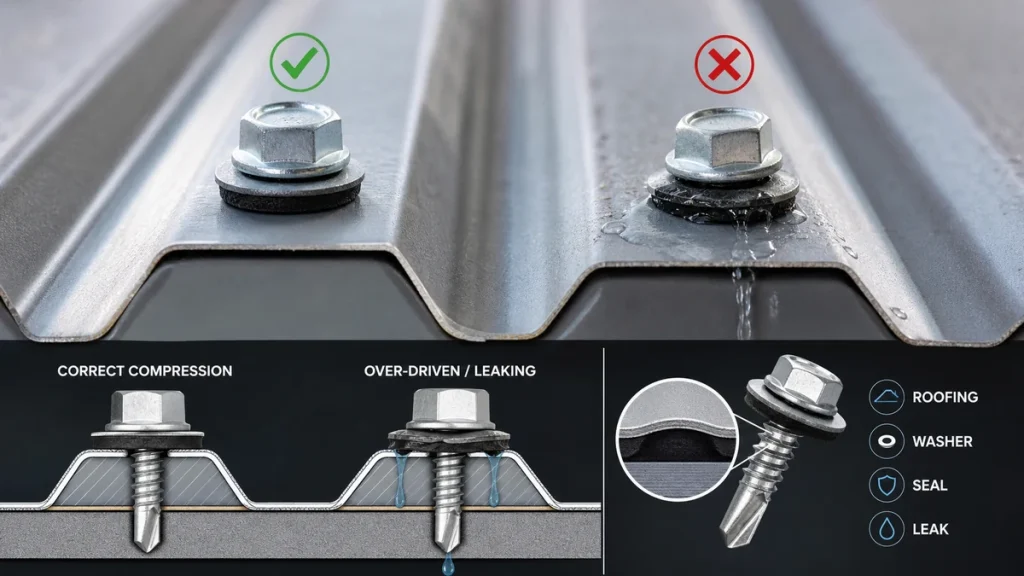
Direct answer: Correct screw length does not guarantee a watertight metal-roof connection. Self tapping roofing screws can leak because of incorrect washer compression, enlarged or stripped holes, insufficient thread engagement, panel movement, or an unsuitable coating-and-washer system. Buyers should diagnose the complete installed connection—including panel profile, support thickness, point type, washer condition, and exposure—rather than […]

What Is the Difference Between Self Drilling and Self Tapping Screws?

What Is the Difference Between Self Drilling and Self Tapping Screws?

Direct Answer: A self-drilling screw has a drill-shaped point that creates a hole and then forms mating threads in a suitable material. A self-tapping screw forms or cuts mating threads but may require a correctly sized pilot hole. Selection depends on substrate type and thickness, joint stack, point geometry, installation tool, finish and application testing—not […]

Frequently Asked Questions

Are these suitable for structural or safety-critical fastening?

Visible period-style fasteners are generally selected for restoration appearance and ordinary assembly, not assumed to be suitable for load-bearing or safety-critical work. Confirm the required mechanical performance and choose a purpose-designed fastener where the connection carries significant loads.

When are reclaimed pieces preferable to new reproductions?

Reclaimed pieces can suit museum-style repairs or projects where authentic wear, patina, and variation are important. New reproductions are usually the more practical choice when several screws must match in dimensions, finish, and installation behavior.

Does an aged finish make any screw compatible with old hardware?

No. Surface appearance does not correct a mismatch in head profile, drive, diameter, length, or thread form. Check the screw against the existing hole and hardware before treating the finish as the deciding factor.

What should I send when asking for a quotation?

Provide the quantity, application, required dimensions, material thickness, and clear photographs with a ruler or caliper for scale. State whether you need consistent reproduction pieces or naturally varied reclaimed items, and identify any preference for head style, drive, material, or surface treatment.

Can a different drive style be used if the head and finish look right?

It may fit mechanically, but a different drive can change the visible character of the hardware and may not suit the existing installation method. For exposed restoration work, match the drive as well as the head and finish unless the fastener will remain concealed.

Leave Your Message

Please share the application, required dimensions or a photo with a scale, and whether you need consistent reproduction screws or varied reclaimed pieces.