Hole Saw Cutter Sets for Metal | Hebei Wotu Fastener Manufacturing Co., Ltd.

Hole Saw Cutter Sets for Metal

A hole saw cutter set for metal is selected mainly by the metal being cut, the hole diameters required and the arbor that fits your drill or machine. The right combination produces clean openings without buying a set whose sizes or cutting design do not match the job.

For maintenance, fabrication and installation work, compare tooth construction, cutting depth, pilot-drill arrangement and compatibility with the intended tool before choosing a set.

Related Products

Hex thin nut

Hex thin nut

Brand: Wotu Surface: zinc plated Specifications: in stock M8~M64 full standard specifications, covering precision, machinery, and steel structure full size range, supporting nonstandard tooth pitch and customized thickness Matching: Can be matched with bolts of corresponding specifications, flat washer, spring washer complete set of shipment Packing: packed in 25kg cartons and packed on wooden pallets.

Read More
Hot-Dip Galvanized Hex Head Bolt (DIN931 Half Thread / DIN933 Full Thread / GB30 Chinese National Standard Bolt, Can Be Equipped With Nut And Washer Set)

Hot-Dip Galvanized Hex Head Bolt (DIN931 Half Thread / DIN933 Full Thread / GB30 Chinese National Standard Bolt, Can Be Equipped With Nut And Washer Set)

Brand: Wotu Surface: overall hot-dip zinc plating treatment Specifications: Comply with DIN and GB standards, in stock M6-M48 full range of specifications, length 20mm-300mm, supports nonstandard customized. Packaging: woven bag inside / 25kg export carton, film-wrapped wooden pallet; supports neutral packaging and customer private-label customization.

Read More
U-bolt ( / U-bolt, M10/M12/M16/M20/M24 multiple specifications)

U-bolt ( / U-bolt, M10/M12/M16/M20/M24 multiple specifications)

Brand: Wotu Surface: natural black oxide / hot-dip galvanized / blue-white zinc plated, multiple processes available Specifications: Based on common industry drawing parameters, suitable for pipe diameter 25mm~139.7mm, screw diameter M10~M24, total length can be nonstandard customized Matching: can be matched with nut, flat washer and spring washer of the same specifications for complete shipment Packaging: Bundling and packaging + 25kg export carton, full-container wooden pallet wrapped with film, supports private-label export packaging

Read More
Hexagonal Wood Screws

Hexagonal Wood Screws

Brand: Wotu Surface: blue and white zinc plated Specifications: Chinese national standard 6#/8#/10#/12#/16#/20#, rod length 35mm~250mm full range of specifications in stock, supports nonstandard length customization Packaging: 25kg cartons, full pallets packed on wooden pallets, support neutral packaging, private-label customization

Read More
Blue-White Zinc Plated Winged Countersunk Head Self-Drilling Screw

Blue-White Zinc Plated Winged Countersunk Head Self-Drilling Screw

Brand: Hengzuan Surface: blue and white zinc plated, optional color zinc plated, black oxide treatment Specifications: in stock ST3.5/ST4.2/ST4.8 mainstream specifications, rod length 16~50mm full size range, supports nonstandard length customization, suitable for drilling steel sheets 2~5mm Packaging: 25kg cartons, full pallets packed on wooden pallets, support neutral packaging, private-label customization

Read More
Painted Hex Head Self-Drilling Screw

Painted Hex Head Self-Drilling Screw

Brand: Hengzuan Surface: screw color zinc plated + hex head outdoor paint Specifications: ST5.5, ST6.3, rod length 25mm~120mm in stock, supports nonstandard customization, suitable for drilling steel sheets 2~5mm Packaging: 25kg cartons, whole wooden pallets

Read More

Compare metal compatibility, sizes and arbor fit

Selection criteria

Compare sets by metal compatibility, tooth construction, cutting depth, diameter range, pilot-drill design and arbor fit. The intended tool and workpiece thickness are as important as the nominal hole size, so ask which components are included and which parts can be replaced.

Criterion What To Check Why It Matters Buyer Tip
Metal type and cutting depth Match the hole saw material and tooth design to the workpiece, such as mild steel, stainless steel, aluminum, or sheet metal. Confirm the maximum cut depth for the saw cups in the set. A set that works well on thin mild steel may overheat, dull quickly, or bind in thicker or harder metal. Cut depth also decides whether the saw can pass through tube, plate, or box section in one operation. Ask: Which metals and thickness range is each hole saw in the set intended to cut?
Hole sizes included in the set Compare the included diameters with the holes needed for conduit, pipe, cable glands, bolts, or fittings. Check whether the sizes are metric, inch, or a mixed set. The wrong size range leaves gaps in the job and can force operators to enlarge holes manually, which reduces accuracy and wastes time. Ask: Can you provide the exact diameter list and tolerance for the hole saws in this set?
Arbor, pilot drill, and shank compatibility Confirm the arbor type, pilot drill size, and shank style. Check that they fit the drill press, magnetic drill, or handheld drill planned for the work. A good saw cup still performs poorly if the arbor is loose, the pilot drill wanders, or the shank does not fit the machine chuck. Ask: What arbor and pilot drill are supplied, and are replacements available for this set?
Tooth construction and coating Check whether the cutters use bi-metal teeth, carbide teeth, or another construction, and whether a coating is specified for heat and wear resistance. Tooth construction affects cutting speed, life, edge finish, and suitability for stainless steel or repeated production work. Coatings can help, but only if they match the material and cutting conditions. Ask: For repeated holes in metal, which tooth type do you recommend and what cutting fluid or speed range should be used?
Chip clearance and finish quality Look at cup depth, side slots, tooth pitch, and instructions for clearing chips during cutting. Metal chips build heat quickly. Poor chip clearance can burn the teeth, mark the workpiece, or jam the cutter, especially on deeper holes. Ask: Does the set include guidance for chip removal, coolant use, and preventing burrs on thin sheet metal?

Choose a set for your metal, thickness and hole pattern

The most important distinction is between cutting thin sheet metal and cutting thicker or harder metal. A set intended for light-gauge steel may not suit stainless steel, structural sections or repeated production work. Material hardness and wall thickness affect tooth wear, cutting stability and the useful hole depth.

Set size also matters. A broad assortment can reduce individual purchases, but an application-specific set may offer more useful diameters and a better match for the arbor and pilot drill already used by your team.

Start with the workpiece: identify whether the material is mild steel, stainless steel, aluminium or another metal, then record its thickness. Buyers should confirm that the hole saw's tooth design and cutting depth suit that material rather than choosing only by outside diameter.

List the hole diameters needed for the current job and likely repeat work. A set with many rarely used sizes can add cost and storage without improving productivity. Check the actual diameter range, the increments between sizes and whether replacement hole saws or pilot drills can be obtained separately.

Confirm the arbor connection and pilot-drill arrangement before ordering. The set must match the chuck, adapter or machine in use, and the arbor should hold the selected cup securely. A common mistake is to compare the saw cups but overlook an incompatible arbor, insufficient clearance or a pilot drill that does not suit the workpiece.

For an enquiry, send the metal type, material thickness, required hole diameters and the drill or arbor connection you plan to use. If the cuts are repetitive, also state the expected workload so the supplier can discuss a suitable tooth construction and replacement-part arrangement.

Criteria Importance Description Example Options
Metal type and wall thickness Very important because the workpiece affects tooth wear, cutting stability and suitable cutting depth. Match the set to the material being cut, such as mild steel, stainless steel or aluminium, and to the thickness of the section or sheet. A set suitable for light-gauge mild steel may not be the right choice for thicker stainless steel.
Diameter range and size increments Important for avoiding unused sizes while still covering current and repeat work. Review the actual hole diameters included and whether the spacing between sizes matches the openings required for installation or fabrication. A focused set of frequently used diameters can be more useful than a broad assortment containing many rarely used sizes.
Arbor and pilot-drill compatibility Essential because an incompatible connection can prevent the selected cup from being mounted securely. Confirm the arbor connection, chuck or machine interface, pilot-drill arrangement and available clearance before comparing cup sizes. A cup with the correct cutting diameter is still unsuitable if its arbor does not match the drill or machine in use.
Tooth construction and cutting depth Important for balancing cutting suitability, service life and the required hole depth. Ask which tooth design is intended for the specified metal and whether the cutting depth covers the workpiece without choosing only by nominal diameter. Repeated work in harder metal may require a different tooth construction from occasional openings in thin sheet.
Hole saw versus another cutting tool Important when the job includes different hole sizes, thin sheet or limited access. Compare the circular-hole capacity and arbor requirements of a hole saw with the smaller-hole flexibility of twist drills or the stepped range of a step drill. A step drill may suit a thin-sheet job with several nearby smaller diameters, while a hole saw may be preferable for a larger circular opening.

Blog Articles / Reviews

How to Specify Countersunk Head Cross Thick Thread Fiberboard Screws for Furniture Assembly Projects

How to Specify Countersunk Head Cross Thick Thread Fiberboard Screws for Furniture Assembly Projects

Fiberboard screws are selected based on more than screw size alone. For furniture assembly and board-based applications, buyers need to match the screw structure with the characteristics of fiberboard, MDF, and similar engineered wood materials. A suitable specification should consider thread design, head style, screw length, diameter, installation method, and application requirements. For buyers sourcing […]

How Should Buyers Evaluate Self Tapping Screws for Project Procurement?

How Should Buyers Evaluate Self Tapping Screws for Project Procurement?

#4 self tapping screws should not be purchased from the “#4” designation alone. For a usable B2B specification, the buyer still needs the actual screw diameter, thread form or pitch, overall length, substrate, pilot-hole condition, head and drive style, material, surface finish and quantity. This matters because suppliers may use different naming systems. Wotu Fastener’s […]

Which Self-Tapping Roofing Screw Specification Fits Metal Panels on Steel or Timber?

Which Self-Tapping Roofing Screw Specification Fits Metal Panels on Steel or Timber?

The correct self-tapping roofing screw depends on the complete panel-and-substrate stack-up. Steel supports typically require a point and thread matched to the support thickness and any pilot-hole requirement; timber supports require a wood-appropriate thread and sufficient embedment. In both cases, buyers must define diameter, length, head, sealing washer, material or coating, environment, pull-out requirements, and […]

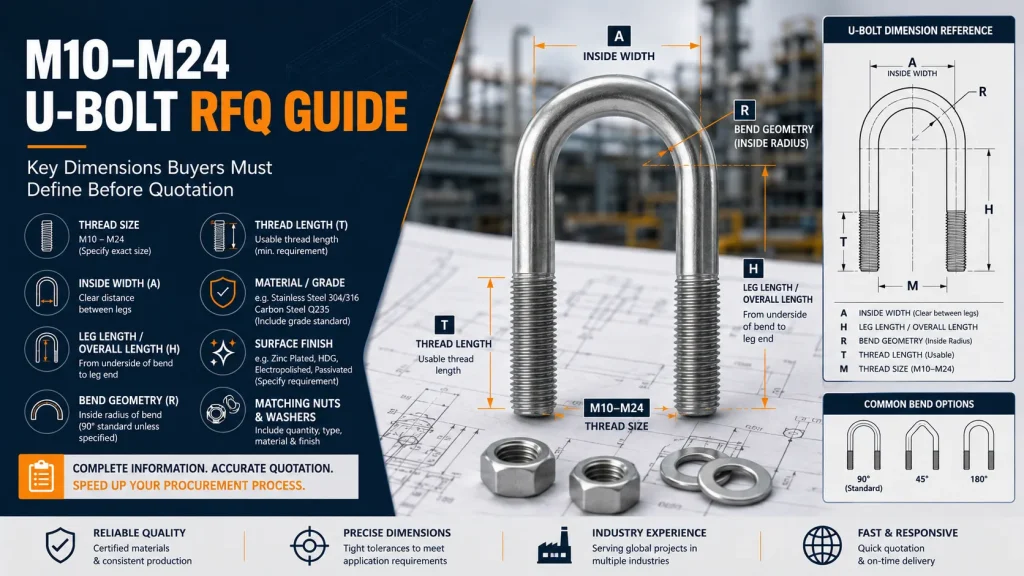
Which M10–M24 U-Bolt Measurements Must Buyers Send Before an RFQ?

Which M10–M24 U-Bolt Measurements Must Buyers Send Before an RFQ?

Direct Answer: For an M10–M24 U-bolt RFQ, buyers should send a dimensioned drawing that defines thread diameter, inside width, leg or overall length, bend geometry, thread length, application diameter, material or grade requirement, surface finish, matching nuts/washers, quantity, and packing needs. Nominal thread size alone is not enough because different measurement datums can produce U-bolts […]

Frequently Asked Questions

Can one set handle mild steel, stainless steel and aluminium?

Not necessarily. Each metal has different cutting and wear characteristics, so confirm that the tooth construction and cutting depth suit the material and wall thickness rather than assuming a general-purpose set will perform equally on all three.

When is a step drill or twist drill a better alternative?

A step drill can be more practical for thin sheet metal and a limited range of smaller openings, while a twist drill suits small holes. A hole saw is usually the more suitable choice for larger circular openings, but it requires enough clearance and a compatible arbor.

Does the hole saw diameter tell me whether it will fit my drill?

No. The stated diameter describes the opening cut by the cup, not the arbor connection or the chuck requirements. Check the arbor, pilot-drill arrangement and available clearance separately before ordering.

What should I provide when requesting a set for a specific job?

Send the metal type, material thickness, required hole diameters and the drill or machine connection available. For repeated cutting, also describe the expected workload so the supplier can advise on tooth construction and replacement parts.

Is a larger assortment always the better purchase?

No. A broad set can be useful for varied installation work, but unused sizes add storage and purchase cost. Compare the actual diameter range and increments with your recurring jobs, and check whether individual cups and pilot drills can be replaced.

Leave Your Message

Tell us the metal type and thickness, the hole diameters you need, and the drill or arbor connection available for the job.