Iron Roof Sheet Fixing Screws | Hebei Wotu Fastener Manufacturing Co., Ltd.

Iron Roof Sheet Fixing Screws

Iron roof sheet projects usually fail or last on two linked decisions: the sheet profile and the fixing method. The sheet must shed water, resist wind uplift and tolerate thermal movement, while the screw and washer must seal the hole without crushing the crest or loosening over time.

If you are matching roof sheets to a steel or timber structure, treat the fastener as part of the roof system rather than a small accessory. The right screw length, drill point, thread type and sealing washer depend on the sheet profile, support material and exposure conditions.

Related Products

Dacromet Hex Head Self-Drilling Screw

Dacromet Hex Head Self-Drilling Screw

Brand: Hengzuan Surface: Dacromet anti-corrosion coating Specifications: in stock ST5.5/ST6.3 mainstream caliber, rod length 50mm~150mm, extended full range of specifications, supports nonstandard extra long customized, suitable for drilling steel sheet thickness 2~6mm Packaging: 25kg export cartons, full pallets wrapped with film, supports neutral export packaging, private-label customization

Read More
Chinese-standard Color Nylon Head Hex Self-Drilling Screw

Chinese-standard Color Nylon Head Hex Self-Drilling Screw

Brand: Hengzuan Surface: screw color zinc plated, head color nylon protective cap, multiple colors available Specifications: Chinese national standard ST5.5, ST6.3 mainstream caliber, rod length 25mm~125mm full range of specifications in stock, supports nonstandard length customization, suitable for drilling steel sheet thickness 2~6mm Packaging: 25kg cartons, full pallets packed on wooden pallets, support neutral packaging, private-label customization

Read More
Hex Head Self-Drilling Screw With Cup Washer

Hex Head Self-Drilling Screw With Cup Washer

Brand: Hengzuan Surface: color zinc plated Specifications: in stock ST5.5/ST6.3 regular diameter, rod length 19mm~75mm in stock, supports nonstandard customized, suitable for drilling steel sheet thickness 2~5mm Packaging: carton packaging, full pallets wooden pallet packaging, support neutral packaging, private-label customization

Read More
Hex Head Self-Drilling Screw

Hex Head Self-Drilling Screw

Brand: Hengzuan Surface: color zinc plated Specifications: ST4.2/ST4.6/ST4.8/ST5.5/ST6.3, length 80mm~165mm in stock Packaging: 25kg cartons, packed in whole pallets, supports neutral private-label

Read More
White Zinc Plated Hex Head Self-Drilling Screw

White Zinc Plated Hex Head Self-Drilling Screw

Brand: Hengzuan Surface: blue and white zinc plated, optional black oxide, color zinc plated coating Specifications: in stock 4.2/4.8/5.5/6.3mm wire diameter, length 16mm~165mm full size range, supports nonstandard customized rod length Packaging: 25kg export cartons, full-container wooden pallets wrapped with film, supports neutral packaging, private-label customization

Read More
Hex Head No. 5 Point Self-Drilling Screw

Hex Head No. 5 Point Self-Drilling Screw

Brand: Wotu Surface: blue and white zinc plated, customized color zinc plated, Dacromet anti-corrosion coating available Specifications: ST5.5, ST6.3 mainstream specifications, rod length 20mm~125mm, full size range in stock, support nonstandard customization, drilling to adapt to steel sheet 2-6mm Packaging: 25kg cartons, whole wooden pallets

Read More

Roof Sheet Fixing Criteria That Affect Sealing and Hold

Selection criteria

Useful selection criteria for an iron roof sheet fixing package include the support material, sheet profile, coating compatibility, screw point style, thread engagement, washer material and installation method. These factors are more useful than choosing by screw length alone, because the same roof sheet can require different fasteners on steel and timber frames.

Criterion What To Check Why It Matters Buyer Tip
Sheet profile and rib shape Compare the roof sheet profile with the fixing position required by the project, such as crest fixing or valley fixing. The rib height and shape affect water runoff, screw seating, washer compression, and how the sheet overlaps at side laps. Ask: Where should the fastener sit on this iron roof sheet profile, and does the washer seal flat at that point?
Base structure under the sheet Confirm whether the roof sheet will fasten into steel purlins, timber battens, or another support material. The support material changes the suitable screw point, thread type, drilling behavior, and holding strength. Ask: Is the recommended roofing screw different for steel and timber supports on this sheet?
Sheet thickness and lap build-up Check the single sheet thickness and the combined thickness at end laps, side laps, and flashing areas. A screw that works on one sheet layer may be too short, too long, or poorly seated where two or more layers overlap. Ask: What screw length is recommended for the thickest lap condition, not just the main field area?
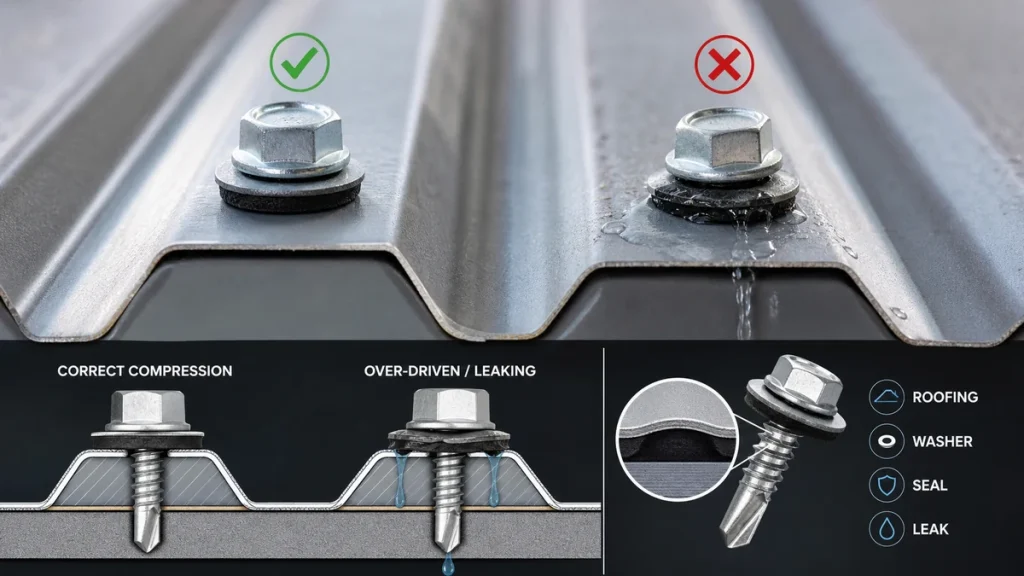
Sealing washer fit Review the washer material, washer diameter, and how it compresses against the iron roof sheet surface. Leaks often come from poor washer seating, over-driving, under-driving, or fixing on an uneven part of the profile. Ask: What washer type is suitable for this roof sheet coating and profile, and how should installers judge correct compression?
Coating compatibility and corrosion exposure Confirm the sheet finish and the roof environment, including coastal air, industrial exposure, or frequent condensation. Mismatched fastener coating, washer material, or sheet finish can shorten service life and stain the roof surface. Ask: Is the proposed screw coating compatible with the iron roof sheet finish and the site exposure?

Choosing Screws for Iron Roof Sheets on Steel or Timber

The practical distinction is between choosing the roof sheet and choosing the fixing detail. Sheet thickness, coating and profile affect span, appearance and corrosion resistance; the screw specification affects pull-out strength, water sealing and installation speed. A good sheet can still leak if the fastener is too short, over-driven, set at the wrong angle or paired with a poor washer.

For iron roof sheets on steel purlins, buyers usually need self-drilling or self-tapping roofing screws suited to metal supports. For timber battens, the thread form and embedment matter more. Confirm the substrate before ordering, because a screw that bites well in timber may not drill cleanly or hold correctly in steel.

Start with the roof build-up: sheet profile, crest height, overlap method, insulation layer if any, and the support material underneath. These details change the required screw length and washer seating. A common mistake is selecting length from the visible sheet thickness only, then finding that the screw does not engage enough material below the sheet.

Match the point and thread to the structure. Metal purlins call for a drilling or tapping action that can penetrate the support without wandering. Timber structures need a thread that grips the batten without stripping it. If the project uses both steel and timber areas, separate the fastener requirements instead of forcing one screw across the whole roof.

Pay close attention to sealing. The washer must compress evenly against the roof sheet, not split, buckle or sit on a rib edge. Over-driving can deform the washer and sheet; under-driving can leave a water path. Installation guidance should cover screw position, driving angle and torque control, not just the nominal screw size.

Before requesting a quote, prepare the sheet profile, substrate type, roof layer thickness, expected exposure to rain or corrosion, and the planned fixing position on the sheet. Ask Hebei Wotu Fastener Manufacturing Co., Ltd. which roofing screw type and washer option they would recommend for those conditions, and whether samples or installation guidance are available for checking fit before bulk purchase.


Criteria Importance Description Example Options
Support material Usually decisive The substrate determines whether the screw needs to drill into steel or bite into timber. Using the wrong point or thread can cause poor holding strength, difficult installation or early loosening. A metal purlin roof may need a self-drilling roofing screw, while a timber batten roof may need a screw with thread engagement suited to wood.
Sheet profile and fixing position High for sealing and fit Crest height, rib shape and where the screw is placed affect the required screw length and how the washer sits on the sheet. A washer that cannot sit flat is more likely to leak. A high-rib profile may require a different fastener length from a shallow corrugated sheet even if both use similar sheet material.
Washer seating and compression Critical for water resistance The washer must compress enough to seal but not so much that it splits, bulges or deforms the sheet. Installation torque and driving angle strongly affect the result. An over-driven screw can damage the washer; an under-driven screw can leave a visible gap for rainwater.
Total build-up thickness Important for selecting length The screw must pass through the roof sheet and any overlap, spacer or insulation layer before engaging the support. Selecting length from sheet thickness alone is a common mistake. A roof with an insulation layer below the sheet will usually need a different length than a single sheet fixed directly to a purlin.
Exposure conditions Important for durability Rain, condensation, industrial air or coastal exposure can influence the preferred coating, washer material and corrosion resistance requirements. These should be confirmed before purchase rather than treated as an afterthought. A farm shed, warehouse roof and coastal storage building may need different fastener and washer considerations even if the roof sheet profile looks similar.

Product Selection

Related Options

For a warehouse, shed, farm building or light industrial roof, the main priority is a sealed fixing that holds through weather and movement without damaging the sheet. Focus on roofing screws and washers that suit the actual panel profile and purlin material rather than looking for a general-purpose fastener for every iron roof sheet job.

Blog Articles / Reviews

Which Self-Tapping Roofing Screw Specification Fits Metal Panels on Steel or Timber?

Which Self-Tapping Roofing Screw Specification Fits Metal Panels on Steel or Timber?

The correct self-tapping roofing screw depends on the complete panel-and-substrate stack-up. Steel supports typically require a point and thread matched to the support thickness and any pilot-hole requirement; timber supports require a wood-appropriate thread and sufficient embedment. In both cases, buyers must define diameter, length, head, sealing washer, material or coating, environment, pull-out requirements, and […]

Why Do Self-Tapping Roofing Screws Leak Even When the Screw Length Looks Correct?

Why Do Self-Tapping Roofing Screws Leak Even When the Screw Length Looks Correct?

Direct answer: Correct screw length does not guarantee a watertight metal-roof connection. Self tapping roofing screws can leak because of incorrect washer compression, enlarged or stripped holes, insufficient thread engagement, panel movement, or an unsuitable coating-and-washer system. Buyers should diagnose the complete installed connection—including panel profile, support thickness, point type, washer condition, and exposure—rather than […]

Frequently Asked Questions

Can the same roofing screw be used for both steel purlins and timber battens?

Not always. Steel supports usually need a drilling or tapping point that can cut into metal cleanly, while timber battens need thread engagement that grips without splitting or stripping the wood. If a roof includes both substrates, it is safer to confirm separate screw specifications for each area.

Why can a roof leak even if the screw length seems correct?

Length is only one part of the seal. Leaks can come from an over-compressed washer, an under-driven screw, poor screw angle, a washer sitting on an uneven rib, or a screw that fails to hold tightly in the support. The washer seat and installation method matter as much as the nominal screw size.

Is a longer screw always better for fixing roof sheets?

No. A screw must have enough engagement in the purlin or batten, but excessive length can slow installation, increase cost and create avoidable fitting problems. The correct choice depends on sheet profile height, any overlap or insulation layer, and the material underneath.

What should be checked before ordering fasteners for a corrugated or ribbed sheet roof?

Confirm the sheet profile, fixing position, total layer thickness, support material and expected exposure conditions. These details help determine screw length, point type, thread style and washer choice. A drawing or sample of the roof sheet profile can reduce guesswork.

Should fixing be done on the crest or the flat area of the sheet?

That depends on the sheet profile, roof design and the installation method specified for the system. The key is that the washer must sit evenly and seal without deforming the sheet. Ask for guidance based on the actual profile rather than assuming one fixing position suits every roof.

Leave Your Message

Share the roof sheet profile, the support material such as steel purlin or timber batten, and the total layer thickness to be fixed. Include any exposure concerns such as heavy rain, coastal air or insulation layers so the screw and washer choice can be checked properly.