Nut Fastener Selection for Bolted Assemblies | Hebei Wotu Fastener Manufacturing Co., Ltd.

Nut fasteners for bolted assemblies

A nut fastener has to match the bolt, the joint space and the load path, not just the thread size. For a buyer choosing hex nuts, thin nuts, locking arrangements or standard-pattern nuts, the main decision is how much thread engagement, bearing area and installation clearance the assembly can accept.

Small changes in nut height, standard, material or surface finish can affect tightening behavior and service life. Before asking Hebei Wotu Fastener Manufacturing Co., Ltd. for a quotation, it helps to define the assembly conditions clearly rather than treating all nuts as interchangeable hardware.

Related Products

Hex nut (Chinese national standard GB52-1976)

Hex nut (Chinese national standard GB52-1976)

Brand: Wotu Surface: 304 stainless steel Specifications: in stock M6~M24 full standard metric specifications, supports nonstandard pitch, thickening/customized Matching: Can be matched with bolts of corresponding specifications, flat washer, spring washer complete set of supporting shipment Packaging: 25kg cartons, whole wooden pallets

Read More
Hex flange nut (Chinese national standard GB/T6177.1-2000)

Hex flange nut (Chinese national standard GB/T6177.1-2000)

Brand: Wotu Surface: zinc plated Specifications: in stockM6/M8/M10/M12/M14/M16/M20 Chinese national standardfull range of specifications, support nonstandard thickness, tooth pitch customized Matching: can be matched with bolts of the same specification, flat washer, spring washer complete set of shipment Packaging: 25kg cartons, whole wooden pallets

Read More
Grade 8/Grade 10 High-strength Black Oxide Hex Nut (DIN934/GB Chinese National Standard Thickened Nut)

Grade 8/Grade 10 High-strength Black Oxide Hex Nut (DIN934/GB Chinese National Standard Thickened Nut)

Brand: Wotu Surface: quenching and tempering heat treatment + high temperature black oxide anti-rust treatment Specifications: Comply with DIN934, GB/T6170 standards, in stock M6-M48 full range of specifications, nonstandard sizes can be customized Packaging: 25kg carton/woven bag inner packaging, whole wooden pallet wrapped with film for export packaging, supports neutral/private-label customization packaging

Read More
Hot-Dip Galvanized Hex Nut (DIN934 Thickened/GB Thin Nut In Multiple Specifications)

Hot-Dip Galvanized Hex Nut (DIN934 Thickened/GB Thin Nut In Multiple Specifications)

Brand: Wotu Surface: high temperature hot dip zinc plated surface treatment Specifications: Comply with DIN934, GB/T6170, GB/T6172.1 Chinese national standard German standard, in stock M6-M64 full range of specifications, length is nonstandard customized as required Packaging: 25kg woven bag/export carton, full-container wooden pallet wrapped with film, supports neutral packaging, private-label customization

Read More
Hot-Dip Galvanized Hex Head Bolt (DIN931 Half Thread / DIN933 Full Thread / GB30 Chinese National Standard Bolt, Can Be Equipped With Nut And Washer Set)

Hot-Dip Galvanized Hex Head Bolt (DIN931 Half Thread / DIN933 Full Thread / GB30 Chinese National Standard Bolt, Can Be Equipped With Nut And Washer Set)

Brand: Wotu Surface: overall hot-dip zinc plating treatment Specifications: Comply with DIN and GB standards, in stock M6-M48 full range of specifications, length 20mm-300mm, supports nonstandard customized. Packaging: woven bag inside / 25kg export carton, film-wrapped wooden pallet; supports neutral packaging and customer private-label customization.

Read More
Chinese National Standard / German Standard Hex Nut (thick Nuts, Thin Nuts, Flange Nuts, Multiple Categories)

Chinese National Standard / German Standard Hex Nut (thick Nuts, Thin Nuts, Flange Nuts, Multiple Categories)

Brand: Wotu Surface: color zinc plated, blue-white zinc plated, black oxide, hot-dip galvanized, various surface treatments available Specifications: Comply with DIN934, GB/T6170, GB/T6172.1, GB/T6177.1 standards, in stock M6-M64 full range of specifications, support nonstandard customized Packaging: woven bag inside/25kg export carton, full-container wooden pallet wrapped with film, supports private-label, neutral export packaging

Read More

Nut fastener selection points for bolted assemblies

Selection notes

Nut fastener selection should compare thread form, dimensional standard, nut height, material grade, surface finish and the way the nut will be tightened. The right choice depends on the mating bolt, available space, vibration exposure and whether the nut is a primary fastening element or part of a locking arrangement.

Criterion What To Check Why It Matters Buyer Tip
Nut style for the joint layout Compare standard hex nuts, thin hex nuts, flange nuts, lock nuts, or other required styles against the drawing and available wrench space. Nut height, bearing face, and locking method change how the fastener fits, clamps, and resists loosening in the assembly. Ask: Which nut style is specified on the drawing, and is the joint space-limited or exposed to vibration?
Thread standard and mating bolt fit Confirm thread system, nominal size, pitch, tolerance class, and whether the nut must match Chinese, German, ISO, DIN, ANSI, or another standard. A nut can appear correct by size but fail to assemble smoothly or achieve proper clamp load if the thread standard or tolerance does not match the bolt. Ask: Can you match this nut to the bolt standard, size, pitch, and tolerance shown in our specification?
Material and strength grade Review the required material and property class or grade, then match it to the bolt strength and service load. A nut that is too weak may strip; a nut that is mismatched to the bolt can make inspection, torque control, and joint reliability harder. Ask: What nut grade should pair with our bolt grade for this application?
Surface treatment and service environment Identify the finish needed for corrosion resistance, appearance, or assembly behavior, such as zinc plating, black oxide, hot-dip galvanizing, or plain finish if suitable. Coatings affect corrosion protection, thread fit, friction during tightening, and compatibility with the mating bolt or washer. Ask: Which finish is appropriate for indoor, outdoor, wet, or chemically exposed use, and will it still assemble with the selected bolt?
Inspection and packing requirements Define the drawing revision, standard, quantity, marking needs, inspection documents, and packaging method before ordering. Clear order details reduce mix-ups between similar nuts, especially where several sizes, grades, and finishes are used in one project. Ask: Can you quote against our drawing or standard and confirm labeling, batch traceability, and packing details before shipment?

Key choices before ordering hex nuts or thin nuts

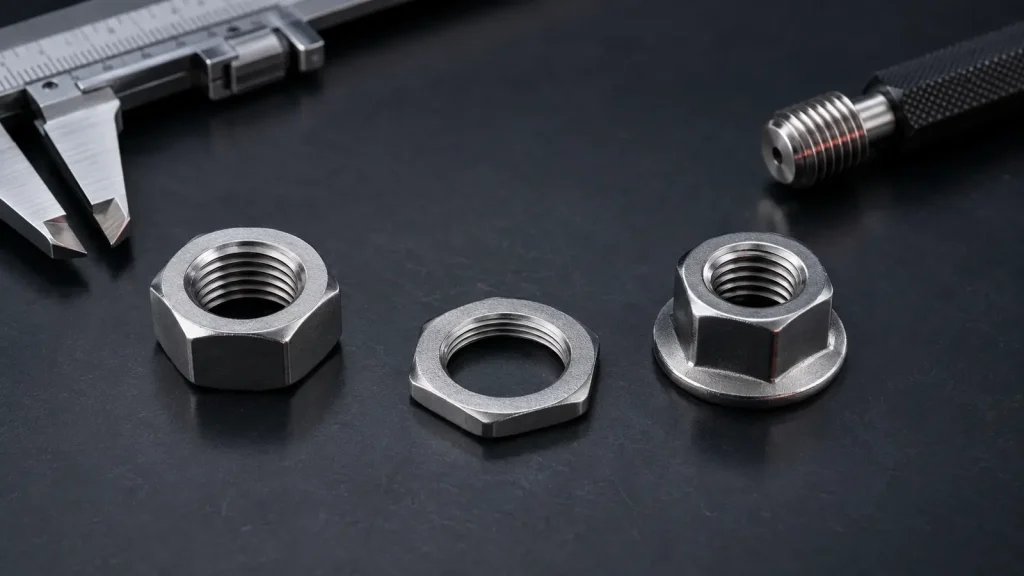
The most useful distinction is between a standard hex nut and a thin hex nut. A standard hex nut gives more thread engagement and is usually the safer default for general bolted joints. A thin nut saves height and can be used in space-limited assemblies or as a jam nut, but it may not provide the same thread engagement as a full-height nut.

Standard systems also matter. A nut made to one national or regional standard may have different dimensions, across-flats size, height or tolerance expectations from another. If the nut must fit existing bolts, tools or drawings, confirm the standard first instead of ordering by diameter alone.

Start with the mating bolt and drawing. Confirm thread diameter, pitch, thread direction, tolerance class and the standard referenced on the drawing. A nut can look correct but fail the purchase requirement if the thread series or dimensional standard does not match the bolt.

Choose nut height for the assembly, not only for cost. Standard hex nuts suit many structural and equipment joints because they provide more engagement. Thin nuts are useful where space is restricted or where a locknut arrangement is planned, but they should be reviewed carefully for the expected clamp load and vibration conditions.

Match finish to the environment and the mating parts. Zinc plating, black oxide, plain finish or other treatments may affect corrosion resistance, appearance, friction and compatibility with the bolt. Avoid mixing finishes without checking whether torque, galling risk or corrosion behavior will change in service.

Give the supplier a usable inquiry. Send the nut standard, size, grade or material requirement, finish, quantity, packing preference and application notes. If the part is for repair or replacement, include a sample photo, drawing or current part marking so the quotation can be checked against the real assembly.

Criteria Importance Description Example Options
Nut height Often critical for joint strength and space Standard-height nuts generally provide more thread engagement, while thin nuts reduce installed height but may not suit every primary fastening point. Use a standard hex nut for a general bolted joint; consider a thin nut where clearance is limited or as part of a jam nut pair.
Dimensional standard Essential when matching drawings, bolts and tools The referenced standard affects dimensions such as nut height and across-flats size. Ordering by thread size alone can lead to fit problems. A maintenance buyer replacing an existing nut should match the drawing standard or sample, not only the nominal diameter.
Thread specification Must match the mating bolt Diameter, pitch, tolerance class and thread direction determine whether the nut will assemble correctly and carry load as intended. A metric coarse-thread bolt requires a nut with the corresponding metric coarse thread, not simply a visually similar nut.
Material and grade Important for load capacity and compatibility The nut material and strength grade should suit the bolt and the expected joint load. A stronger bolt does not automatically make the joint suitable if the nut grade is mismatched. For a specified equipment assembly, confirm the required grade from the drawing or engineering note before substituting stock hardware.
Surface finish Important for environment and tightening behavior Finish selection can influence corrosion resistance, appearance and friction during tightening. It should be compatible with the bolt, washer and service conditions. For outdoor or humid conditions, ask what finish options are suitable rather than assuming a plain steel nut will be acceptable.

Product Selection

Related Options

For equipment builders, steel fabricators and maintenance buyers, the priority is usually fit and repeatability: the nut must run correctly on the bolt, seat properly on the surface and meet the drawing standard. A clear specification helps narrow the choice between standard hex nuts, thin nuts and other nut styles for the actual joint.

Blog Articles / Reviews

Hex Thin Nut vs Standard Hex Nut: Which Fits Space-Limited or Locking Assemblies?

Hex Thin Nut vs Standard Hex Nut: Which Fits Space-Limited or Locking Assemblies?

Direct Answer: Choose a hex thin nut when reduced nut height is genuinely required by the assembly or when the engineering design specifies it as part of a locking arrangement. Choose a standard hex nut when full nut height, normal thread engagement, and the specified load-bearing function are required. Buyers should compare nut height, thread […]

How Should Buyers Select Chinese and German Standard Hex Nuts?

How Should Buyers Select Chinese and German Standard Hex Nuts?

Direct Answer: Select a hex nut by the exact standard number and edition, thread diameter and pitch, nut style, property class, material, finish, mating bolt and acceptance method. “Chinese standard” or “German standard” alone is not a complete specification. Regular, thick, thin and flange nuts can differ in geometry and load behavior, so buyers should […]

Oxidation Treatment Specifications for Self-Drilling Screw Fasteners

Oxidation Treatment Specifications for Self-Drilling Screw Fasteners

The surface treatment of self-drilling screws requires specific procedures. What manufacturing processes are generally used for surface treatment? Hebei Wotu Fastener Manufacturing Co., Ltd. will explain oxidation treatment below. The surface treatment of self-drilling screws requires specific procedures. What manufacturing processes are generally used for surface treatment? Hebei Wotu Fastener Manufacturing Co., Ltd. will explain […]

National Standards for Self-Drilling Screws – Fasteners

National Standards for Self-Drilling Screws – Fasteners

When using fasteners, are you familiar with the standards governing them? Today, Hebei Wotu Fastener Manufacturing Co., Ltd. will discuss the national standards for fasteners with you. Let’s take a look. 1. Standards for Fastener Product Dimensions: These specifically define the basic dimensions of the product; for threaded products, this also includes the basic dimensions […]

Frequently Asked Questions

Can a thin nut replace a standard hex nut?

Only if the joint can accept reduced thread engagement and bearing height. Thin nuts are useful where height is limited or where a jam nut arrangement is planned, but a standard hex nut is usually the safer default for a primary load-bearing joint.

What information is most important before asking for a quotation?

Provide the thread diameter and pitch, nut standard, material or grade requirement, finish, quantity and application conditions. If the nut must fit an existing bolt or drawing, include the drawing reference or a sample photo so the dimensional standard can be checked.

Is thread size enough to identify the correct nut?

No. Two nuts with the same nominal thread can differ in height, across-flats dimension, tolerance, chamfer style or standard system. The mating bolt, tool clearance and drawing requirement should all be confirmed before ordering.

How should I choose between different standards for hex nuts?

Start with the standard already used in the assembly or specified on the drawing. Chinese, German and other standards may define different dimensions or tolerances, so changing standards can affect wrench fit, seating area and interchangeability with existing stock.

Does the surface finish change how the nut performs?

Yes, finish can affect corrosion resistance, appearance and tightening behavior. For example, a plated nut may behave differently from a plain or blackened nut during torque tightening, so the nut finish should be considered together with the bolt finish and service environment.

Leave Your Message

Send the nut size and thread pitch, the required standard or drawing, and the finish or application environment. If you are replacing an existing part, include a photo or sample details so the nut can be checked against the mating bolt.