Short Fat Screws for Shallow Joints | Hebei Wotu Fastener Manufacturing Co., Ltd.

Short Fat Screws for Shallow Joints

Short fat screws are compact fasteners with relatively large diameters, used when a joint needs strong thread engagement without a long screw projecting through the assembly. The key purchase decision is not simply the overall length: match the screw diameter, thread form, head, drive and material to the substrate and joint thickness.

For furniture panels, fiberboard, softwood or other compact assemblies, the right geometry can improve holding power and reduce the risk of protrusion. A screw that is too short may not engage enough material, while one that is too thick or aggressively driven may split the substrate or damage the head.

Related Products

Hexagonal Wood Screws

Hexagonal Wood Screws

Brand: Wotu Surface: blue and white zinc plated Specifications: Chinese national standard 6#/8#/10#/12#/16#/20#, rod length 35mm~250mm full range of specifications in stock, supports nonstandard length customization Packaging: 25kg cartons, full pallets packed on wooden pallets, support neutral packaging, private-label customization

Read More

Hex Head Self-Drilling Screw With Bonded Washer

Hex Head Self-Drilling Screw With Bonded Washer

Brand: Hengzuan Surface: blue and white zinc plated, color zinc plated can be customized on request Specifications: in stock 4.2/4.8/5.5/6.3mm mainstream wire diameter, length 20mm~165mm full range of specifications, nonstandard rod length, drill point size can be customized Packaging: 25kg export cartons, full pallets wrapped with film, supports neutral export packaging, customer private-label customization

Read More

Dacromet Hex Head Self-Drilling Screw

Dacromet Hex Head Self-Drilling Screw

Brand: Hengzuan Surface: Dacromet anti-corrosion coating Specifications: in stock ST5.5/ST6.3 mainstream caliber, rod length 50mm~150mm, extended full range of specifications, supports nonstandard extra long customized, suitable for drilling steel sheet thickness 2~6mm Packaging: 25kg export cartons, full pallets wrapped with film, supports neutral export packaging, private-label customization

Read More

7-letter, 9-letter L-shaped anchor bolt (Chinese national standard GB/T799-1988 embedded anchor screw)

7-letter, 9-letter L-shaped anchor bolt (Chinese national standard GB/T799-1988 embedded anchor screw)

Brand: Wotu Surface: Natural black oxide treatment, customized hot-dip galvanized, zinc plated as required Specifications: Follow Chinese national standard GB/T799-1988, in stock M12-M48, total length 120mm~1500mm, nonstandard customized diameter, bending length, total screw length available Matching: Nuts, flat washers and spring washers of the same specification can be supplied in complete sets. Packaging: Bundling and packaging, using wooden pallets and film-wrapped export packaging in large quantities

Read More
Blue-White Zinc Plated Pan Head With Pad Self-Tapping Screw

Blue-White Zinc Plated Pan Head With Pad Self-Tapping Screw

Brand: Hengzuan Surface: blue and white zinc plated Specifications: in stock ST4.2/ST4.8full range of specifications, length 13~50mm in stock, support nonstandard length customization Packaging: 25kg cartons, solid wood packaging, support neutral packaging, private-label customization

Read More

Compare diameter, length and head fit for shallow joints

Screw selection points

Compare short fat screws by nominal diameter and length first, then review thread profile, point style, head bearing area, drive recess, material and finish. The correct choice depends on the substrate, edge distance, installation method and whether the joint needs a flush appearance or maximum bearing under the head.

Criterion What To Check Why It Matters Buyer Tip
Diameter and usable length Compare the screw diameter and the length below the head against the joint thickness. A short screw needs enough thread engagement, while a larger diameter increases holding area but may split brittle material. Ask: What minimum thread engagement is recommended for our material and joint thickness?
Thread form and pitch Confirm whether the threads are coarse, fine, or designed for a specific material. Coarse threads usually suit wood and board; fine or specialized threads may suit metal or pre-tapped holes better. Ask: Which thread profile is intended for our substrate, and is a pilot hole required?
Head shape and seating Check the head diameter, head style, and whether it should sit flush or remain above the surface. A countersunk head can finish flush, while a pan or truss head can spread clamping force where countersinking is unsuitable. Ask: Will the selected head seat correctly without damaging the workpiece or attached part?
Drive recess and installation access Verify the drive type and recess depth with the bit and driver used on the assembly line. A suitable recess reduces bit slip and helps transfer torque to a short, thick screw without damaging the head. Ask: Which driver bit and installation torque should operators use for this screw?
Material and surface finish Confirm the screw material and finish against indoor, damp, outdoor, or chemically exposed use. The finish affects corrosion resistance, appearance, and suitability for the surrounding material; it does not replace correct joint design. Ask: What environment was this material and finish selected for, and is a different finish needed for our application?

Specify short large-diameter screws without splitting or breakthrough

The practical distinction is between a screw that is short because the joint is shallow and a screw that is short but unusually large in diameter. The first mainly limits penetration depth; the second changes thread engagement, withdrawal resistance and the risk of splitting or material breakout.

Specify the actual diameter and length instead of relying on the description “short fat.” Also confirm whether the screw must sit flush, remain visible, pass through a clearance hole, or form its own thread. These details determine the suitable head and thread design.

Start with the joint. Measure the combined thickness of the parts being joined and allow for the required thread engagement without allowing the point to emerge. For a panel assembly, check the distance from the screw line to the edge; a large diameter can increase splitting risk even when the length appears correct.

Match the thread to the material. Coarser threads can suit softer or fibrous materials, while a different thread form may be needed for metal or a pre-drilled assembly. Do not substitute a self-drilling screw for a self-tapping or wood-oriented screw simply because the overall size looks similar; the point and thread perform different jobs.

Choose the head and drive for the installation. A countersunk head is useful where a flush surface matters, but it can remove material around the hole and may weaken a thin panel if driven too deeply. A pan or similar raised head may provide a broader bearing surface. Confirm the drive type and bit fit to reduce cam-out and damaged heads during repeated assembly.

Confirm the specification before ordering. Send the material, joint thickness, required screw length and diameter, head or drive preference, and exposure conditions to the supplier. Ask for confirmation of the available geometry, finish and sample suitability rather than ordering from the informal size description alone.

Criteria Importance Description Example Options
Diameter versus edge distance Critical where the screw is close to an edge or used in thin panel stock A larger diameter can add holding power, but it also places more stress on the surrounding material. The available edge distance and material density should guide how large the screw can be. A compact screw for a furniture side panel may need a conservative pilot hole and enough material around the thread to avoid splitting.
Thread form and substrate High because holding strength depends on how the thread bites into the receiving material Coarse or deep threads may suit softer and fibrous materials, while metal or pre-drilled assemblies may need a different thread design. The same outside size can perform very differently in wood, fiberboard and sheet metal. A screw that grips well in fiberboard may not be the right choice for fastening into a metal bracket without a suitable pilot or tapping design.
Head style Important for surface finish, bearing area and risk of material damage Countersunk heads create a flush finish but require enough material for the countersink. Raised or broader heads spread load over the surface and can be safer on thin or soft materials. A flush furniture joint may call for a countersunk head, while a bracket on a soft panel may benefit from a wider bearing head.
Point style Important when deciding whether the screw enters a pilot hole, cuts its own thread or drills through material The point affects starting, alignment and material removal. Choosing by length alone can lead to poor engagement, cracked material or an unsuitable hole in metal. A self-drilling point may be useful for certain sheet metal work, while a wood or fiberboard joint may need a different point and thread combination.
Drive recess and installation method Practical for production assembly and repeatable tightening The drive must fit the tool and torque level. A poor bit fit can strip the recess, damage the finish or make consistent assembly difficult. For repeated assembly work, confirm the drive type and matching bit rather than accepting a visually similar screw head.

Blog Articles / Reviews

How to Specify Countersunk Head Cross Thick Thread Fiberboard Screws for Furniture Assembly Projects

How to Specify Countersunk Head Cross Thick Thread Fiberboard Screws for Furniture Assembly Projects

Fiberboard screws are selected based on more than screw size alone. For furniture assembly and board-based applications, buyers need to match the screw structure with the characteristics of fiberboard, MDF, and similar engineered wood materials. A suitable specification should consider thread design, head style, screw length, diameter, installation method, and application requirements. For buyers sourcing […]

How Should Buyers Evaluate Self Tapping Screws for Project Procurement?

How Should Buyers Evaluate Self Tapping Screws for Project Procurement?

#4 self tapping screws should not be purchased from the “#4” designation alone. For a usable B2B specification, the buyer still needs the actual screw diameter, thread form or pitch, overall length, substrate, pilot-hole condition, head and drive style, material, surface finish and quantity. This matters because suppliers may use different naming systems. Wotu Fastener’s […]

Why Do Self-Tapping Roofing Screws Leak Even When the Screw Length Looks Correct?

Why Do Self-Tapping Roofing Screws Leak Even When the Screw Length Looks Correct?

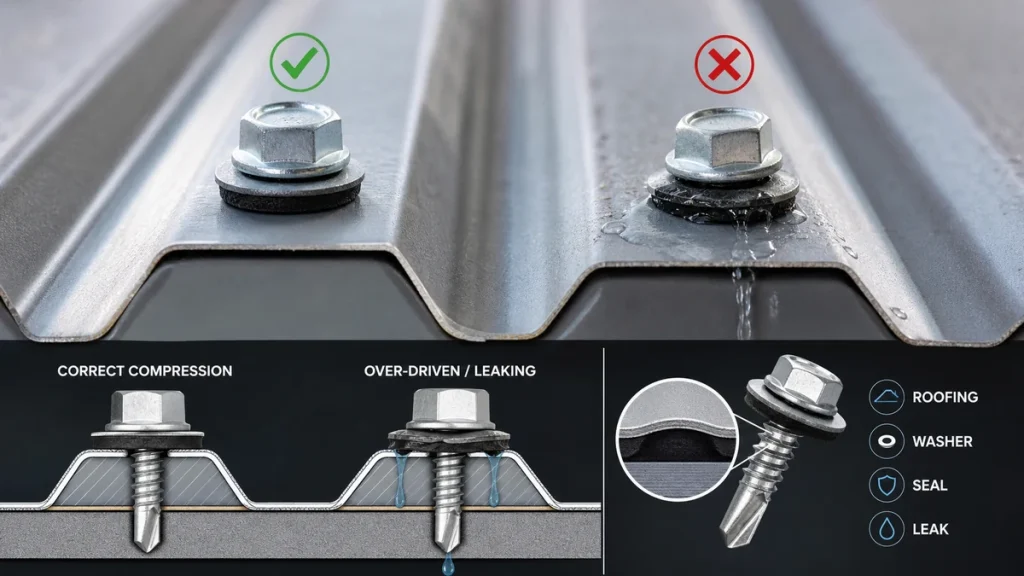
Direct answer: Correct screw length does not guarantee a watertight metal-roof connection. Self tapping roofing screws can leak because of incorrect washer compression, enlarged or stripped holes, insufficient thread engagement, panel movement, or an unsuitable coating-and-washer system. Buyers should diagnose the complete installed connection—including panel profile, support thickness, point type, washer condition, and exposure—rather than […]

What Is the Difference Between Self Drilling and Self Tapping Screws?

What Is the Difference Between Self Drilling and Self Tapping Screws?

Direct Answer: A self-drilling screw has a drill-shaped point that creates a hole and then forms mating threads in a suitable material. A self-tapping screw forms or cuts mating threads but may require a correctly sized pilot hole. Selection depends on substrate type and thickness, joint stack, point geometry, installation tool, finish and application testing—not […]

Frequently Asked Questions

Where are short, large-diameter screws most useful?

They suit shallow joints where a standard long screw may break through the back of the part, but the assembly still needs strong thread engagement. Common examples include panel assemblies, furniture parts, brackets on thin stock and applications where a wider screw body gives better holding than a narrow fastener of the same length.

Is a thicker screw always stronger in a short joint?

Not always. A larger diameter can improve pull-out resistance, but it can also split wood, bulge fiberboard or weaken a thin edge if the pilot hole, edge distance or driving torque is wrong. The best choice balances diameter, thread depth and available material around the hole.

Should I choose a countersunk head or a pan head?

Choose a countersunk head when the screw must sit flush with the surface, such as in furniture or trim work. Choose a pan, washer or other raised head when you want more bearing area and less risk of the head cutting into a thin or soft surface.

Are self-tapping and self-drilling versions interchangeable?

No. A self-drilling screw has a drill point for certain metal-to-metal applications, while a self-tapping screw forms or cuts threads in a prepared or suitable material. For shallow wood, fiberboard or mixed-material joints, the point style and thread form should match the substrate rather than the general screw size.

What information should I send before asking for a quotation?

Send the required diameter and length, the materials being fastened, total joint thickness, pilot hole plan if any, head style, drive type and finish requirement. If the size is described informally as “short fat,” include a drawing, sample or exact dimensions so the supplier can confirm the closest available specification.

What is a common mistake with shallow screw applications?

A common mistake is checking only the total screw length and ignoring the usable thread engagement. The head height, point shape, clearance hole and countersink depth can all reduce how much thread actually holds in the receiving material.

Leave Your Message

For an enquiry, provide the substrate, combined joint thickness and required screw diameter and length. Also state whether you need a flush head, a particular drive or finish, and the intended installation method.