Stud Bolt Size Guide | Hebei Wotu Fastener Manufacturing Co., Ltd.

Choosing the Right Stud Bolt Size

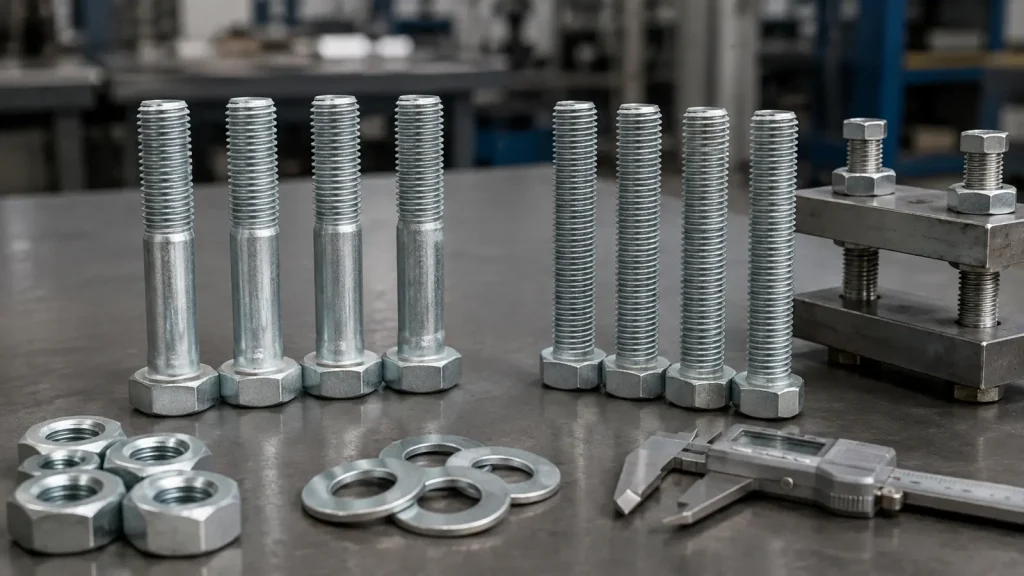
Stud bolt size affects fit-up, clamping length, nut engagement, and installation clearance. A correct size is more than the nominal thread diameter; buyers also need the overall length, thread standard, material grade, coating, nut and washer requirements, and the joint details the stud will serve.

For flanged joints, steel structures, machinery bases, and pipe supports, the main decision is usually not “larger or smaller,” but which size gives enough thread engagement and usable clamping length without bottoming out, interfering with nearby parts, or leaving too much exposed thread.

Related Products

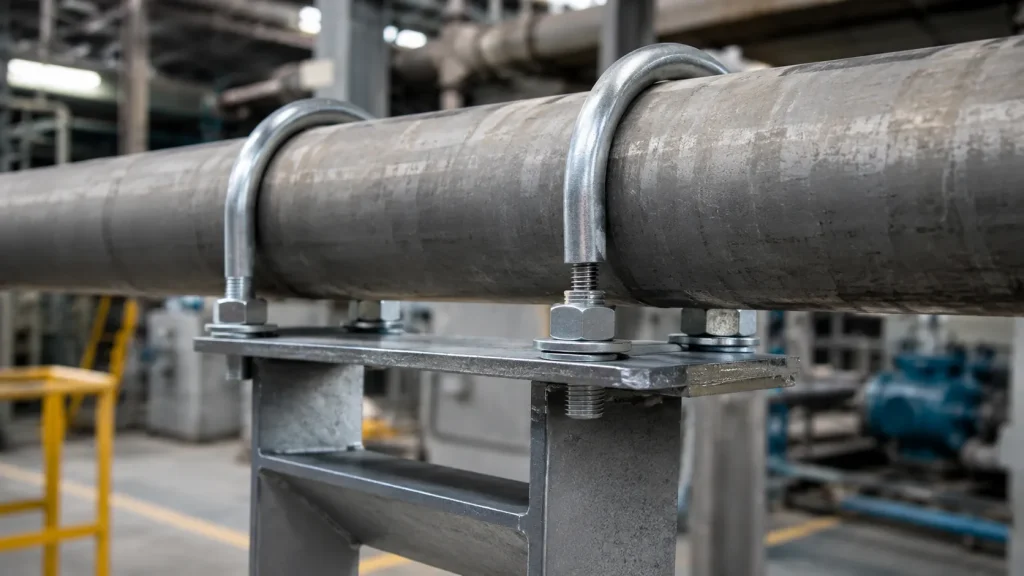
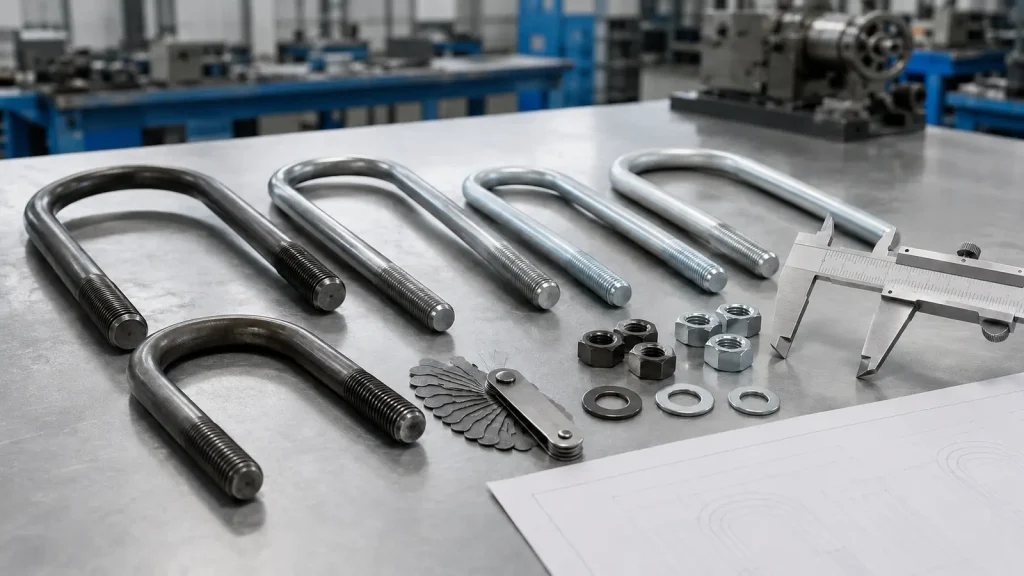
U-bolt ( / U-bolt, M10/M12/M16/M20/M24 multiple specifications)

U-bolt ( / U-bolt, M10/M12/M16/M20/M24 multiple specifications)

Brand: Wotu Surface: natural black oxide / hot-dip galvanized / blue-white zinc plated, multiple processes available Specifications: Based on common industry drawing parameters, suitable for pipe diameter 25mm~139.7mm, screw diameter M10~M24, total length can be nonstandard customized Matching: can be matched with nut, flat washer and spring washer of the same specifications for complete shipment Packaging: Bundling and packaging + 25kg export carton, full-container wooden pallet wrapped with film, supports private-label export packaging

Read More
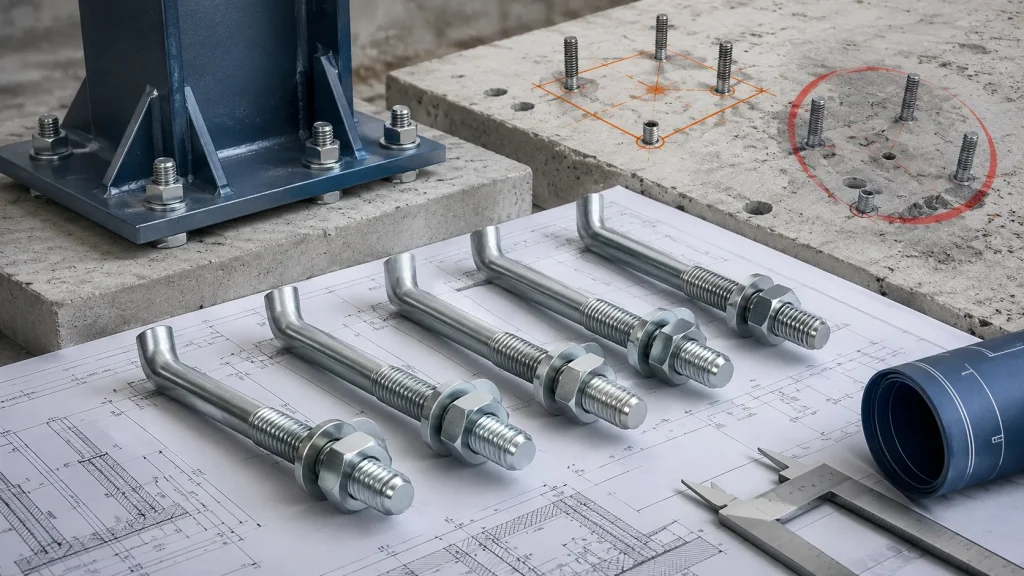
7-letter, 9-letter L-shaped anchor bolt (Chinese national standard GB/T799-1988 embedded anchor screw)

7-letter, 9-letter L-shaped anchor bolt (Chinese national standard GB/T799-1988 embedded anchor screw)

Brand: Wotu Surface: Natural black oxide treatment, customized hot-dip galvanized, zinc plated as required Specifications: Follow Chinese national standard GB/T799-1988, in stock M12-M48, total length 120mm~1500mm, nonstandard customized diameter, bending length, total screw length available Matching: Nuts, flat washers and spring washers of the same specification can be supplied in complete sets. Packaging: Bundling and packaging, using wooden pallets and film-wrapped export packaging in large quantities

Read More
Hot-Dip Galvanized Hex Head Bolt (DIN931 Half Thread / DIN933 Full Thread / GB30 Chinese National Standard Bolt, Can Be Equipped With Nut And Washer Set)

Hot-Dip Galvanized Hex Head Bolt (DIN931 Half Thread / DIN933 Full Thread / GB30 Chinese National Standard Bolt, Can Be Equipped With Nut And Washer Set)

Brand: Wotu Surface: overall hot-dip zinc plating treatment Specifications: Comply with DIN and GB standards, in stock M6-M48 full range of specifications, length 20mm-300mm, supports nonstandard customized. Packaging: woven bag inside / 25kg export carton, film-wrapped wooden pallet; supports neutral packaging and customer private-label customization.

Read More
Grade 8/Grade 10 High-strength Black Oxide Hex Nut (DIN934/GB Chinese National Standard Thickened Nut)

Grade 8/Grade 10 High-strength Black Oxide Hex Nut (DIN934/GB Chinese National Standard Thickened Nut)

Brand: Wotu Surface: quenching and tempering heat treatment + high temperature black oxide anti-rust treatment Specifications: Comply with DIN934, GB/T6170 standards, in stock M6-M48 full range of specifications, nonstandard sizes can be customized Packaging: 25kg carton/woven bag inner packaging, whole wooden pallet wrapped with film for export packaging, supports neutral/private-label customization packaging

Read More
Chinese National Standard / German Standard Hex Nut (thick Nuts, Thin Nuts, Flange Nuts, Multiple Categories)

Chinese National Standard / German Standard Hex Nut (thick Nuts, Thin Nuts, Flange Nuts, Multiple Categories)

Brand: Wotu Surface: color zinc plated, blue-white zinc plated, black oxide, hot-dip galvanized, various surface treatments available Specifications: Comply with DIN934, GB/T6170, GB/T6172.1, GB/T6177.1 standards, in stock M6-M64 full range of specifications, support nonstandard customized Packaging: woven bag inside/25kg export carton, full-container wooden pallet wrapped with film, supports private-label, neutral export packaging

Read More
Hot-Dip Galvanized Hex Nut (DIN934 Thickened/GB Thin Nut In Multiple Specifications)

Hot-Dip Galvanized Hex Nut (DIN934 Thickened/GB Thin Nut In Multiple Specifications)

Brand: Wotu Surface: high temperature hot dip zinc plated surface treatment Specifications: Comply with DIN934, GB/T6170, GB/T6172.1 Chinese national standard German standard, in stock M6-M64 full range of specifications, length is nonstandard customized as required Packaging: 25kg woven bag/export carton, full-container wooden pallet wrapped with film, supports neutral packaging, private-label customization

Read More

Stud Bolt Size Details That Affect Fit and Assembly

Size and specification guide

When comparing stud bolt options, focus on the size callout, thread form, total length, material grade, surface finish, and whether nuts and washers must be supplied as a matched set. These details determine whether the fastener will assemble cleanly and carry the intended load.

Criterion What To Check Why It Matters Buyer Tip
Nominal thread diameter Confirm the stud bolt diameter by standard callout, such as M, UNC, or other project-specified thread series. Diameter must match the nut, tapped hole, flange, or equipment connection; a close-looking size can still be unusable. Ask: What exact thread designation and standard should the stud bolt follow?
Overall length and usable thread length Verify whether the specified length is overall length, thread-to-thread length, or an application-specific effective length. Too short may not allow full nut engagement; too long may interfere with nearby parts or waste space in assemblies. Ask: Should the length be measured end to end, and what nut engagement is required after assembly?
Thread pitch and thread form Compare coarse, fine, metric, imperial, and any required tolerance class before ordering. Stud bolts with the same diameter can have different pitches, and mismatched pitch can damage threads during installation. Ask: Is the required pitch and tolerance class shown on the drawing or purchase specification?
End style and chamfer Confirm whether both ends are fully threaded, whether one end is shorter, and whether chamfered or rounded starts are required. End style affects how easily the nut starts, how the stud seats, and whether it fits blind holes or flange assemblies. Ask: Are both threaded ends identical, or does the application need a tap-end and nut-end configuration?
Allowance for coating thickness If the stud bolt is plated, galvanized, or otherwise coated, confirm thread fit after coating with the mating nut. Coating can change thread clearance, especially on larger or hot-dip galvanized fasteners, and may require matched nuts. Ask: Should the stud bolts be supplied with compatible nuts tested for fit after coating?

Choosing the Right Stud Bolt Size for Your Joint

The most common confusion is between nominal diameter and usable length. A stud bolt described as M20 or 3/4 inch only tells you the thread diameter. It does not tell you how long the stud is, how much thread is available, or whether the thread form matches the nut, flange, or tapped hole.

Length matters because different joint types measure studs differently. A fully threaded stud, a double-end stud, and a stud used with two nuts may all have the same diameter but need different length calculations. If the order only says the diameter, the buyer risks receiving a fastener that cannot be tightened properly on site.

Start with the thread system. Confirm metric or inch series before choosing the stud bolt size. For metric orders, state the diameter and pitch if the pitch is not standard. For inch orders, include thread count and standard. Mixing thread systems or assuming the pitch is “obvious” is a common cause of nut mismatch.

Define the length from the joint, not from memory. Check the flange thickness, gasket or spacer thickness, washer stack, nut height, and required thread projection. A stud that is slightly short may not provide enough nut engagement; a stud that is too long can hit adjacent equipment or create handling problems during assembly.

Match size with grade, coating, and service conditions. Higher-strength material, hot-dip galvanizing, stainless steel, or other finishes can change the practical fit of the thread and nut combination. If coated studs are required, confirm that matching nuts are suitable for the coating and thread allowance.

Send a complete inquiry instead of a partial size callout. A practical next step is to provide the stud diameter, thread standard, total length, material grade, finish, quantity, nut and washer requirements, and a drawing or joint description if the application is not standard.


Criteria Importance Description Example Options
Nominal diameter Essential for matching the joint, nut, washer, and design requirements. The diameter identifies the basic thread size, but it must be considered with the joint load, hole or tapped-hole details, and available installation space. A callout such as M20 or 3/4 inch identifies a diameter family, not the complete order specification.
Thread system and pitch Essential because an incorrect thread form prevents proper nut engagement. State metric or inch threading and include the pitch or thread count when it is not unambiguous. Do not assume a metric or inch nut will match another thread system. A metric diameter with its pitch is clearer than a diameter alone; an inch callout should include its thread count and standard.
Total length and usable clamping length Critical for achieving nut engagement without bottoming out or leaving excessive exposed thread. Calculate from the joint stack, including flange or plate thickness, gasket or spacer, washers, nuts, and the required thread projection. The measurement method can differ for fully threaded and double-end studs. A stud for a thicker flange assembly may need additional length even when the thread diameter stays unchanged.
Stud configuration Important for installation method, tapped-hole engagement, and clearance around the joint. Compare fully threaded, double-end, and other required configurations according to how the stud enters the joint and where the nuts must sit. A tapped equipment connection may require defined engagement at one end, while a through-joint may allow a fully threaded arrangement.
Material, finish, and matched accessories Important for service conditions and reliable assembly. Confirm the material grade and surface finish together with compatible nuts and washers. Coatings, stainless materials, or other finishes can affect thread fit and accessory selection. If a coated stud is specified, request nuts intended for that finish rather than automatically reusing uncoated fasteners.

Product Selection

Related Options

For pipe flanges, equipment foundations, and structural connections, the priority is a stud bolt size that matches the joint stack and installation space. A clear drawing or measurement set helps confirm the correct diameter, length, thread, and accessory combination before production or purchase.

Blog Articles / Reviews

Anchor Bolts: 7 Ordering Errors That Cause Site Rework

Anchor Bolts: 7 Ordering Errors That Cause Site Rework

ost anchor bolt ordering errors come from incomplete drawings, unclear dimensions, unsuitable material or coating choices, undefined tolerances, and mismatched nuts or washers. These mistakes affect steel fabricators, EPC contractors, equipment installers, importers, and distributors because anchor bolts are usually embedded before the connected structure arrives on site. Once concrete has cured, even a small […]

Why Do U Bolts Loosen in Pipe Supports? 6 Causes and Prevention Methods

Why Do U Bolts Loosen in Pipe Supports? 6 Causes and Prevention Methods

U bolts usually loosen in pipe supports because the connection loses clamping force, receives continuous vibration, restricts thermal pipe movement, uses an incorrectly sized U bolt, experiences surface settlement, or suffers from corrosion and inadequate inspection. This issue affects EPC contractors, pipe installers, industrial maintenance teams, equipment manufacturers and fastener distributors working with water, oil […]

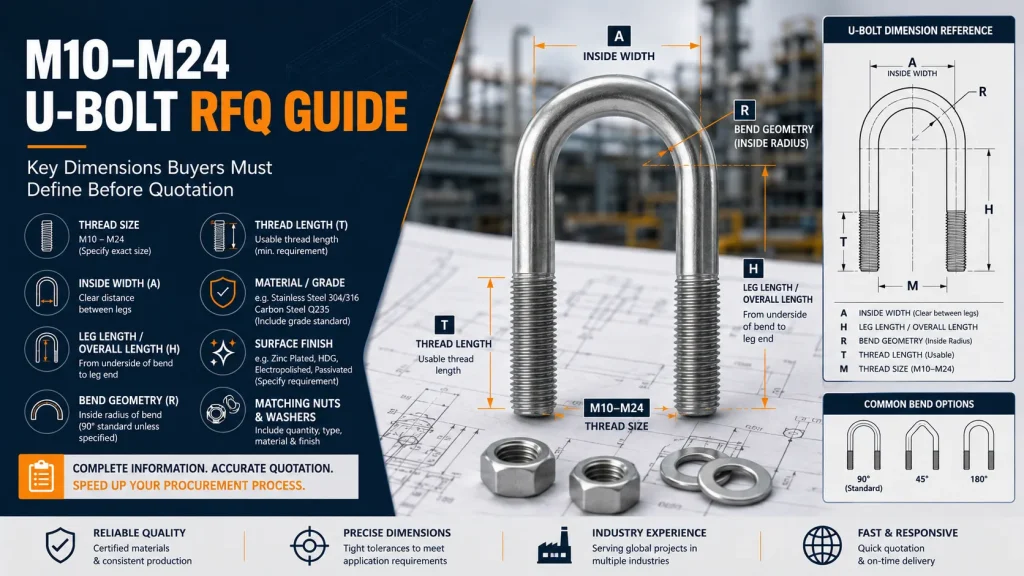
Which M10–M24 U-Bolt Measurements Must Buyers Send Before an RFQ?

Which M10–M24 U-Bolt Measurements Must Buyers Send Before an RFQ?

Direct Answer: For an M10–M24 U-bolt RFQ, buyers should send a dimensioned drawing that defines thread diameter, inside width, leg or overall length, bend geometry, thread length, application diameter, material or grade requirement, surface finish, matching nuts/washers, quantity, and packing needs. Nominal thread size alone is not enough because different measurement datums can produce U-bolts […]

What Should Buyers Verify When Comparing Bolt Manufacturers?

What Should Buyers Verify When Comparing Bolt Manufacturers?

A bolt manufacturer should be evaluated against a defined joint, drawing and acceptance plan—not a product list or unit price alone. Buyers need to verify whether the supplier can manufacture the required geometry, control material and heat-treatment requirements where applicable, manage threads and coatings as one dimensional system, inspect critical characteristics, preserve batch traceability and […]

DIN 931 vs DIN 933 Hex Bolts: What Should Buyers Confirm Before Bulk Ordering?

DIN 931 vs DIN 933 Hex Bolts: What Should Buyers Confirm Before Bulk Ordering?

DIN 931-style half-thread and DIN 933-style full-thread hex bolts should not be selected from diameter and overall length alone. The practical choice depends on the joint stack, required grip, location of the thread transition, available nut engagement, mating hardware, material or property requirement, coating system and governing product specification. A half-thread bolt is not automatically […]

The Widespread Application of Hot-Dip Galvanized Bolts in Daily Life

The Widespread Application of Hot-Dip Galvanized Bolts in Daily Life

Hot-dip galvanized bolts are widely used in daily life, especially due to their advantages, which have led to their rapid development in the market and widespread consumer appeal. So what are the specific advantages of hot-dip galvanized bolts in use? Today, Hebei Wotu Fastener Manufacturing Co., Ltd. will discuss this with you. 1. Due to […]

Frequently Asked Questions

How do I choose a stud for a flanged pipe joint?

Measure the complete joint stack, including flange thickness, gasket or spacer, washers, nuts, and the thread projection needed after tightening. Then confirm the diameter, thread standard, total length, material grade, and finish as one specification rather than selecting by diameter alone.

Is a fully threaded stud always the best alternative to a double-end stud?

No. A fully threaded stud can suit joints that need flexible nut positioning along the threaded length, while a double-end stud may be better for a tapped hole or equipment connection with a defined engagement at each end. The choice depends on the joint design, available clearance, and how the fastener will be installed.

Does an M20 or 3/4 inch callout define the complete fastener size?

No. It normally identifies the nominal thread diameter, but not the pitch or thread count, total length, thread extent, material, finish, or matching nut requirements. Those additional details determine whether the part fits and can be tightened correctly.

What information should I send for a quotation?

Provide the diameter, metric or inch thread standard, pitch or thread count, total length, material grade, surface finish, quantity, and any nut or washer requirements. A joint drawing or measurements showing the flange, spacer, washer, nut, and required thread projection can resolve sizing questions before production.

Can a coated stud use the same nuts as an uncoated stud?

Do not assume they are interchangeable. Coating thickness and the selected thread allowance can affect assembly, so confirm that the nuts are intended to match the stud finish and thread condition, especially when ordering a complete fastening set.

Leave Your Message

Send the required diameter and thread standard, total stud length, material grade and finish, plus any nut or washer requirements. If possible, include the joint drawing or flange details so the usable clamping length can be checked.