Tata Metal Roofing Sheet Selection Guide | Hebei Wotu Fastener Manufacturing Co., Ltd.

Fasteners for tata metal roofing sheet installation

A tata metal roofing sheet is usually chosen for a roof where corrosion protection, panel profile, coating finish and long-term weather sealing all matter. The sheet itself is only one part of the decision; the fixing method has a direct effect on leaks, wind uplift resistance and service life.

For buyers planning a metal roof, the key question is not only which sheet profile to buy, but which screw, washer, drill point and coating match the sheet, purlin material and site exposure.

Related Products

Hex thin nut

Hex thin nut

Brand: Wotu Surface: zinc plated Specifications: in stock M8~M64 full standard specifications, covering precision, machinery, and steel structure full size range, supporting nonstandard tooth pitch and customized thickness Matching: Can be matched with bolts of corresponding specifications, flat washer, spring washer complete set of shipment Packing: packed in 25kg cartons and packed on wooden pallets.

Read More

Hex Head Self-Drilling Screw With Cup Washer

Hex Head Self-Drilling Screw With Cup Washer

Brand: Hengzuan Surface: color zinc plated Specifications: in stock ST5.5/ST6.3 regular diameter, rod length 19mm~75mm in stock, supports nonstandard customized, suitable for drilling steel sheet thickness 2~5mm Packaging: carton packaging, full pallets wooden pallet packaging, support neutral packaging, private-label customization

Read More
Wafer Head Self-Drilling Screw

Wafer Head Self-Drilling Screw

Brand: Hengzuan Surface: blue and white zinc plated, can be customized color zinc plated, black oxide plated Specifications: Comply with GB/T15856.2 Chinese national standard, in stock ST3.5/ST4.2/ST4.8/ST5.5 mainstream wire diameter, rod length 13mm~50mm full range of specifications, nonstandard length customization on demand, drilling applicable plate thickness 2~5mm Packaging: 25kg export cartons, full pallets wrapped with film, supports neutral export packaging, private-label customization

Read More
Countersunk Head Blue-White Zinc Plated Self-Drilling Screw (Chinese National Standard: Phillips Countersunk Head Self-Drilling And Self-Tapping Screw GB/T15856.2-2002)

Countersunk Head Blue-White Zinc Plated Self-Drilling Screw (Chinese National Standard: Phillips Countersunk Head Self-Drilling And Self-Tapping Screw GB/T15856.2-2002)

Brand: Hengzuan Surface: blue and white zinc plated, can be customized color zinc plated, black oxide plated Specifications: Comply with GB/T15856.2-2002 Chinese national standard, in stock ST4.2/ST4.8/ST5.5 full range of specifications, length 13mm~75mm optional, supports customized nonstandard rod lengths; drilling adaptation plate thickness 0.7~6mm Packaging: 25kg export cartons, full pallets wrapped with film, supports neutral export packaging, customer private-label customization

Read More
Countersunk Head Blue Zinc Self-Drilling Screw

Countersunk Head Blue Zinc Self-Drilling Screw

Brand: Hengzuan Surface: blue and white zinc plated, can be customized color zinc plated, black oxide plated Specifications: in stock 3.5/3.9/4.2/4.8/5.5 mainstream wire diameter, rod length 13mm~75mm full size range, nonstandard length can be customized as needed Packaging: 25kg export cartons, full wooden pallets wrapped with film, supports neutral export packaging, private-label customization

Read More

Fastener choices for tata metal roofing sheet installation

Roofing fastener selection

Relevant selection criteria include the support material, screw type, drill point, thread pattern, washer material, head style, coating and required installed length. For roofing work, the right choice should fasten the sheet securely without damaging the panel profile or compromising the weather seal.

Criterion What To Check Why It Matters Buyer Tip
Roof sheet profile and crest height Confirm the Tata metal roofing sheet profile, rib spacing, and whether screws fix through the crest or valley. The sheet shape changes screw position, washer seating, and the length needed to reach the purlin without poor compression. Ask: Which exact sheet profile and fixing position will the installer use?
Purlin material under the sheet Verify whether the roof sheets fasten into steel purlins, timber members, or a pre-drilled structure. Metal-to-metal and metal-to-wood fixing often need different screw points and thread forms; the wrong type can strip, stall, or loosen. Ask: Are the purlins steel or timber, and what thickness or section will the screw bite into?
Screw length and sealing washer fit Match screw length to sheet profile, washer thickness, insulation if used, and the required embedment into the support. A screw that looks long enough may still leak if the washer is not compressed correctly or the thread does not engage the base material properly. Ask: Can you recommend the screw length based on the sheet profile, support material, and any insulation layer?
Drilling method on site Decide whether installers need self-drilling screws or self-tapping screws used with pilot holes. Self-drilling screws can save drilling steps in suitable metal sections, while self-tapping screws may be chosen where pilot holes are required or specified. Ask: Will the crew drill pilot holes, or should the fastener drill and tap in one operation?
Corrosion and weather exposure Review roof location, rain exposure, coastal or industrial conditions, and compatibility with the sheet coating. Fastener coating and washer material affect service life and help prevent staining, rust, and water entry around fixings. Ask: What screw coating and washer material do you recommend for the project environment and sheet finish?

What to confirm before fixing metal roof sheets

The practical distinction is between selecting the roofing sheet and selecting the fastening system for that sheet. A sheet supplier may specify the panel thickness, coating and profile, while the fastener choice must match the substrate below it, such as steel purlins, timber supports or pre-drilled assemblies.

This matters because an incorrect screw can still appear to install correctly but fail at the washer, strip the substrate, under-drill, over-drill or create a leak path. For tata metal roofing sheet installation, confirm the sheet profile, support material and required fixing position before choosing self-drilling or self-tapping roofing screws.

Start with the roof build-up. A metal sheet fixed to steel purlins usually needs a different drill point and thread form than a sheet fixed to timber. If the roof has insulation, spacers or overlapping sheets, screw length should be checked against the full stack, not just the visible panel thickness.

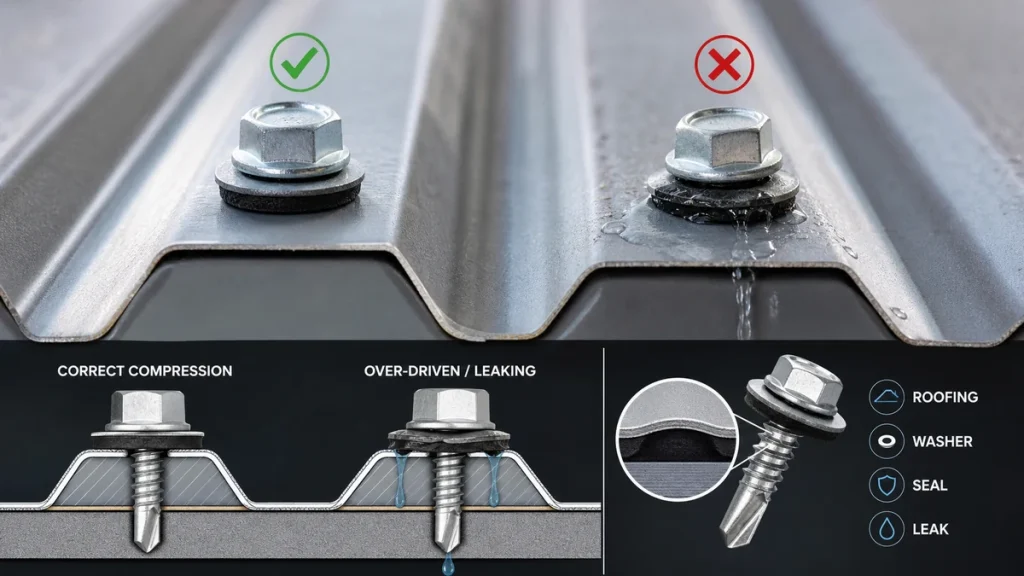
Match the washer to the application. A roofing screw relies on controlled washer compression to seal around the hole. Too little compression leaves a gap; too much can deform the washer or the sheet. This is a common cause of leakage even when the screw length looks reasonable.

Check coating compatibility. Outdoor roofing fasteners should be selected with attention to corrosion exposure, sheet coating, local environment and expected maintenance. Avoid mixing materials or coatings without checking galvanic risk, especially on coastal, industrial or high-humidity projects.

Before sending an inquiry, prepare the sheet profile, approximate sheet thickness, purlin material, roof environment and fixing location. If the tata metal roofing sheet supplier has an installation recommendation, share it so the fastener can be matched to the roof system rather than chosen by appearance alone.

Criteria Importance Description Example Options
Support material High importance because the substrate determines how the screw forms its thread and develops holding strength. Separate metal-to-metal, metal-to-timber and pre-drilled applications before selecting the fastener. A screw selected for steel purlins should not automatically be substituted for one intended for timber supports.
Self-drilling or self-tapping design Important for installation method, hole preparation and compatibility with the support. Self-drilling designs include a drilling point for suitable metal assemblies; self-tapping designs may be used where the material or a prepared hole allows the screw to form its thread. A pre-drilled connection may call for a different point and thread arrangement from a sheet fixed directly to a steel support.
Washer and weather seal Critical because a mechanically secure fixing can still leak if the washer does not seal correctly. Check washer material, diameter, flexibility and compression against the sheet profile and fixing location. A washer that is too loosely compressed may leave a water path, while excessive tightening may deform the sheet or washer.
Corrosion and coating compatibility Important for exposed roofs and for assemblies containing different metals or protective coatings. Compare the fastener finish and washer materials with the sheet coating and the site's humidity, salt or industrial exposure. A coastal or high-humidity roof may require closer review of material and coating compatibility than an enclosed, low-exposure application.
Installed length and roof build-up Important because the screw must pass through the complete assembly and engage the support without creating avoidable sealing or installation problems. Account for the sheet, overlaps, insulation, spacers and any other layers rather than measuring only the visible panel. A fixing through an insulated roof build-up may need a different length from one passing through a single sheet into the same type of support.

Blog Articles / Reviews

Which Self-Tapping Roofing Screw Specification Fits Metal Panels on Steel or Timber?

Which Self-Tapping Roofing Screw Specification Fits Metal Panels on Steel or Timber?

The correct self-tapping roofing screw depends on the complete panel-and-substrate stack-up. Steel supports typically require a point and thread matched to the support thickness and any pilot-hole requirement; timber supports require a wood-appropriate thread and sufficient embedment. In both cases, buyers must define diameter, length, head, sealing washer, material or coating, environment, pull-out requirements, and […]

Why Do Self-Tapping Roofing Screws Leak Even When the Screw Length Looks Correct?

Why Do Self-Tapping Roofing Screws Leak Even When the Screw Length Looks Correct?

Direct answer: Correct screw length does not guarantee a watertight metal-roof connection. Self tapping roofing screws can leak because of incorrect washer compression, enlarged or stripped holes, insufficient thread engagement, panel movement, or an unsuitable coating-and-washer system. Buyers should diagnose the complete installed connection—including panel profile, support thickness, point type, washer condition, and exposure—rather than […]

Frequently Asked Questions

Can these roofing sheets be fixed to both steel and timber supports?

The suitable fastener depends on the support material beneath the sheet. Steel purlins may require a drill point and thread suited to metal, while timber generally needs a thread that can form a secure hold without relying on metal drilling.

When is a self-drilling screw preferable to a self-tapping screw?

A self-drilling screw can be useful where the assembly requires the screw to create its own hole in the metal support. A self-tapping screw may suit a pre-drilled assembly or another application where the hole is already prepared; the sheet and support details should be checked before choosing.

Does choosing the correct screw length prevent roof leaks?

No. Length is only one part of the sealing decision. Washer material, washer compression, fixing position, sheet overlap and installation control also affect whether water can enter around the fastener.

How should the washer and coating be matched to the roof?

The washer should seal the hole without being under-compressed or crushed, and its material should be suitable for outdoor exposure. The fastener coating should also be checked against the sheet coating and site environment to reduce corrosion or material-compatibility problems.

What information should be included when requesting suitable fasteners?

Provide the sheet profile, approximate sheet thickness, support material, overlap arrangement, fixing location and roof environment. Also state whether the assembly is pre-drilled and identify any insulation, spacer or other layer that affects the required installed length.

Leave Your Message

Share the sheet profile, support material and roof environment. If available, include the sheet thickness, overlap detail and whether the fixing is into steel, timber or a pre-drilled assembly.