GI Nut Selection for Threaded Assemblies | Hebei Wotu Fastener Manufacturing Co., Ltd.

GI nut selection for threaded assemblies

A GI nut is generally specified for a threaded assembly that needs a zinc-coated surface, often to improve resistance to moisture and outdoor exposure. The main buying decision is not the name alone: confirm the nut's thread standard, size, coating process and compatibility with the mating bolt.

For equipment, steelwork, enclosures or general construction, the correct GI nut should fit the joint without thread interference and provide a coating suitable for the surrounding environment. A thin nut may solve a clearance problem, but it should not replace a full-height nut when the joint depends on sufficient thread engagement.

Related Products

Hex nut DIN934-1987 (A/B accuracy classification)

Hex nut DIN934-1987 (A/B accuracy classification)

Brand: Wotu Standard basis: German standard DIN934-1987, metric coarse thread/fine thread universal thread Surface: 304 stainless steel Specifications: M6~M24 full range of specifications Supporting equipment: same specification bolts, flat washer, spring washer complete set of shipment Packaging: 25kg standard carton, whole wooden pallet packaging

Read More
Hex thin nut

Hex thin nut

Brand: Wotu Surface: zinc plated Specifications: in stock M8~M64 full standard specifications, covering precision, machinery, and steel structure full size range, supporting nonstandard tooth pitch and customized thickness Matching: Can be matched with bolts of corresponding specifications, flat washer, spring washer complete set of shipment Packing: packed in 25kg cartons and packed on wooden pallets.

Read More
Hex nut (Chinese national standard GB52-1976)

Hex nut (Chinese national standard GB52-1976)

Brand: Wotu Surface: 304 stainless steel Specifications: in stock M6~M24 full standard metric specifications, supports nonstandard pitch, thickening/customized Matching: Can be matched with bolts of corresponding specifications, flat washer, spring washer complete set of supporting shipment Packaging: 25kg cartons, whole wooden pallets

Read More
Hex flange nut (Chinese national standard GB/T6177.1-2000)

Hex flange nut (Chinese national standard GB/T6177.1-2000)

Brand: Wotu Surface: zinc plated Specifications: in stockM6/M8/M10/M12/M14/M16/M20 Chinese national standardfull range of specifications, support nonstandard thickness, tooth pitch customized Matching: can be matched with bolts of the same specification, flat washer, spring washer complete set of shipment Packaging: 25kg cartons, whole wooden pallets

Read More
Grade 8/Grade 10 High-strength Black Oxide Hex Nut (DIN934/GB Chinese National Standard Thickened Nut)

Grade 8/Grade 10 High-strength Black Oxide Hex Nut (DIN934/GB Chinese National Standard Thickened Nut)

Brand: Wotu Surface: quenching and tempering heat treatment + high temperature black oxide anti-rust treatment Specifications: Comply with DIN934, GB/T6170 standards, in stock M6-M48 full range of specifications, nonstandard sizes can be customized Packaging: 25kg carton/woven bag inner packaging, whole wooden pallet wrapped with film for export packaging, supports neutral/private-label customization packaging

Read More
Chinese National Standard / German Standard Hex Nut (thick Nuts, Thin Nuts, Flange Nuts, Multiple Categories)

Chinese National Standard / German Standard Hex Nut (thick Nuts, Thin Nuts, Flange Nuts, Multiple Categories)

Brand: Wotu Surface: color zinc plated, blue-white zinc plated, black oxide, hot-dip galvanized, various surface treatments available Specifications: Comply with DIN934, GB/T6170, GB/T6172.1, GB/T6177.1 standards, in stock M6-M64 full range of specifications, support nonstandard customized Packaging: woven bag inside/25kg export carton, full-container wooden pallet wrapped with film, supports private-label, neutral export packaging

Read More

Match the GI nut to the bolt, coating and joint

GI nut selection

Compare GI nuts by thread standard, nominal size, nut style, mechanical requirement, coating process and fit with the mating bolt. For an exposed assembly, give particular attention to corrosion protection and threaded fit; for a confined or locking assembly, check the difference between a thin nut and a standard-height nut.

Criterion What To Check Why It Matters Buyer Tip
Thread size, pitch and standard Match the nut to the bolt drawing, thread gauge or approved sample, including metric or inch thread details. A nut with the wrong pitch or thread system may start poorly, bind, or damage the mating bolt. Can you confirm the thread designation, pitch, tolerance and inspection method for the GI nut?
Galvanizing type and coating coverage Ask whether the nut is hot-dip galvanized, electro-galvanized or another finish, and inspect threads, bearing faces and corners for consistent coverage. The coating affects corrosion protection, thread fit and the nut's compatibility with the mating fastener. Which galvanizing process is used, and how do you control coating coverage without making the threads too tight?
Nut profile and thickness Compare the required hex width, height and clearance with the assembly drawing; confirm whether a standard or thin nut is needed. A thin nut can solve a clearance problem but may provide less thread engagement than a standard nut. Is the available space driving the choice, or does the joint require the full engagement of a standard-height nut?
Mating bolt and installation condition Check that the GI nut is intended for use with the same thread, coating system and bolt grade as the assembly. Different coatings or materials can affect fit, corrosion behavior and installation torque. Which bolt finish and material will be paired with this nut, and has the combination been checked for fit?
Batch consistency and inspection records Request the applicable drawing, sample approval process and records covering dimensions, threads and surface finish for each batch. Consistent dimensions matter when nuts are installed repeatedly or used in interchangeable assemblies. What batch inspection documents can you provide for thread fit, key dimensions and galvanizing condition?

Choose the right GI nut for the assembly

The key distinction is between a nut's mechanical specification and its galvanized finish. A galvanized nut may still differ in thread form, nut style, strength class and coating thickness. Matching only the outside size can lead to the wrong thread or an assembly that does not provide the required clamping performance.

Also confirm what “GI” means in the enquiry. Some buyers use it for a galvanized steel fastener, while others may expect a particular zinc-coating process such as hot-dip galvanizing or zinc plating. That detail matters because coating build-up can affect thread fit, appearance and corrosion performance.

Start with the joint specification. State the nut type, nominal diameter, thread pitch and thread standard, such as metric or inch. If the bolt is already selected, provide its marking or specification so the nut can be matched rather than judged by outside dimensions alone. The supplied comparison of Chinese and German standard hex nuts is relevant when drawings or purchasing documents use different standards.

Choose the coating for the environment. Indoor, sheltered and exposed installations may call for different levels of corrosion protection. Ask whether the GI nut is hot-dip galvanized, electro-galvanized or finished by another process, and confirm how the coating is controlled on the threads. A heavier coating can offer a different corrosion trade-off but may also require closer attention to thread compatibility.

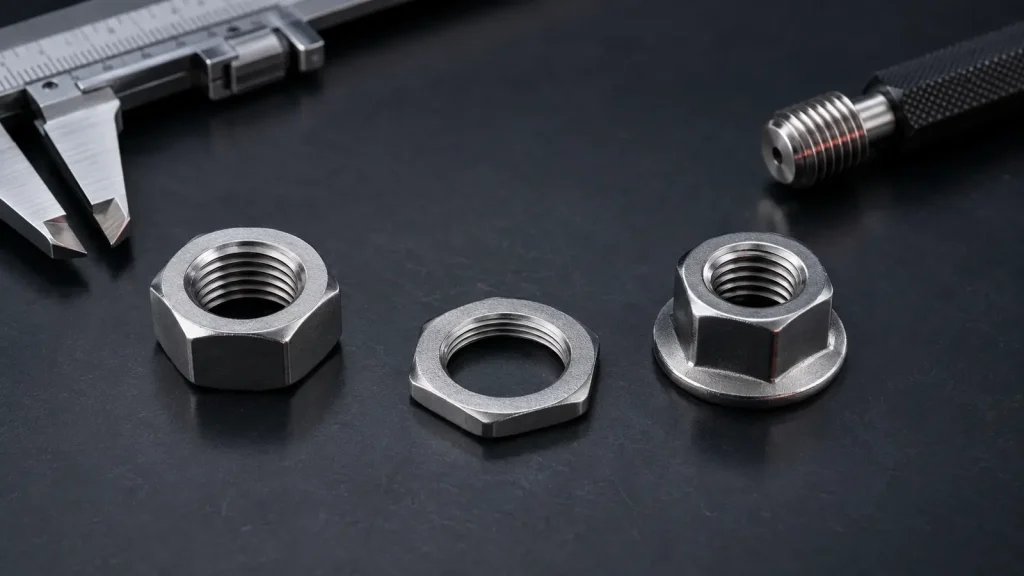
Check the nut shape and available clearance. A standard hex nut is a general choice, while a thin hex nut can help where space is restricted or where it is used as a locknut alongside another nut. It should not be selected simply because it uses less material. Review the discussion of thin and standard hex nuts if the assembly has limited space or a locking arrangement.

Make the enquiry specific. Send the required size and thread, nut style, coating expectation and application environment. Also ask Hebei Wotu Fastener Manufacturing Co., Ltd. whether the requested GI nut is available in that combination and what inspection or packing information can be supplied. This avoids replacing a suitable specification with a visually similar but incompatible nut.

Criteria Importance Description Example Options
Thread standard and size Essential for assembly compatibility The nut must match the bolt's nominal diameter, pitch and thread system. Outside dimensions alone do not confirm that the threads will engage correctly. A metric bolt requires a matching metric nut with the specified pitch; an inch-thread bolt requires the corresponding inch-thread nut.
Coating process Important for corrosion protection and thread fit Confirm whether the requested finish is hot-dip galvanized, electro-galvanized or another zinc-based process. Coating build-up and surface treatment can affect both environmental suitability and assembly. An exposed frame may require a different coating choice from a dry, sheltered enclosure, subject to the project's specification.
Nut height and style Important when space or thread engagement is limited A standard-height hex nut generally offers more thread engagement than a thin nut. A thin nut can address clearance or locking needs, but it should not be selected solely because it uses less material. Use the specified thin form for a restricted-clearance locking arrangement; use the specified standard form where the joint needs greater engagement.
Mechanical requirement Essential for load-bearing or tightly controlled joints The nut's required strength class, material and applicable product standard should correspond to the bolt and the joint design. A galvanized appearance does not establish mechanical performance. A structural connection may require a defined nut class and standard rather than a general-purpose nut with a similar finish.
Bolt and nut compatibility after coating Important for reliable installation Check that the coated nut can run onto the mating bolt without damaging the threads or preventing the intended clamping arrangement. This is especially relevant when coating thickness is greater or the two fasteners use different finishes. Provide the bolt specification with the enquiry and confirm the expected coated thread combination before ordering a large batch.

Blog Articles / Reviews

Hex Thin Nut vs Standard Hex Nut: Which Fits Space-Limited or Locking Assemblies?

Hex Thin Nut vs Standard Hex Nut: Which Fits Space-Limited or Locking Assemblies?

Direct Answer: Choose a hex thin nut when reduced nut height is genuinely required by the assembly or when the engineering design specifies it as part of a locking arrangement. Choose a standard hex nut when full nut height, normal thread engagement, and the specified load-bearing function are required. Buyers should compare nut height, thread […]

How Should Buyers Select Chinese and German Standard Hex Nuts?

How Should Buyers Select Chinese and German Standard Hex Nuts?

Direct Answer: Select a hex nut by the exact standard number and edition, thread diameter and pitch, nut style, property class, material, finish, mating bolt and acceptance method. “Chinese standard” or “German standard” alone is not a complete specification. Regular, thick, thin and flange nuts can differ in geometry and load behavior, so buyers should […]

Frequently Asked Questions

Is a galvanized nut suitable for an outdoor steel connection?

It can be suitable when the coating process, thread fit and mechanical requirements match the exposure and joint design. For a continuously wet, highly corrosive or otherwise demanding location, ask for the coating details and confirm that the selected finish is appropriate rather than treating every galvanized nut as equivalent.

When should I choose a thin nut instead of a standard-height nut?

A thin nut is useful when available space is restricted or when the design uses it as part of a locking arrangement. It provides less height for thread engagement, so a standard-height nut is usually the safer choice when the joint depends on full engagement and there is enough clearance.

Does “GI” specify the complete nut?

No. The term usually describes a galvanized finish or galvanized steel construction, but it does not identify the thread standard, diameter, nut style, strength requirement or exact coating process. Those details must be stated separately so the nut matches the bolt and the assembly.

What information should I include when requesting a quotation?

Provide the nominal size, thread pitch and standard, nut style, quantity, required coating or finish, and the application environment. If the bolt is already selected, include its specification or marking, and ask what inspection or packing information can accompany the requested combination.

Is zinc plating always interchangeable with hot-dip galvanizing?

No. They are different coating processes and can differ in coating build-up, thread fit, appearance and corrosion behaviour. State the required process instead of using “galvanized” as the only description, particularly where the bolt and nut threads must assemble smoothly.

Leave Your Message

For an accurate enquiry, provide the nut size and thread standard, the required coating or finish, and the application environment or bolt specification.