Flange Bolt Chart Selection Guide | Hebei Wotu Fastener Manufacturing Co., Ltd.

Flange Bolt Chart and Selection Guide

A flange bolt chart is most useful when it connects the bolt you need to the joint you are fastening: thread size, length, flange diameter, head style, property class, surface finish and the standard the drawing follows.

The first decision is to confirm what “flange bolt” means in your purchase request. It may refer to a hex flange bolt with an integrated washer face, or to bolts used on a pipe flange connection. Those are different buying problems and should not be mixed in one order.

Related Products

Hex flange nut (Chinese national standard GB/T6177.1-2000)

Hex flange nut (Chinese national standard GB/T6177.1-2000)

Brand: Wotu Surface: zinc plated Specifications: in stockM6/M8/M10/M12/M14/M16/M20 Chinese national standardfull range of specifications, support nonstandard thickness, tooth pitch customized Matching: can be matched with bolts of the same specification, flat washer, spring washer complete set of shipment Packaging: 25kg cartons, whole wooden pallets

Read More
Chinese National Standard / German Standard Hex Nut (thick Nuts, Thin Nuts, Flange Nuts, Multiple Categories)

Chinese National Standard / German Standard Hex Nut (thick Nuts, Thin Nuts, Flange Nuts, Multiple Categories)

Brand: Wotu Surface: color zinc plated, blue-white zinc plated, black oxide, hot-dip galvanized, various surface treatments available Specifications: Comply with DIN934, GB/T6170, GB/T6172.1, GB/T6177.1 standards, in stock M6-M64 full range of specifications, support nonstandard customized Packaging: woven bag inside/25kg export carton, full-container wooden pallet wrapped with film, supports private-label, neutral export packaging

Read More
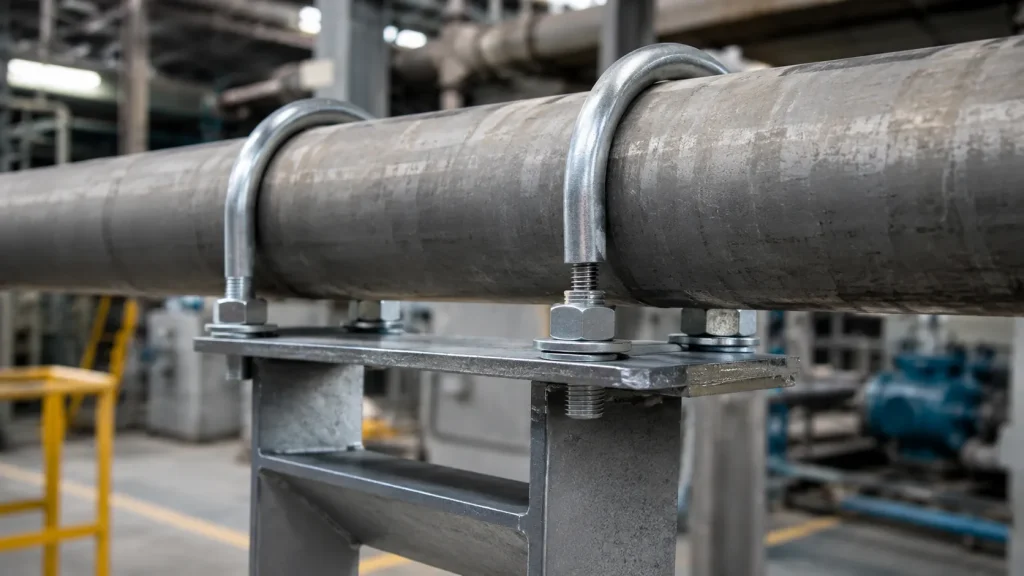
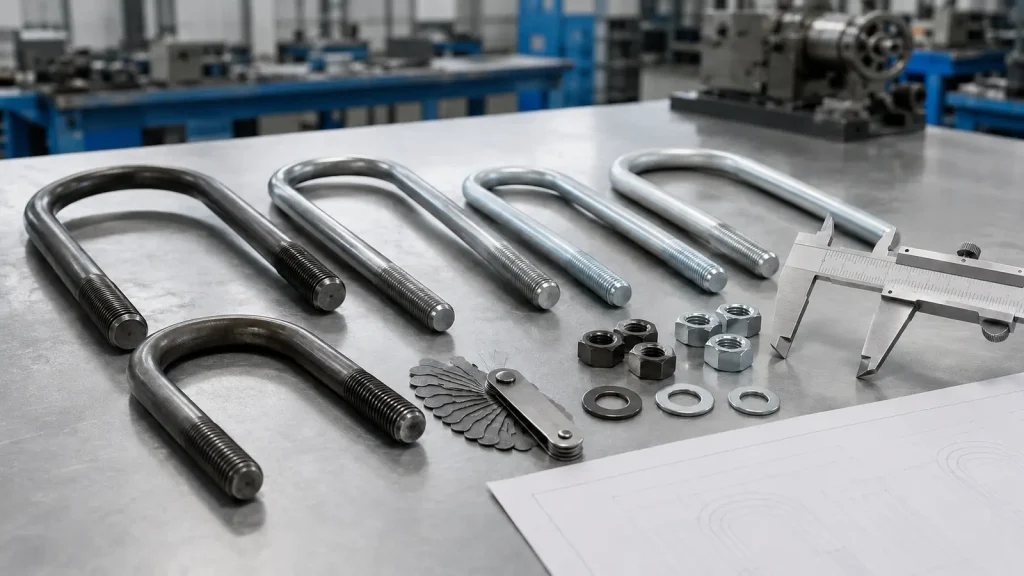
U-bolt ( / U-bolt, M10/M12/M16/M20/M24 multiple specifications)

U-bolt ( / U-bolt, M10/M12/M16/M20/M24 multiple specifications)

Brand: Wotu Surface: natural black oxide / hot-dip galvanized / blue-white zinc plated, multiple processes available Specifications: Based on common industry drawing parameters, suitable for pipe diameter 25mm~139.7mm, screw diameter M10~M24, total length can be nonstandard customized Matching: can be matched with nut, flat washer and spring washer of the same specifications for complete shipment Packaging: Bundling and packaging + 25kg export carton, full-container wooden pallet wrapped with film, supports private-label export packaging

Read More
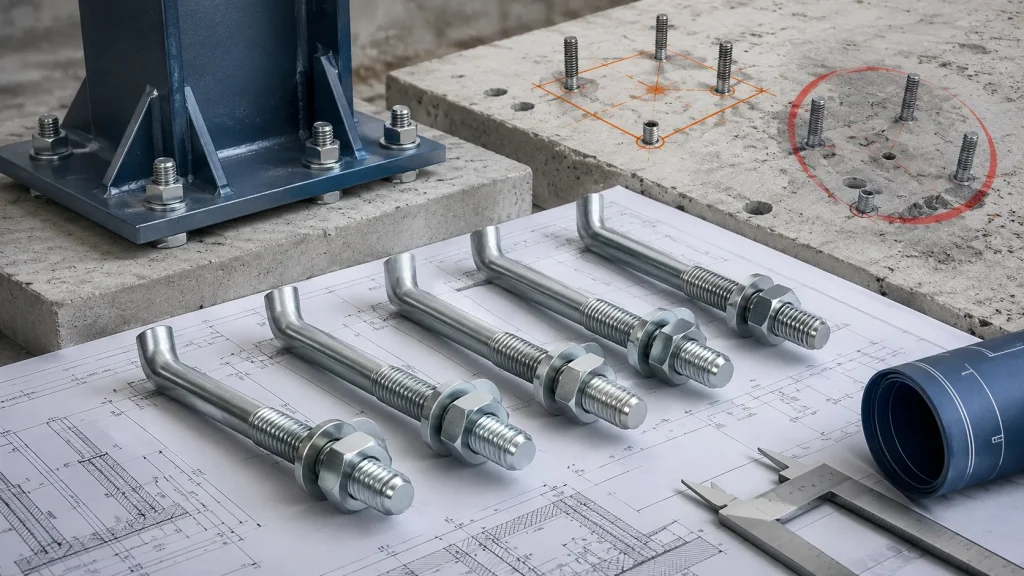
7-letter, 9-letter L-shaped anchor bolt (Chinese national standard GB/T799-1988 embedded anchor screw)

7-letter, 9-letter L-shaped anchor bolt (Chinese national standard GB/T799-1988 embedded anchor screw)

Brand: Wotu Surface: Natural black oxide treatment, customized hot-dip galvanized, zinc plated as required Specifications: Follow Chinese national standard GB/T799-1988, in stock M12-M48, total length 120mm~1500mm, nonstandard customized diameter, bending length, total screw length available Matching: Nuts, flat washers and spring washers of the same specification can be supplied in complete sets. Packaging: Bundling and packaging, using wooden pallets and film-wrapped export packaging in large quantities

Read More
Hot-Dip Galvanized Hex Head Bolt (DIN931 Half Thread / DIN933 Full Thread / GB30 Chinese National Standard Bolt, Can Be Equipped With Nut And Washer Set)

Hot-Dip Galvanized Hex Head Bolt (DIN931 Half Thread / DIN933 Full Thread / GB30 Chinese National Standard Bolt, Can Be Equipped With Nut And Washer Set)

Brand: Wotu Surface: overall hot-dip zinc plating treatment Specifications: Comply with DIN and GB standards, in stock M6-M48 full range of specifications, length 20mm-300mm, supports nonstandard customized. Packaging: woven bag inside / 25kg export carton, film-wrapped wooden pallet; supports neutral packaging and customer private-label customization.

Read More
Color Zinc Plated Hex Flange Wood Screw With Washer

Color Zinc Plated Hex Flange Wood Screw With Washer

Brand: Hengzuan Surface: color zinc plated, can be customizedblue-white zinc plated Specifications: in stock 4.8/5.5 common wire diameter, rod length 16~125mm full range of specifications, supports nonstandard customized Packaging: 25kg cartons, whole wooden pallets, support neutral packaging, private-label customization

Read More

Flange Bolt Chart Details to Check Before Ordering

Chart criteria

When comparing flange bolt options, check the chart against the actual mating part rather than choosing from diameter alone. The practical selection criteria are dimensional standard, thread form, under-head length, flange face style, strength class, coating and packaging or marking requirements for receiving inspection.

Criterion What To Check Why It Matters Buyer Tip
Nominal diameter and thread designation Match the chart entry to the required thread system, diameter and pitch, then verify it against the mating nut or tapped hole. A correct outside diameter with the wrong pitch or thread system will not assemble properly and can damage the joint. Can you confirm the full thread callout, including diameter, pitch and thread system, for each size?
Bolt length and threaded length Confirm how length is measured and compare the required grip length with the threaded portion shown in the drawing or chart. Length that is too short may not provide enough thread engagement; excess length can interfere with surrounding parts or installation. Please confirm the required grip length and whether the listed length is measured from beneath the head.
Flange diameter and bearing surface Compare the flange diameter and underside profile with the joint clearance, hole size and the washer or load-spreading requirement. The integrated flange spreads load without a separate washer, but an oversized flange may clash with adjacent parts or fail to seat correctly. What maximum flange diameter and underside style can the assembly accept?
Head dimensions and tool access Verify the head height, across-flats dimension and available clearance for the intended socket or wrench. A bolt can fit the hole yet remain difficult to install if the head is too large, too tall or inaccessible. Can you provide the head dimensions and confirm the installation tool and clearance limits?
Material, strength grade and surface finish Match the specified material, mechanical grade and finish to the joint environment and the mating fasteners; request documentation if required. These choices affect load suitability, corrosion exposure and compatibility at the joint, so a dimensional match alone is not enough. Which material, grade and finish should be stated beside each chart size on the quotation?

Choosing the Right Flange Bolt for the Joint

For hex flange bolts, the chart should help you check the thread diameter, thread pitch, under-head length, flange outside diameter, head width, head height and whether the underside is serrated or smooth. A serrated flange can resist loosening in some assemblies, but it may mark coated or softer mating surfaces; a smooth flange is often preferred where surface damage or controlled clamping is a concern.

For pipe flange bolting, the key chart is usually tied to the flange standard and pressure class, not only the bolt itself. The buyer must confirm the flange standard, nominal pipe size, pressure rating, number of holes, bolt circle and required bolt or stud length. A bolt that matches the thread size can still be wrong if the flange thickness, gasket and nut engagement are not considered.

Start with the governing standard. A drawing that calls for DIN, ISO, ASME or another standard changes the dimensions a supplier must hold. Do not replace a specified standard with a “similar” flange bolt unless the mating parts, wrench access and strength requirements have been checked.

Separate size from strength. Diameter and length describe fit; property class, material and heat treatment describe load capacity. A common mistake is to copy the size from an old bolt without confirming the grade marking or service condition. If the bolt clamps a structural bracket, machine guard, pipe support or equipment frame, the strength class matters as much as the dimensions.

Choose the underside and finish for the assembly. Serrated flange bolts can grip against rotation, but they can damage paint, zinc layers or softer metals. Coatings such as zinc plating or hot-dip galvanizing affect corrosion resistance and may affect thread fit, nut pairing and appearance. Ask for the finish by name rather than only asking for a “silver” or “anti-rust” bolt.

Send the details that remove ambiguity. For an inquiry, provide the standard or drawing, thread diameter and pitch, length measured from under the head, flange style, property class, finish, nut or washer requirement if any, and the working environment. If the request concerns pipe flange bolting, include the flange standard, size, pressure class, gasket type and whether you need bolts, studs, nuts or a complete bolting set.


Criteria Importance Description Example Options
Hex flange bolt vs pipe flange bolting Critical for avoiding the wrong product category A hex flange bolt is defined by its head and integrated flange face. Pipe flange bolting is selected around the flange connection, including hole pattern, gasket stack and nut engagement. An equipment bracket may need a hex flange bolt, while a pipeline connection may need studs or bolts matched to the flange standard.
Serrated flange vs smooth flange Important for surface protection and loosening resistance Serrations can add grip under the head, but they may damage coatings or soft mating materials. Smooth flanges spread load without the same cutting action. A painted bracket may favor a smooth flange, while a bare steel assembly may allow a serrated underside if the design accepts it.
Dimensional standard High when parts must interchange with drawings or existing stock Different standards can change head dimensions, flange diameter, thread length and tolerances even when the nominal thread size looks similar. A drawing that specifies a DIN or ISO part should be quoted against that standard rather than a visually similar bolt.
Strength class and material High for loaded joints and safety-related assemblies Size controls fit, while material and property class affect the bolt’s ability to carry clamp load. Copying only the diameter and length from an old bolt can lead to an unsuitable replacement. Two M12 flange bolts can have different property classes and should not be treated as equivalent without checking the application.
Surface finish and thread fit Important for corrosion exposure, appearance and mating parts Zinc plating, hot-dip galvanizing and other finishes affect corrosion behavior and may influence thread compatibility, nut pairing and final appearance. Outdoor equipment may need a corrosion-resistant finish, while an indoor machine assembly may prioritize clean appearance and consistent assembly.

Blog Articles / Reviews

Anchor Bolts: 7 Ordering Errors That Cause Site Rework

Anchor Bolts: 7 Ordering Errors That Cause Site Rework

ost anchor bolt ordering errors come from incomplete drawings, unclear dimensions, unsuitable material or coating choices, undefined tolerances, and mismatched nuts or washers. These mistakes affect steel fabricators, EPC contractors, equipment installers, importers, and distributors because anchor bolts are usually embedded before the connected structure arrives on site. Once concrete has cured, even a small […]

Why Do U Bolts Loosen in Pipe Supports? 6 Causes and Prevention Methods

Why Do U Bolts Loosen in Pipe Supports? 6 Causes and Prevention Methods

U bolts usually loosen in pipe supports because the connection loses clamping force, receives continuous vibration, restricts thermal pipe movement, uses an incorrectly sized U bolt, experiences surface settlement, or suffers from corrosion and inadequate inspection. This issue affects EPC contractors, pipe installers, industrial maintenance teams, equipment manufacturers and fastener distributors working with water, oil […]

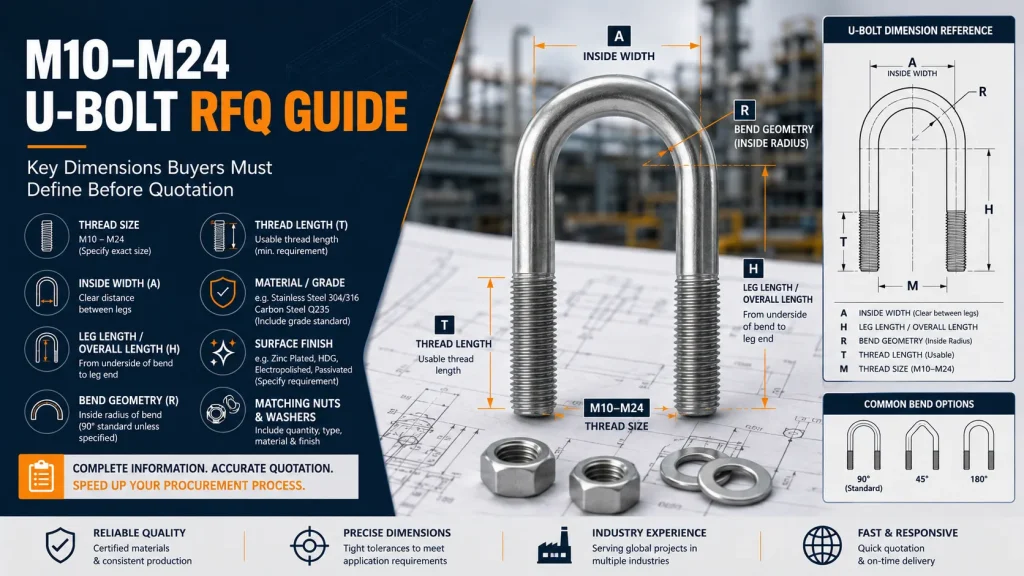
Which M10–M24 U-Bolt Measurements Must Buyers Send Before an RFQ?

Which M10–M24 U-Bolt Measurements Must Buyers Send Before an RFQ?

Direct Answer: For an M10–M24 U-bolt RFQ, buyers should send a dimensioned drawing that defines thread diameter, inside width, leg or overall length, bend geometry, thread length, application diameter, material or grade requirement, surface finish, matching nuts/washers, quantity, and packing needs. Nominal thread size alone is not enough because different measurement datums can produce U-bolts […]

What Should Buyers Verify When Comparing Bolt Manufacturers?

What Should Buyers Verify When Comparing Bolt Manufacturers?

A bolt manufacturer should be evaluated against a defined joint, drawing and acceptance plan—not a product list or unit price alone. Buyers need to verify whether the supplier can manufacture the required geometry, control material and heat-treatment requirements where applicable, manage threads and coatings as one dimensional system, inspect critical characteristics, preserve batch traceability and […]

DIN 931 vs DIN 933 Hex Bolts: What Should Buyers Confirm Before Bulk Ordering?

DIN 931 vs DIN 933 Hex Bolts: What Should Buyers Confirm Before Bulk Ordering?

DIN 931-style half-thread and DIN 933-style full-thread hex bolts should not be selected from diameter and overall length alone. The practical choice depends on the joint stack, required grip, location of the thread transition, available nut engagement, mating hardware, material or property requirement, coating system and governing product specification. A half-thread bolt is not automatically […]

The Widespread Application of Hot-Dip Galvanized Bolts in Daily Life

The Widespread Application of Hot-Dip Galvanized Bolts in Daily Life

Hot-dip galvanized bolts are widely used in daily life, especially due to their advantages, which have led to their rapid development in the market and widespread consumer appeal. So what are the specific advantages of hot-dip galvanized bolts in use? Today, Hebei Wotu Fastener Manufacturing Co., Ltd. will discuss this with you. 1. Due to […]

Frequently Asked Questions

How do I know if I need a hex flange bolt or bolting for a pipe flange?

A hex flange bolt is a fastener with a built-in washer face under the head, often used in machinery, brackets, frames and equipment assemblies. Pipe flange bolting refers to the bolts, studs and nuts used to join two pipe flanges, where the flange standard, pressure class, gasket and hole pattern drive the selection.

Is a serrated flange bolt always better than a smooth flange bolt?

No. Serrations can help resist rotation in some assemblies, but they can also bite into paint, zinc coating, aluminum or other softer surfaces. A smooth flange is often a better choice where surface finish, coating protection or controlled clamp load matters.

Which dimensions should be taken from the chart before sending an inquiry?

For a hex flange bolt, confirm thread diameter, pitch, length measured from under the head, head size, flange diameter and flange face type. Also state the standard, property class, material or finish requirement, and any mating nut or washer condition shown on the drawing.

Can I replace a standard hex bolt and washer with a flange bolt?

Sometimes, but it should not be treated as an automatic substitution. The flange diameter, bearing area, wrench clearance, head height and underside style may change how the joint clamps and how the surface behaves during tightening.

Why can two bolts with the same thread size still be wrong for the same job?

Thread size only describes part of the fit. Length, thread pitch, strength class, coating thickness, head style, flange face and the standard behind the dimensions can all affect assembly, tightening and service performance.

What should I confirm with Hebei Wotu Fastener Manufacturing Co., Ltd. before ordering?

Ask whether the required standard, size range, property class, finish and flange face style can be supplied for your drawing or sample. If the order is for pipe flange bolting, also confirm whether bolts, studs, nuts or complete sets are needed and provide the flange standard and pressure class.

Leave Your Message

Send the bolt standard or drawing, thread size and pitch, under-head length, flange style, property class and finish. If the bolts are for a pipe flange, also include the flange standard, size, pressure class and gasket or nut requirements.