Rail Nut Selection Guide | Hebei Wotu Fastener Manufacturing Co., Ltd.

Choose the Right Rail Nut for Your Assembly

A rail nut is typically used to secure threaded hardware inside a slotted support rail, strut channel or mounting track. The main buying decision is fit: the nut must match the rail profile, thread, installation method and expected load so it stays engaged while the assembly is tightened.

Start by confirming whether you need a spring nut, channel nut, sliding nut or another rail-specific design. These options differ in how they enter the rail, resist movement and suit installations where access to the channel is limited.

Related Products

Hex nut DIN934-1987 (A/B accuracy classification)

Hex nut DIN934-1987 (A/B accuracy classification)

Brand: Wotu Standard basis: German standard DIN934-1987, metric coarse thread/fine thread universal thread Surface: 304 stainless steel Specifications: M6~M24 full range of specifications Supporting equipment: same specification bolts, flat washer, spring washer complete set of shipment Packaging: 25kg standard carton, whole wooden pallet packaging

Read More

Hex flange nut (Chinese national standard GB/T6177.1-2000)

Hex flange nut (Chinese national standard GB/T6177.1-2000)

Brand: Wotu Surface: zinc plated Specifications: in stockM6/M8/M10/M12/M14/M16/M20 Chinese national standardfull range of specifications, support nonstandard thickness, tooth pitch customized Matching: can be matched with bolts of the same specification, flat washer, spring washer complete set of shipment Packaging: 25kg cartons, whole wooden pallets

Read More
Hot-Dip Galvanized Hex Nut (DIN934 Thickened/GB Thin Nut In Multiple Specifications)

Hot-Dip Galvanized Hex Nut (DIN934 Thickened/GB Thin Nut In Multiple Specifications)

Brand: Wotu Surface: high temperature hot dip zinc plated surface treatment Specifications: Comply with DIN934, GB/T6170, GB/T6172.1 Chinese national standard German standard, in stock M6-M64 full range of specifications, length is nonstandard customized as required Packaging: 25kg woven bag/export carton, full-container wooden pallet wrapped with film, supports neutral packaging, private-label customization

Read More
Hot-Dip Galvanized Hex Head Bolt (DIN931 Half Thread / DIN933 Full Thread / GB30 Chinese National Standard Bolt, Can Be Equipped With Nut And Washer Set)

Hot-Dip Galvanized Hex Head Bolt (DIN931 Half Thread / DIN933 Full Thread / GB30 Chinese National Standard Bolt, Can Be Equipped With Nut And Washer Set)

Brand: Wotu Surface: overall hot-dip zinc plating treatment Specifications: Comply with DIN and GB standards, in stock M6-M48 full range of specifications, length 20mm-300mm, supports nonstandard customized. Packaging: woven bag inside / 25kg export carton, film-wrapped wooden pallet; supports neutral packaging and customer private-label customization.

Read More
Hex thin nut

Hex thin nut

Brand: Wotu Surface: zinc plated Specifications: in stock M8~M64 full standard specifications, covering precision, machinery, and steel structure full size range, supporting nonstandard tooth pitch and customized thickness Matching: Can be matched with bolts of corresponding specifications, flat washer, spring washer complete set of shipment Packing: packed in 25kg cartons and packed on wooden pallets.

Read More
Hex nut (Chinese national standard GB52-1976)

Hex nut (Chinese national standard GB52-1976)

Brand: Wotu Surface: 304 stainless steel Specifications: in stock M6~M24 full standard metric specifications, supports nonstandard pitch, thickening/customized Matching: Can be matched with bolts of corresponding specifications, flat washer, spring washer complete set of supporting shipment Packaging: 25kg cartons, whole wooden pallets

Read More

Rail nut fit, retention and material options

Rail nut selection criteria

When comparing rail nuts, review more than thread size. The important criteria include rail-profile compatibility, insertion and retention method, body dimensions, bearing surface, material, surface finish, resistance to turning and access for tightening. If the rail will carry a safety-sensitive or heavily loaded assembly, request fit confirmation and application-specific technical information before approval.

Criterion What To Check Why It Matters Buyer Tip
Thread size and standard Compare the nut thread with the bolt, threaded rod or insert specified for the rail system. A matching nominal size is not enough if the thread form or pitch differs; mismatch can cause poor engagement or installation failure. Ask: Which thread standard and pitch does this rail nut use, and can you provide the applicable drawing or inspection record?
Rail or channel profile fit Confirm the nut fits the rail’s internal width, slot shape and retaining feature before tightening. A nut that is too wide, too narrow or poorly retained may not seat correctly or may rotate during assembly. Send the rail profile drawing and ask the supplier to confirm the compatible channel range and insertion method.
Bearing surface and load transfer Review the nut’s contact area against the rail and the size of the connected bracket or fitting. The contact geometry affects how clamping force is transferred and whether the nut can pull through, tilt or damage the rail. Ask for a dimensional drawing showing the bearing face, retaining shoulders and clearance around the threaded hole.
Material and corrosion protection Match the nut material and surface treatment to the rail environment, including moisture, chemicals and outdoor exposure. Corrosion can seize the thread, reduce adjustability and make later maintenance difficult; incompatible finishes may also affect the joint. Ask which base material and coating are available, and whether the finish is compatible with the mating bolt or rail.
Installation and retention method Check whether the nut slides into the rail, snaps in, or must be held in position during tightening. The retention method affects assembly access, installation speed and the risk of the nut shifting inside a concealed rail. Ask for installation instructions and confirm whether the nut remains captive before the bracket is fitted.

Choose the right nut for your rail profile and assembly method

The most useful distinction is between a nut that slides into an open rail and one that is retained by a spring, clip or shaped body. A sliding design can suit assemblies built from an accessible rail end, while a retained design can be easier to position at an intermediate point without removing existing hardware.

Thread compatibility alone is not enough. Check the rail’s internal dimensions, lip shape and usable insertion opening, then confirm that the nut presents enough bearing area for the bracket or fitting. For overhead, vibrating or frequently adjusted assemblies, ask how the nut is prevented from turning or shifting during installation.

Match the nut to the rail profile. Rail systems that look similar may have different channel widths, lip geometry and internal clearances. Provide the rail manufacturer’s profile drawing or a cross-section with dimensions rather than selecting by thread size alone. A nut that fits the thread but cannot seat fully can damage the rail or reduce clamping reliability.

Choose the retention method for the installation sequence. A spring or clip may hold the nut in position before tightening, which is useful for mid-rail assembly. A plain channel nut may be suitable when the rail is open at the end and the nut can be inserted before other parts are fitted. Consider whether the assembly will be repositioned later, since retention features can affect adjustment and removal.

Check load, movement and environment. Compare the nut material and finish with the rail, bracket and surrounding conditions. Outdoor exposure, moisture, chemicals and galvanic contact may call for a different material or coating than a dry indoor frame. For vibrating equipment or repeated adjustment, ask for the applicable installation guidance and whether a locking feature or separate washer is required.

Send a complete enquiry. Include the rail or channel profile, required thread and nut style, application, material or finish preference, expected loading, and any relevant drawing. Ask the supplier to confirm the fit against the profile and to identify the inspection or dimensional documents available for the proposed part.

Criteria Importance Description Example Options
Rail profile compatibility Critical for fit and clamping reliability The nut body must match the channel opening, lip geometry and internal space of the rail. Thread size alone does not confirm that the nut will seat correctly. A nut with the correct thread may still be unusable if it is too wide to enter the channel or too thin to engage the rail lips properly.
Insertion method Important for installation sequence Some nuts slide in from the end of the rail, while others can be inserted or positioned at an intermediate point. This affects retrofit work, closed-frame assemblies and maintenance access. For a rail that is already installed with blocked ends, a retained or drop-in style may be more practical than an end-entry sliding nut.
Retention before tightening Useful where positioning is difficult Spring, clip or shaped retention features help keep the nut in place while the bracket is aligned and the bolt is started. Plain nuts may move more freely but can be harder to position in vertical or overhead rails. A spring-retained nut can make installation easier when one person is fixing a bracket to a vertical channel.
Material and surface finish Depends on environment and mating parts Material and coating should suit the rail, bracket and surrounding conditions. Moisture, outdoor exposure, chemicals and galvanic contact can affect the best choice. A dry indoor frame may not need the same finish as a support rail exposed to moisture or washdown conditions.
Resistance to rotation and movement Important for tightening and service stability The nut should stay aligned as the bolt is tightened and should not shift under normal service conditions. Anti-rotation shape, serrations or separate locking components may be relevant depending on the assembly. For equipment subject to vibration, the buyer should confirm whether the selected nut needs a washer, locking feature or other retention method.

Product Selection

Related Options

For a support frame assembled from slotted channel, the practical priority is usually secure positioning without making installation unnecessarily difficult. Compare options by how they enter the rail, whether they remain in place before tightening, and how easily the bracket can be adjusted or removed during maintenance. Product selection should follow the actual rail profile and assembly sequence rather than a general nut description.

Blog Articles / Reviews

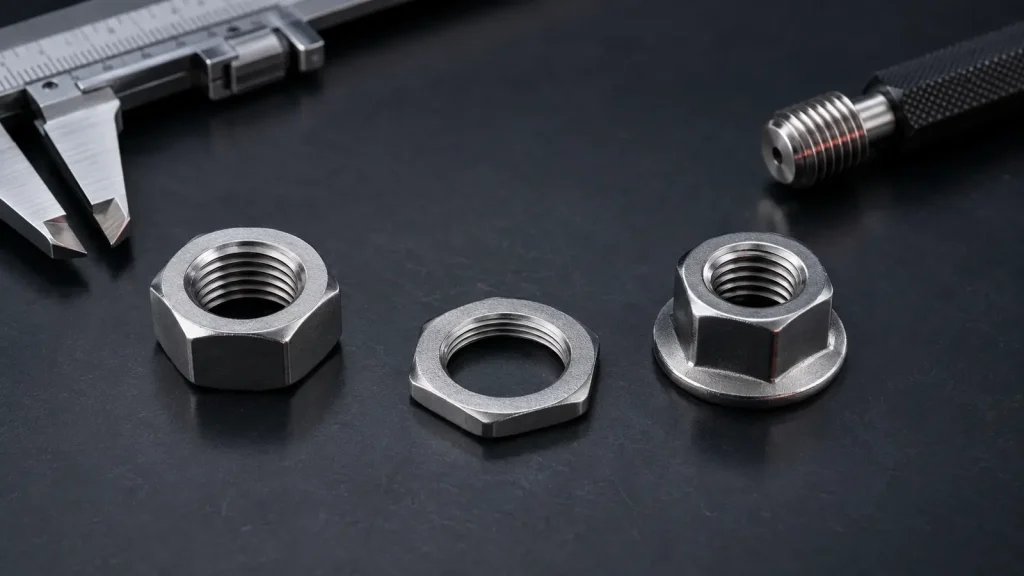
Hex Thin Nut vs Standard Hex Nut: Which Fits Space-Limited or Locking Assemblies?

Hex Thin Nut vs Standard Hex Nut: Which Fits Space-Limited or Locking Assemblies?

Direct Answer: Choose a hex thin nut when reduced nut height is genuinely required by the assembly or when the engineering design specifies it as part of a locking arrangement. Choose a standard hex nut when full nut height, normal thread engagement, and the specified load-bearing function are required. Buyers should compare nut height, thread […]

How Should Buyers Select Chinese and German Standard Hex Nuts?

How Should Buyers Select Chinese and German Standard Hex Nuts?

Direct Answer: Select a hex nut by the exact standard number and edition, thread diameter and pitch, nut style, property class, material, finish, mating bolt and acceptance method. “Chinese standard” or “German standard” alone is not a complete specification. Regular, thick, thin and flange nuts can differ in geometry and load behavior, so buyers should […]

Frequently Asked Questions

How do I know if a nut will fit my rail or channel?

Check the rail profile before checking the thread. The channel width, lip shape, internal depth and insertion opening determine whether the nut can enter, rotate or seat correctly. A drawing or cross-section of the rail is usually more useful than a simple size description.

Should I choose a spring nut or a plain sliding channel nut?

A spring nut can hold its position before tightening, which helps when the nut must be placed midway along a rail or installed overhead. A plain sliding nut may suit assemblies where it can be inserted from the end of the rail and moved into position. The better choice depends on access, installation sequence and whether the bracket will be adjusted later.

Is thread size enough to specify the correct part?

No. Two nuts with the same thread may have different body widths, thicknesses, bearing areas and retention features. If the body does not match the rail, the nut may bind, tilt, spin during tightening or fail to clamp the fitting properly.

What should I check for vibration or adjustable assemblies?

Ask how the nut resists turning or movement during tightening and service. Depending on the rail system, the assembly may need a serrated face, spring retention, a locking feature, a washer or a separate locking method. The right choice depends on the bracket, load direction and how often the assembly is repositioned.

What information should I send for a purchasing enquiry?

Send the rail profile drawing or dimensions, thread requirement, preferred nut style, material or finish needs, and the application environment. If the part supports a load-bearing bracket or overhead equipment, include the expected load direction and any assembly drawing so fit and installation details can be checked.

Leave Your Message

To review your enquiry, provide the rail or channel profile, required thread and nut style, and the application environment or expected loading.