Difference Between Stud And Bolt Selection Guide | Hebei Wotu Fastener Manufacturing Co., Ltd.

Difference Between a Stud and a Bolt

Choosing between a stud and a bolt depends mainly on how the joint is assembled and serviced. A bolt has a head that lets the installer tighten it from one side, while a stud normally has threaded ends or a threaded length and is secured with one or more nuts.

Studs are often considered for flanges, engine housings and joints that are opened repeatedly. Bolts are often more convenient where the fastener must pass through aligned parts and the installer can reach the head. The correct choice also depends on thread engagement, access, joint depth, material and the required fastener specification.

Related Products

7-letter, 9-letter L-shaped anchor bolt (Chinese national standard GB/T799-1988 embedded anchor screw)

7-letter, 9-letter L-shaped anchor bolt (Chinese national standard GB/T799-1988 embedded anchor screw)

Brand: Wotu Surface: Natural black oxide treatment, customized hot-dip galvanized, zinc plated as required Specifications: Follow Chinese national standard GB/T799-1988, in stock M12-M48, total length 120mm~1500mm, nonstandard customized diameter, bending length, total screw length available Matching: Nuts, flat washers and spring washers of the same specification can be supplied in complete sets. Packaging: Bundling and packaging, using wooden pallets and film-wrapped export packaging in large quantities

Read More
Hot-Dip Galvanized Hex Head Bolt (DIN931 Half Thread / DIN933 Full Thread / GB30 Chinese National Standard Bolt, Can Be Equipped With Nut And Washer Set)

Hot-Dip Galvanized Hex Head Bolt (DIN931 Half Thread / DIN933 Full Thread / GB30 Chinese National Standard Bolt, Can Be Equipped With Nut And Washer Set)

Brand: Wotu Surface: overall hot-dip zinc plating treatment Specifications: Comply with DIN and GB standards, in stock M6-M48 full range of specifications, length 20mm-300mm, supports nonstandard customized. Packaging: woven bag inside / 25kg export carton, film-wrapped wooden pallet; supports neutral packaging and customer private-label customization.

Read More
Hot-Dip Galvanized Chinese National Standard Flat Washer (GB/T97.1A Level Flat Washer)

Hot-Dip Galvanized Chinese National Standard Flat Washer (GB/T97.1A Level Flat Washer)

Brand: Wotu Surface: overall hot-dip zinc plated anti-corrosion treatment, optional blue-white zinc plated, color zinc plated, black oxide Specifications: Execute GB/T97.1-2002 Chinese national standard, in stock M6-M64 full range of specifications, inner diameter, outer diameter, thickness strictly comply with Chinese national standard parameters, support nonstandard size customized Packaging: 25kg woven bag / export carton packaging, full pallets wrapped with film, supports private-label customization

Read More
U-bolt ( / U-bolt, M10/M12/M16/M20/M24 multiple specifications)

U-bolt ( / U-bolt, M10/M12/M16/M20/M24 multiple specifications)

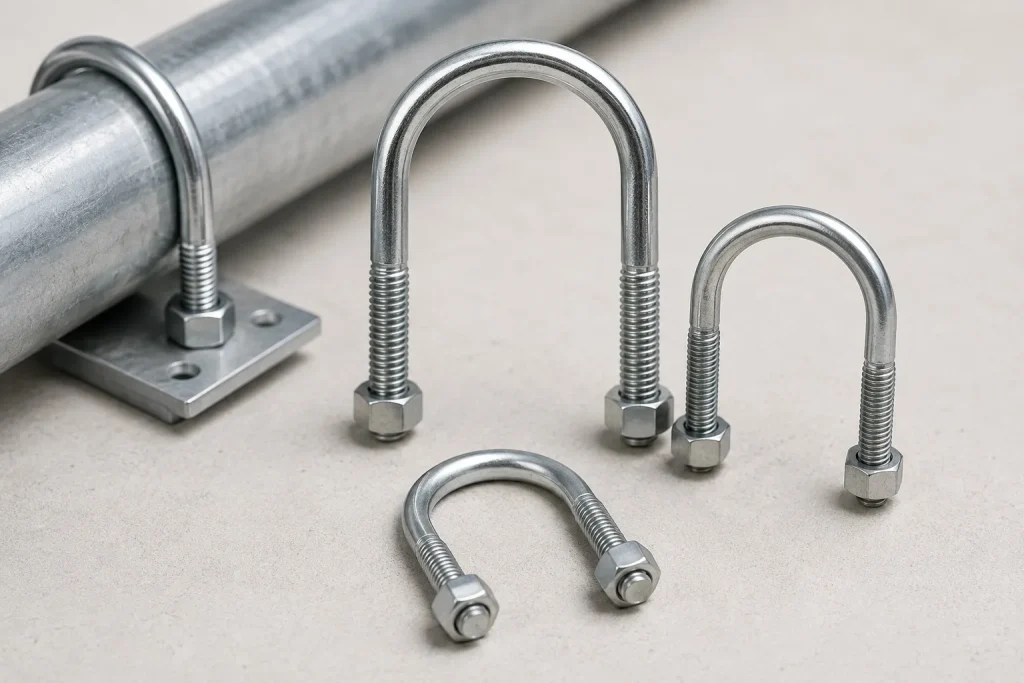
Brand: Wotu Surface: natural black oxide / hot-dip galvanized / blue-white zinc plated, multiple processes available Specifications: Based on common industry drawing parameters, suitable for pipe diameter 25mm~139.7mm, screw diameter M10~M24, total length can be nonstandard customized Matching: can be matched with nut, flat washer and spring washer of the same specifications for complete shipment Packaging: Bundling and packaging + 25kg export carton, full-container wooden pallet wrapped with film, supports private-label export packaging

Read More
Chinese National Standard / German Standard Hex Nut (thick Nuts, Thin Nuts, Flange Nuts, Multiple Categories)

Chinese National Standard / German Standard Hex Nut (thick Nuts, Thin Nuts, Flange Nuts, Multiple Categories)

Brand: Wotu Surface: color zinc plated, blue-white zinc plated, black oxide, hot-dip galvanized, various surface treatments available Specifications: Comply with DIN934, GB/T6170, GB/T6172.1, GB/T6177.1 standards, in stock M6-M64 full range of specifications, support nonstandard customized Packaging: woven bag inside/25kg export carton, full-container wooden pallet wrapped with film, supports private-label, neutral export packaging

Read More
Grade 8/Grade 10 High-strength Black Oxide Hex Nut (DIN934/GB Chinese National Standard Thickened Nut)

Grade 8/Grade 10 High-strength Black Oxide Hex Nut (DIN934/GB Chinese National Standard Thickened Nut)

Brand: Wotu Surface: quenching and tempering heat treatment + high temperature black oxide anti-rust treatment Specifications: Comply with DIN934, GB/T6170 standards, in stock M6-M48 full range of specifications, nonstandard sizes can be customized Packaging: 25kg carton/woven bag inner packaging, whole wooden pallet wrapped with film for export packaging, supports neutral/private-label customization packaging

Read More

Stud or bolt: which configuration fits the joint?

Fastener selection

Compare studs and bolts by thread form, thread length, overall length, head or end configuration, material, finish and compatibility with the nut and mating component. The joint layout, installation access and maintenance cycle should determine the configuration; a similar-looking fastener is not necessarily a suitable replacement.

Criterion What To Check Why It Matters Buyer Tip
Headed fastener or headless threaded rod Confirm whether the joint needs a bolt head on one side or a stud with threads at both ends. A bolt is usually tightened by turning the head or nut through the assembly. A stud stays installed in one part while a nut clamps the other side, which can protect tapped holes during repeated maintenance. Will this joint be opened often, and should the threaded hole remain undisturbed during service?
Thread engagement in the base material Compare the tapped depth, thread length and usable engagement for the part receiving the fastener. Studs are often chosen where consistent engagement in a blind hole matters. Bolts may bottom out or provide too little thread engagement if length is selected only by grip thickness. Can you provide the tapped-hole depth, required engagement, and whether the hole is blind or through?
Assembly access and tightening method Look at which side the installer can reach and whether there is tool clearance for a bolt head, nut, or double-nut stud installation. A bolt needs access to its head and usually the nut or threaded hole. A stud-and-nut joint can simplify alignment when heavy parts are lowered over fixed fasteners. During installation, can workers reach both sides, or would fixed studs make positioning easier?
Alignment and removal behavior Decide whether the fastener should act as a locating guide before clamping, and how parts will be removed later. Studs can guide flanges, covers, and machinery components into place. Bolts are easier to remove completely, but repeated insertion into a tapped component can wear the internal thread. Does the joint need guide pins during assembly, or is full fastener removal preferred?
Specified standard, grade, coating and nut fit Match the fastener form to the drawing or standard, then confirm thread pitch, strength grade, finish, nut type and washer requirements. Changing from a bolt to a stud is not only a shape change; it can affect clamp length, exposed thread, corrosion protection and matching hardware. Is substitution allowed by the drawing, or must the order follow a named bolt or stud standard exactly?

Match the fastener to access, engagement and service needs

The practical difference is where the tightening force is applied. A bolt is turned through its head, whereas a stud remains installed while a nut is tightened. This can make a stud useful when repeated removal could damage a tapped hole, or when the joint needs a fixed guide for positioning a cover or flange.

A bolt may be the simpler option when access is available on only one side or when the assembly needs a fastener that can be inserted and removed as one piece. Do not assume that every threaded rod is interchangeable with a stud: check the thread arrangement, unthreaded length, end treatment and applicable standard before ordering.

Start with access and maintenance. Choose a bolt when the installer can reach and turn the head and the fastener needs to pass through the assembled parts. Consider a stud when the joint is opened regularly, alignment is important, or a nut can be tightened without turning the threaded member. A stud may also preserve a tapped housing better, but it requires enough space for the stud and nut.

Check the joint rather than only the nominal diameter. Confirm the thread size and pitch, usable thread engagement, grip length, unthreaded section, nut clearance and whether the hole is through or blind. A bolt that is too long can interfere with internal parts; a stud with insufficient engagement can leave too little thread for the nut.

Match the fastener to the environment. Review the base and mating materials, corrosion exposure, temperature, coating and any galvanic-corrosion concern. The nut, washer and fastener finish should be compatible with the joint. For a specified assembly, confirm the required material grade, mechanical class and standard instead of substituting by appearance.

Send an assembly drawing or a clear description before requesting a quotation. Include whether you need a headed bolt, a fully threaded stud or a stud with different thread lengths at each end, together with thread details, overall length, material or grade, finish, quantity and application. Ask the supplier to confirm the proposed configuration against the drawing.


Criteria Importance Description Example Options
Tightening method Usually the first design difference to check A bolt is tightened through its head, while a stud normally stays in place and the nut is tightened. This affects tool access, assembly order and service work. A cover plate with clear head access may use bolts; a flange that benefits from fixed alignment may use studs and nuts.
Thread engagement Critical for joint reliability Both options need enough engaged thread in the nut or tapped component. Studs also require the installed end and nut end to be defined correctly. A blind tapped housing needs the available hole depth checked before choosing stud length or bolt length.
Maintenance frequency Important where parts are removed repeatedly Studs can reduce repeated wear on an internal thread because the nut is removed instead of turning the fastener in and out of the base material. Bolts may be simpler for occasional removal. A service cover removed during routine inspection may justify a stud arrangement if space allows.
Space and access Often decides what can actually be installed Studs need room for the projecting threaded length and nut, while bolts need access to the head and enough clearance for insertion. The better choice depends on the assembly layout. A compact bracket may not have clearance for an exposed stud and nut, making a headed bolt easier to package.
Ordering definition Prevents mismatched parts and rework A bolt order usually defines head style, thread, length, material and finish. A stud order may also need end-thread lengths, unthreaded section, installation end and nut-end details. For a stud, a drawing should show whether both ends use the same thread and how much thread is required on each side.

Product Selection

Related Options

For a flange or housing that is dismantled repeatedly, the main priority is a stud-and-nut arrangement that provides reliable thread engagement and leaves enough clearance for tightening. For a one-sided machine-frame connection, a headed bolt may be more practical. Compare available options against the actual joint drawing rather than treating one type as universally superior.

Blog Articles / Reviews

What Is the Difference Between Self Drilling and Self Tapping Screws?

What Is the Difference Between Self Drilling and Self Tapping Screws?

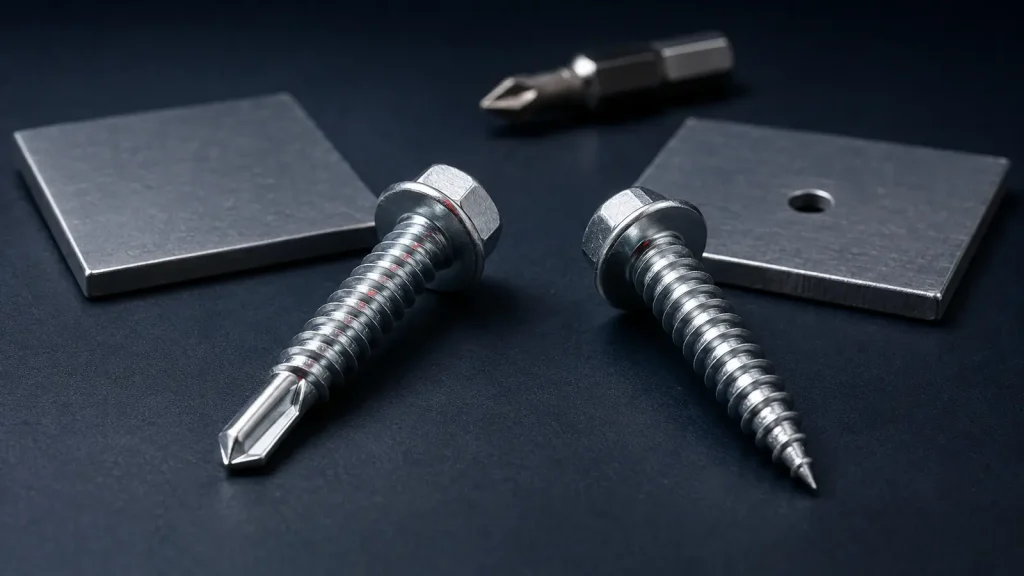
Direct Answer: A self-drilling screw has a drill-shaped point that creates a hole and then forms mating threads in a suitable material. A self-tapping screw forms or cuts mating threads but may require a correctly sized pilot hole. Selection depends on substrate type and thickness, joint stack, point geometry, installation tool, finish and application testing—not […]

Why Do U Bolts Loosen in Pipe Supports? 6 Causes and Prevention Methods

Why Do U Bolts Loosen in Pipe Supports? 6 Causes and Prevention Methods

U bolts usually loosen in pipe supports because the connection loses clamping force, receives continuous vibration, restricts thermal pipe movement, uses an incorrectly sized U bolt, experiences surface settlement, or suffers from corrosion and inadequate inspection. This issue affects EPC contractors, pipe installers, industrial maintenance teams, equipment manufacturers and fastener distributors working with water, oil […]

Anchor Bolts: 7 Ordering Errors That Cause Site Rework

Anchor Bolts: 7 Ordering Errors That Cause Site Rework

ost anchor bolt ordering errors come from incomplete drawings, unclear dimensions, unsuitable material or coating choices, undefined tolerances, and mismatched nuts or washers. These mistakes affect steel fabricators, EPC contractors, equipment installers, importers, and distributors because anchor bolts are usually embedded before the connected structure arrives on site. Once concrete has cured, even a small […]

Which M10–M24 U-Bolt Measurements Must Buyers Send Before an RFQ?

Which M10–M24 U-Bolt Measurements Must Buyers Send Before an RFQ?

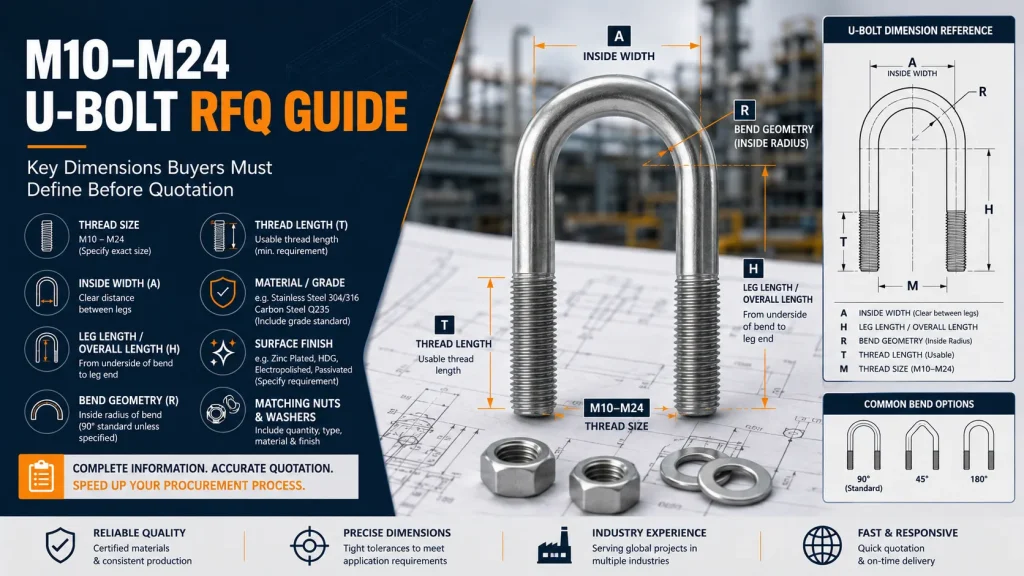
Direct Answer: For an M10–M24 U-bolt RFQ, buyers should send a dimensioned drawing that defines thread diameter, inside width, leg or overall length, bend geometry, thread length, application diameter, material or grade requirement, surface finish, matching nuts/washers, quantity, and packing needs. Nominal thread size alone is not enough because different measurement datums can produce U-bolts […]

Hex Thin Nut vs Standard Hex Nut: Which Fits Space-Limited or Locking Assemblies?

Hex Thin Nut vs Standard Hex Nut: Which Fits Space-Limited or Locking Assemblies?

Direct Answer: Choose a hex thin nut when reduced nut height is genuinely required by the assembly or when the engineering design specifies it as part of a locking arrangement. Choose a standard hex nut when full nut height, normal thread engagement, and the specified load-bearing function are required. Buyers should compare nut height, thread […]

Frequently Asked Questions

Can a stud replace a bolt in the same joint?

Sometimes, but not by diameter alone. The joint must have enough thread engagement, nut clearance and installation space, and the mating part must suit a stud that remains in place while the nut is tightened.

Which option is better for equipment that is opened often?

A stud is often preferred where covers, flanges or housings are removed repeatedly because the internal thread is not turned every time the joint is opened. The nut takes most of the repeated tightening and removal, which can help protect a tapped body if the stud is correctly installed.

Is a fully threaded rod the same as a stud?

No. A stud may be fully threaded, but many studs have specific thread lengths, different thread forms at each end, or an unthreaded shank section. Buyers should define the required configuration instead of ordering by appearance.

When is a headed bolt the more practical choice?

A headed bolt is usually simpler when the installer needs to insert and remove the fastener as one piece, or when the head can be held or turned easily. It can also be more convenient for through-hole assemblies where the head, nut and washer positions are already defined.

What details should be confirmed before ordering either type?

Confirm thread size and pitch, total length, usable thread length, material or strength class, finish, nut and washer compatibility, and the standard or drawing requirement. If the part goes into a blind tapped hole, also confirm the available depth so the fastener does not bottom out.

Leave Your Message

For an accurate enquiry, send the application or joint drawing, the required thread size and pitch, and the fastener length, material or finish. Also note whether you need a headed bolt, a fully threaded stud or different thread lengths at each end.