Metal To Metal Screws Selection Guide | Hebei Wotu Fastener Manufacturing Co., Ltd.

Metal to Metal Screws for Reliable Sheet-Metal Joints

Metal-to-metal screws join steel or other sheet-metal components without relying on a separate nut and bolt. The key purchase decision is choosing a screw that can form or cut a reliable thread in the actual metal thickness while providing enough clamping force for the joint.

Start with the assembly, not the screw name: identify the combined material thickness, access to the joint, hole condition, service environment and required head style. Those details determine whether a self-drilling or self-tapping design is the better fit.

Related Products

Hex thin nut

Hex thin nut

Brand: Wotu Surface: zinc plated Specifications: in stock M8~M64 full standard specifications, covering precision, machinery, and steel structure full size range, supporting nonstandard tooth pitch and customized thickness Matching: Can be matched with bolts of corresponding specifications, flat washer, spring washer complete set of shipment Packing: packed in 25kg cartons and packed on wooden pallets.

Read More
Hex flange nut (Chinese national standard GB/T6177.1-2000)

Hex flange nut (Chinese national standard GB/T6177.1-2000)

Brand: Wotu Surface: zinc plated Specifications: in stockM6/M8/M10/M12/M14/M16/M20 Chinese national standardfull range of specifications, support nonstandard thickness, tooth pitch customized Matching: can be matched with bolts of the same specification, flat washer, spring washer complete set of shipment Packaging: 25kg cartons, whole wooden pallets

Read More
Wafer Head Self-Drilling Screw

Wafer Head Self-Drilling Screw

Brand: Hengzuan Surface: blue and white zinc plated, can be customized color zinc plated, black oxide plated Specifications: Comply with GB/T15856.2 Chinese national standard, in stock ST3.5/ST4.2/ST4.8/ST5.5 mainstream wire diameter, rod length 13mm~50mm full range of specifications, nonstandard length customization on demand, drilling applicable plate thickness 2~5mm Packaging: 25kg export cartons, full pallets wrapped with film, supports neutral export packaging, private-label customization

Read More
Countersunk Head Blue-White Zinc Plated Self-Drilling Screw (Chinese National Standard: Phillips Countersunk Head Self-Drilling And Self-Tapping Screw GB/T15856.2-2002)

Countersunk Head Blue-White Zinc Plated Self-Drilling Screw (Chinese National Standard: Phillips Countersunk Head Self-Drilling And Self-Tapping Screw GB/T15856.2-2002)

Brand: Hengzuan Surface: blue and white zinc plated, can be customized color zinc plated, black oxide plated Specifications: Comply with GB/T15856.2-2002 Chinese national standard, in stock ST4.2/ST4.8/ST5.5 full range of specifications, length 13mm~75mm optional, supports customized nonstandard rod lengths; drilling adaptation plate thickness 0.7~6mm Packaging: 25kg export cartons, full pallets wrapped with film, supports neutral export packaging, customer private-label customization

Read More
Countersunk Head Blue Zinc Self-Drilling Screw

Countersunk Head Blue Zinc Self-Drilling Screw

Brand: Hengzuan Surface: blue and white zinc plated, can be customized color zinc plated, black oxide plated Specifications: in stock 3.5/3.9/4.2/4.8/5.5 mainstream wire diameter, rod length 13mm~75mm full size range, nonstandard length can be customized as needed Packaging: 25kg export cartons, full wooden pallets wrapped with film, supports neutral export packaging, private-label customization

Read More

Metal-to-metal screw features to compare

Selection criteria

When comparing metal-to-metal screw options, review the point style, thread geometry, diameter, length, head and drive, material or coating, and the fit with your installation process. The correct choice depends on the joined metals, total thickness, required thread engagement and exposure conditions rather than on the screw label alone.

Criterion What To Check Why It Matters Buyer Tip
Screw point style for the metal thickness Confirm whether the joint needs a self-drilling point or a self-tapping screw used with a pilot hole. A self-drilling screw can drill and form threads in one step, but the drill point must suit the steel thickness. A tapping screw may give better control when holes are already punched or drilled. Ask: What are the thicknesses and grades of both metal parts, and will the holes be pre-drilled or made by the screw?
Thread engagement in the lower metal layer Compare the screw length and thread form against the total stack-up, including washers, coatings, brackets, or air gaps. The screw must clamp the top sheet while enough thread bites into the base metal. Too little engagement can strip; too much unused length can interfere behind the joint. Ask: What is the full material stack from the screw head to the back side of the base metal?
Head style and bearing surface Match pan, hex washer, countersunk, or other head styles to the assembly surface and installation tool. The head affects clamping area, appearance, tool access, and whether the screw sits proud or flush. A wrong head can damage thin sheet or prevent parts from seating. Ask: Does the finished joint need a flush surface, a large bearing area, or fast installation with a socket driver?
Corrosion protection for the service environment Specify the expected exposure: indoor dry use, outdoor weather, condensation, chemical contact, or contact with dissimilar metals. Coating choice affects rust resistance and the risk of staining or premature failure. It also matters when the screw contacts coated sheet or aluminum. Ask: What metal parts will the screw contact, and will the assembly be used indoors, outdoors, or in a wet area?
Drive recess and installation method Check the required drive type and whether screws will be installed by hand tools, impact drivers, or automated equipment. Drive fit affects cam-out, bit wear, installation speed, and repeatability. Poor drive selection can damage the head before the screw reaches full clamp load. Ask: What driver type and torque control will be used on the production line or job site?

Choose the right point, thread and finish for the joint

Self-drilling screws have a drill-shaped point that can create the hole and form the thread in suitable metal, which can reduce preparation steps. Self-tapping screws form or cut threads after entering a prepared or pilot hole, so they may be preferable when hole position, thread engagement or controlled installation matters more than drilling speed.

The distinction matters because a point that is too light for the combined metal thickness may fail to penetrate cleanly, while an unsuitable thread form can strip the hole or leave the joint loose. Confirm the actual material thickness and the manufacturer's recommended installation method before selecting one design for the whole project.

Match the point and thread to the metal. For overlapping sheet metal, consider whether the screw must drill through both layers or enter a pre-drilled hole. Check the thickness of each layer, the total stack-up and the amount of thread that will remain engaged. A screw selected only by overall length can leave too little engagement or extend farther than the assembly allows.

Choose the head and drive for the joint. A pan or hex-style head can suit exposed fastening where the head must clamp a bracket or panel. A countersunk head is useful when a flush surface is required, but the mating material must allow the head to seat properly. Match the drive to the installation tools and access available; a convenient drive can reduce slipping and damaged heads during production.

Consider the service environment and joint movement. Indoor dry assemblies may have different coating or material requirements from outdoor, humid or chemically exposed equipment. Check compatibility between the screw finish and the joined metals to reduce the risk of corrosion. If vibration, thermal movement or repeated loading is expected, ask how the proposed design maintains clamping force rather than choosing solely by appearance.

Send a clear enquiry before ordering. Provide a drawing or sample description, the metal type and thickness for each layer, the required length and head style, the installation method, and the environment. Ask Hebei Wotu Fastener Manufacturing Co., Ltd. to confirm the suitable point, thread form, finish and available inspection or documentation for your application. If you are replacing an existing screw, include its dimensions and explain the failure or fit problem.

Criteria Importance Description Example Options
Point style Usually the first decision for metal-to-metal fastening The point determines whether the screw drills its own hole or enters a prepared hole. A mismatch can cause poor penetration, oversized holes or stripped threads. A self-drilling point may suit repetitive sheet-metal assembly, while a self-tapping screw may suit a pre-punched bracket.
Metal thickness and thread engagement Critical for joint strength and repeatable installation The screw must match both the individual layer thicknesses and the total stack-up. Enough thread must remain engaged after the screw seats. Two thin sheets need a different evaluation from a thin cover fastened to a thicker steel frame.
Head and drive style Important for clamping, access and finished appearance The head affects how the load spreads over the top part, while the drive affects tool fit and installation reliability. A flush head is not automatically better if the material cannot seat it properly. A countersunk head may suit a flush panel, while a hex or pan head may suit an exposed bracket connection.
Hole preparation Changes installation speed and control Some assemblies benefit from screws that drill and fasten in one operation. Others need pilot holes or punched holes to control location, reduce wandering or protect thin material. A production line may value fewer steps, while a precision enclosure may require pre-positioned holes.
Environment and finish compatibility Important when the joint faces moisture, outdoor exposure or dissimilar metals The screw material or coating should suit the service environment and the metals being joined. Compatibility matters because corrosion can reduce clamping force and make future maintenance harder. An indoor dry assembly may not need the same finish consideration as an exterior metal panel connection.

Blog Articles / Reviews

How to Specify Countersunk Head Cross Thick Thread Fiberboard Screws for Furniture Assembly Projects

How to Specify Countersunk Head Cross Thick Thread Fiberboard Screws for Furniture Assembly Projects

Fiberboard screws are selected based on more than screw size alone. For furniture assembly and board-based applications, buyers need to match the screw structure with the characteristics of fiberboard, MDF, and similar engineered wood materials. A suitable specification should consider thread design, head style, screw length, diameter, installation method, and application requirements. For buyers sourcing […]

How Should Buyers Evaluate Self Tapping Screws for Project Procurement?

How Should Buyers Evaluate Self Tapping Screws for Project Procurement?

#4 self tapping screws should not be purchased from the “#4” designation alone. For a usable B2B specification, the buyer still needs the actual screw diameter, thread form or pitch, overall length, substrate, pilot-hole condition, head and drive style, material, surface finish and quantity. This matters because suppliers may use different naming systems. Wotu Fastener’s […]

Which Self-Tapping Roofing Screw Specification Fits Metal Panels on Steel or Timber?

Which Self-Tapping Roofing Screw Specification Fits Metal Panels on Steel or Timber?

The correct self-tapping roofing screw depends on the complete panel-and-substrate stack-up. Steel supports typically require a point and thread matched to the support thickness and any pilot-hole requirement; timber supports require a wood-appropriate thread and sufficient embedment. In both cases, buyers must define diameter, length, head, sealing washer, material or coating, environment, pull-out requirements, and […]

Why Do Self-Tapping Roofing Screws Leak Even When the Screw Length Looks Correct?

Why Do Self-Tapping Roofing Screws Leak Even When the Screw Length Looks Correct?

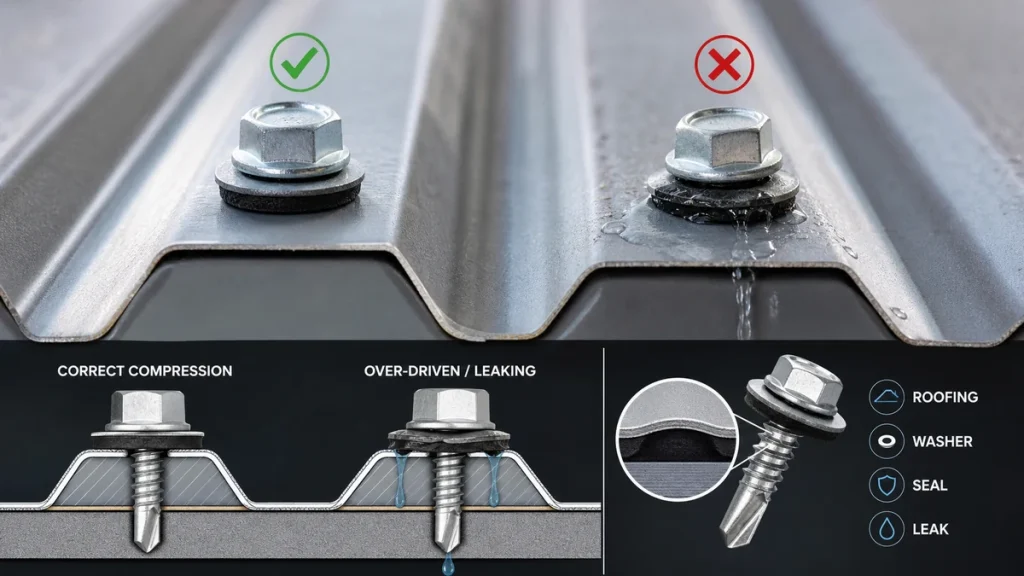
Direct answer: Correct screw length does not guarantee a watertight metal-roof connection. Self tapping roofing screws can leak because of incorrect washer compression, enlarged or stripped holes, insufficient thread engagement, panel movement, or an unsuitable coating-and-washer system. Buyers should diagnose the complete installed connection—including panel profile, support thickness, point type, washer condition, and exposure—rather than […]

Frequently Asked Questions

Should I choose a self-drilling or self-tapping screw for joining sheet metal?

Choose a self-drilling design when the screw needs to create its own hole through suitable metal thickness and speed matters on the assembly line. Choose a self-tapping screw when a pilot hole is already present or when hole position and thread control are more important than eliminating the drilling step.

Can one screw size cover several metal thicknesses?

Not always. A screw that works well in thin sheet may not drill or thread properly in a thicker stack-up, and a screw chosen for heavier material may be oversized for light sheet. Confirm each layer thickness, total stack-up and required thread engagement before using one specification across different assemblies.

Is overall screw length the main factor in a metal-to-metal joint?

Length matters, but it is not enough by itself. The point style, thread form, diameter, head type and engaged thread length all affect whether the joint clamps securely or strips out. Buyers often run into problems when they match only the visible length of an old screw without checking the hole condition and material thickness.

What trade-off is there between a countersunk head and a pan or hex head?

A countersunk head can sit flush, which is useful where the surface must remain level or unobstructed. It needs a suitable countersink in the top material, while a pan or hex-style head can provide broad clamping without recessing the surface. The best choice depends on appearance, tool access and how the load spreads over the joined part.

What information should be sent with an enquiry?

Send the metal type, thickness of each layer, total stack-up, hole condition, required head and drive style, surface exposure and installation method. If the screw will replace an existing fastener, include a sample, drawing or measurements and explain any stripping, leaking, loosening or fit issue that needs to be corrected.

Leave Your Message

Please share the metal type and thickness of each joined layer, the required screw length and head style, and the installation environment or method so we can review a suitable option.