Wedge Bolts for Concrete Anchoring | Hebei Wotu Fastener Manufacturing Co., Ltd.

Wedge bolts for concrete anchoring

A wedge bolt is usually selected for fastening into concrete or masonry where the joint must resist pull-out, vibration, and repeated service loads. The main decision is not only the diameter or length of the bolt, but whether the anchor style, thread, coating, and base material match the job conditions.

For a buyer, the safest starting point is the application: what will be fixed, what substrate it goes into, and whether the installation is indoor, outdoor, temporary, or structural. Those details affect the anchor type and the questions to confirm before ordering.

Related Products

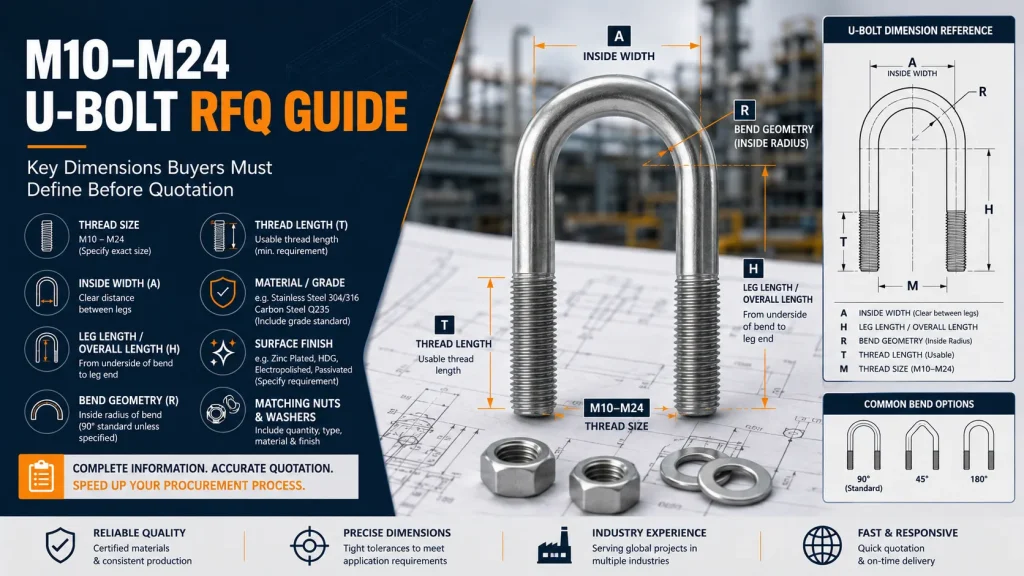
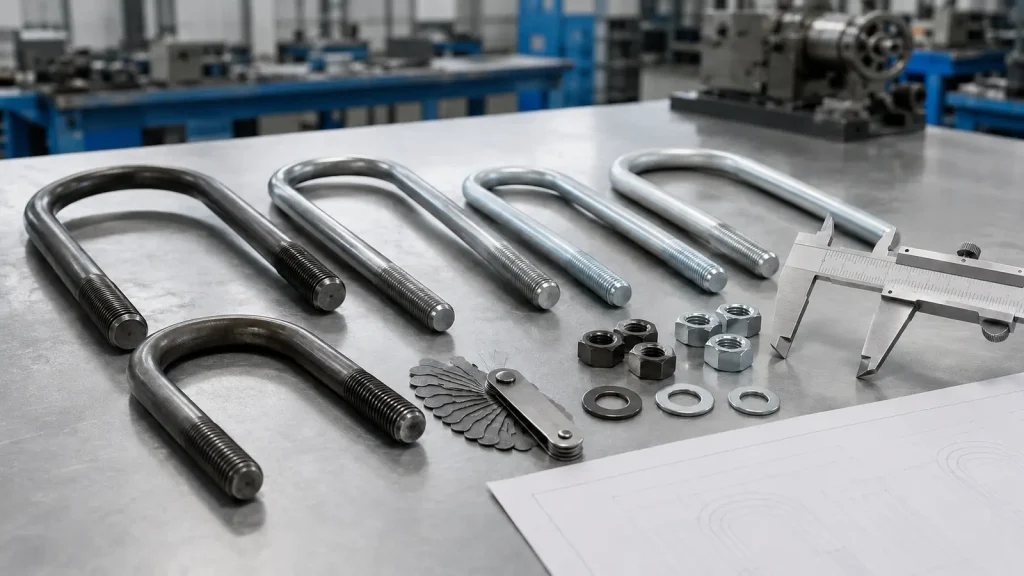
U-bolt ( / U-bolt, M10/M12/M16/M20/M24 multiple specifications)

U-bolt ( / U-bolt, M10/M12/M16/M20/M24 multiple specifications)

Brand: Wotu Surface: natural black oxide / hot-dip galvanized / blue-white zinc plated, multiple processes available Specifications: Based on common industry drawing parameters, suitable for pipe diameter 25mm~139.7mm, screw diameter M10~M24, total length can be nonstandard customized Matching: can be matched with nut, flat washer and spring washer of the same specifications for complete shipment Packaging: Bundling and packaging + 25kg export carton, full-container wooden pallet wrapped with film, supports private-label export packaging

Read More
7-letter, 9-letter L-shaped anchor bolt (Chinese national standard GB/T799-1988 embedded anchor screw)

7-letter, 9-letter L-shaped anchor bolt (Chinese national standard GB/T799-1988 embedded anchor screw)

Brand: Wotu Surface: Natural black oxide treatment, customized hot-dip galvanized, zinc plated as required Specifications: Follow Chinese national standard GB/T799-1988, in stock M12-M48, total length 120mm~1500mm, nonstandard customized diameter, bending length, total screw length available Matching: Nuts, flat washers and spring washers of the same specification can be supplied in complete sets. Packaging: Bundling and packaging, using wooden pallets and film-wrapped export packaging in large quantities

Read More
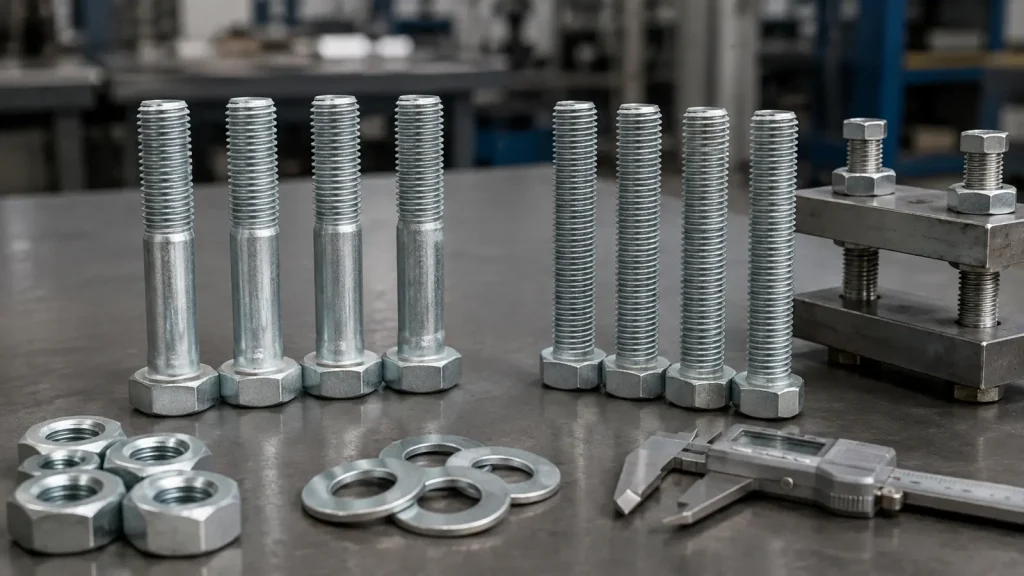
Hot-Dip Galvanized Hex Head Bolt (DIN931 Half Thread / DIN933 Full Thread / GB30 Chinese National Standard Bolt, Can Be Equipped With Nut And Washer Set)

Hot-Dip Galvanized Hex Head Bolt (DIN931 Half Thread / DIN933 Full Thread / GB30 Chinese National Standard Bolt, Can Be Equipped With Nut And Washer Set)

Brand: Wotu Surface: overall hot-dip zinc plating treatment Specifications: Comply with DIN and GB standards, in stock M6-M48 full range of specifications, length 20mm-300mm, supports nonstandard customized. Packaging: woven bag inside / 25kg export carton, film-wrapped wooden pallet; supports neutral packaging and customer private-label customization.

Read More
Hex nut DIN934-1987 (A/B accuracy classification)

Hex nut DIN934-1987 (A/B accuracy classification)

Brand: Wotu Standard basis: German standard DIN934-1987, metric coarse thread/fine thread universal thread Surface: 304 stainless steel Specifications: M6~M24 full range of specifications Supporting equipment: same specification bolts, flat washer, spring washer complete set of shipment Packaging: 25kg standard carton, whole wooden pallet packaging

Read More
Hex thin nut

Hex thin nut

Brand: Wotu Surface: zinc plated Specifications: in stock M8~M64 full standard specifications, covering precision, machinery, and steel structure full size range, supporting nonstandard tooth pitch and customized thickness Matching: Can be matched with bolts of corresponding specifications, flat washer, spring washer complete set of shipment Packing: packed in 25kg cartons and packed on wooden pallets.

Read More
Hex nut (Chinese national standard GB52-1976)

Hex nut (Chinese national standard GB52-1976)

Brand: Wotu Surface: 304 stainless steel Specifications: in stock M6~M24 full standard metric specifications, supports nonstandard pitch, thickening/customized Matching: Can be matched with bolts of corresponding specifications, flat washer, spring washer complete set of supporting shipment Packaging: 25kg cartons, whole wooden pallets

Read More

Key details that define the right wedge bolt

Wedge bolt selection notes

When comparing wedge bolt options, focus on anchor type, diameter, total length, thread length, head style, washer and nut requirements, coating, and the material being fixed into. These details decide whether the fastener will install cleanly and hold as intended.

Criterion What To Check Why It Matters Buyer Tip
Concrete base and load type Confirm whether the anchor will be installed in cracked or uncracked concrete, and whether loads are tension, shear, or combined. A wedge anchor’s suitability depends on the concrete condition and how the fixture loads the fastener. Ask the supplier for the product’s approved base materials and load data for your application.
Diameter, embedment, and fixture thickness Compare the required load, effective embedment, fixture thickness, washer and nut clearance with the proposed bolt size and length. A bolt that is too short may not develop the required anchorage; one that is too long may create clearance or installation problems. Send the fixture thickness, hole size, required embedment, and available edge clearance with your enquiry.
Hole preparation and installation torque Verify the required drill diameter, hole depth, cleaning method, and tightening torque for the exact wedge bolt. Dust, an incorrectly sized hole, or insufficient tightening can prevent the expansion clip from engaging the concrete properly. Request the installation instructions and confirm whether your drilling and torque tools match them.
Steel grade and corrosion protection Compare the bolt material and coating with indoor, damp, outdoor, or corrosive service conditions. Corrosion can reduce the anchor’s useful service life and may affect the suitability of the surrounding assembly. Ask which material and coating options are available and whether they are suitable for the project environment.
Edge distance and anchor spacing Check the required distance from concrete edges and between adjacent anchors against the layout drawings. Anchors installed too close to an edge or to one another can reduce concrete capacity and increase the risk of breakout. Provide the anchor layout and concrete member dimensions so the supplier can confirm the proposed arrangement.

Choosing a wedge bolt for concrete fastening

The important distinction is between a wedge-style expansion anchor and other fasteners that may also be called wedge bolts in local purchasing language. Expansion anchors grip by forcing a wedge or clip against the wall of a drilled hole, while concrete screws cut into the base material and sleeve anchors expand over a larger surface. They may look similar in a quotation request, but they behave differently on site.

This matters because the wrong style can create installation delays, loose fixings, or damaged concrete. If the drawings or site team use the term “wedge bolt,” confirm the intended anchor type, hole size requirement, embedment approach, head style, and finish before comparing quotations.

Match the anchor to the base material. A wedge anchor normally suits solid concrete better than hollow block, soft masonry, or cracked edges. If the base is old concrete, lightweight concrete, brick, or stone, ask whether a different anchor style is more suitable instead of ordering by bolt diameter alone.

Check the installed condition, not just the catalog size. The same nominal bolt size can perform differently depending on embedment depth, fixture thickness, washer arrangement, hole cleaning, and tightening method. One common mistake is sending only “M12 wedge bolt” without the required length, coating, and fixture thickness, which can lead to a bolt that is too short after passing through the bracket or plate.

Choose the finish for the environment. Plain, zinc-plated, hot-dip galvanized, and stainless options serve different corrosion conditions. Indoor dry use usually has different needs from outdoor frames, pipe supports, marine-adjacent sites, or chemical exposure. A heavier protective finish can improve corrosion resistance but may affect thread fit or availability, so confirm the required finish before production or purchase.

Separate drawing requirements from site habits. Installers may use a familiar anchor, while the engineering drawing may specify another type or standard. Before placing an order, send the drawing, base material, fixture thickness, bolt size, required finish, and any packaging or marking needs. Hebei Wotu Fastener Manufacturing Co., Ltd. can then confirm what information is needed to assess the inquiry rather than guessing from a short item name.


Criteria Importance Description Example Options
Anchor type Critical to installation and holding behavior Products described with similar names may work differently. Expansion anchors, sleeve anchors, and concrete screws do not grip the base material in the same way. A steel base plate fixed to solid concrete may call for a wedge-style expansion anchor, while hollow masonry may need another anchor type.
Base material condition Often the factor that changes the fastener choice Solid concrete, aged concrete, brick, block, and stone can respond differently to drilling, expansion, and tightening. The substrate should be known before treating two fasteners as interchangeable. An anchor suitable for dense concrete may not hold reliably in a hollow block wall.
Bolt length and fixture thickness Important for fit after installation Total length must allow for the fixture, washer and nut arrangement, and required embedment. Ordering only by diameter can lead to a fastener that cannot engage properly after passing through the bracket or plate. Two M12 anchors can have different usable installed lengths if one passes through a thicker mounting plate.
Finish and environment Important for service life and compatibility Indoor dry areas, outdoor frames, wet locations, and corrosive surroundings may require different surface protection or material choices. Heavier coatings can also affect thread fit and availability. A dry indoor equipment mount may not need the same finish as an outdoor support exposed to rain.
Drawing and site terminology Useful for avoiding quotation and delivery mistakes The term used by a buyer, installer, or drawing may not always describe the same fastener. Confirming the drawing requirement prevents substitution based only on a short product name. A request for a wedge bolt should be checked against the drawing to confirm head style, nut and washer needs, and the intended anchor design.

Product Selection

Related Options

For a real project, the best-fit wedge bolt is the one that matches the substrate and fixture, such as fastening steel brackets to concrete, securing equipment bases, or installing support frames. Start with the drawing and site conditions, then confirm the bolt geometry and finish before treating two quotes as equivalent.

Blog Articles / Reviews

Anchor Bolts: 7 Ordering Errors That Cause Site Rework

Anchor Bolts: 7 Ordering Errors That Cause Site Rework

ost anchor bolt ordering errors come from incomplete drawings, unclear dimensions, unsuitable material or coating choices, undefined tolerances, and mismatched nuts or washers. These mistakes affect steel fabricators, EPC contractors, equipment installers, importers, and distributors because anchor bolts are usually embedded before the connected structure arrives on site. Once concrete has cured, even a small […]

Why Do U Bolts Loosen in Pipe Supports? 6 Causes and Prevention Methods

Why Do U Bolts Loosen in Pipe Supports? 6 Causes and Prevention Methods

U bolts usually loosen in pipe supports because the connection loses clamping force, receives continuous vibration, restricts thermal pipe movement, uses an incorrectly sized U bolt, experiences surface settlement, or suffers from corrosion and inadequate inspection. This issue affects EPC contractors, pipe installers, industrial maintenance teams, equipment manufacturers and fastener distributors working with water, oil […]

Which M10–M24 U-Bolt Measurements Must Buyers Send Before an RFQ?

Which M10–M24 U-Bolt Measurements Must Buyers Send Before an RFQ?

Direct Answer: For an M10–M24 U-bolt RFQ, buyers should send a dimensioned drawing that defines thread diameter, inside width, leg or overall length, bend geometry, thread length, application diameter, material or grade requirement, surface finish, matching nuts/washers, quantity, and packing needs. Nominal thread size alone is not enough because different measurement datums can produce U-bolts […]

What Should Buyers Verify When Comparing Bolt Manufacturers?

What Should Buyers Verify When Comparing Bolt Manufacturers?

A bolt manufacturer should be evaluated against a defined joint, drawing and acceptance plan—not a product list or unit price alone. Buyers need to verify whether the supplier can manufacture the required geometry, control material and heat-treatment requirements where applicable, manage threads and coatings as one dimensional system, inspect critical characteristics, preserve batch traceability and […]

DIN 931 vs DIN 933 Hex Bolts: What Should Buyers Confirm Before Bulk Ordering?

DIN 931 vs DIN 933 Hex Bolts: What Should Buyers Confirm Before Bulk Ordering?

DIN 931-style half-thread and DIN 933-style full-thread hex bolts should not be selected from diameter and overall length alone. The practical choice depends on the joint stack, required grip, location of the thread transition, available nut engagement, mating hardware, material or property requirement, coating system and governing product specification. A half-thread bolt is not automatically […]

The Widespread Application of Hot-Dip Galvanized Bolts in Daily Life

The Widespread Application of Hot-Dip Galvanized Bolts in Daily Life

Hot-dip galvanized bolts are widely used in daily life, especially due to their advantages, which have led to their rapid development in the market and widespread consumer appeal. So what are the specific advantages of hot-dip galvanized bolts in use? Today, Hebei Wotu Fastener Manufacturing Co., Ltd. will discuss this with you. 1. Due to […]

Frequently Asked Questions

Is this type of anchor suitable for hollow block or brick?

A wedge-style expansion anchor is normally associated with solid concrete rather than hollow block, weak brick, or soft masonry. For hollow or uneven base materials, confirm the substrate first because a sleeve anchor, chemical anchor, or another fixing method may be more appropriate.

How is it different from a concrete screw or sleeve anchor?

A wedge anchor expands against the drilled hole as it is tightened, while a concrete screw cuts its own thread into the base material. A sleeve anchor expands over a broader body, which can sometimes suit different masonry conditions. The best choice depends on the base material, fixture, edge distance, and whether the fixing may need removal later.

What information should be sent before asking for a quotation?

Send the diameter, total length, required thread length if specified, head or nut style, washer requirement, finish, fixture thickness, and base material. A drawing or photo of the installed assembly reduces the risk of quoting a bolt that fits the item name but not the actual site condition.

Does a larger diameter always mean a safer fixing?

No. A larger bolt can still fail if the embedment, hole condition, concrete quality, edge distance, or installation method is wrong. Oversizing may also create drilling problems or conflict with the fixture hole, so size should follow the design requirement rather than a general assumption.

Which finish should be considered for outdoor use?

Outdoor exposure usually requires more corrosion protection than a dry indoor installation. Zinc plating, hot-dip galvanizing, and stainless materials have different cost, appearance, corrosion resistance, and thread-fit considerations, so the finish should be confirmed together with the installation environment.

Leave Your Message

Send the required bolt size and length, the base material, and the fixture thickness. If available, include the drawing, finish requirement, and installation environment.