Fastener Nut and Bolt Selection | Hebei Wotu Fastener Manufacturing Co., Ltd.

Fastener nut and bolt selection for secure joints

A fastener nut and bolt set has to match the joint, not just the thread size. The right choice depends on the load path, mating material, installation space, corrosion exposure and whether the assembly must be removed later.

For purchasing, the main decision is usually not “nut or bolt” but which standard, grade, finish and fit will keep the connection secure without adding unnecessary cost or installation trouble.

Related Products

Hot-Dip Galvanized Hex Head Bolt (DIN931 Half Thread / DIN933 Full Thread / GB30 Chinese National Standard Bolt, Can Be Equipped With Nut And Washer Set)

Hot-Dip Galvanized Hex Head Bolt (DIN931 Half Thread / DIN933 Full Thread / GB30 Chinese National Standard Bolt, Can Be Equipped With Nut And Washer Set)

Brand: Wotu Surface: overall hot-dip zinc plating treatment Specifications: Comply with DIN and GB standards, in stock M6-M48 full range of specifications, length 20mm-300mm, supports nonstandard customized. Packaging: woven bag inside / 25kg export carton, film-wrapped wooden pallet; supports neutral packaging and customer private-label customization.

Read More
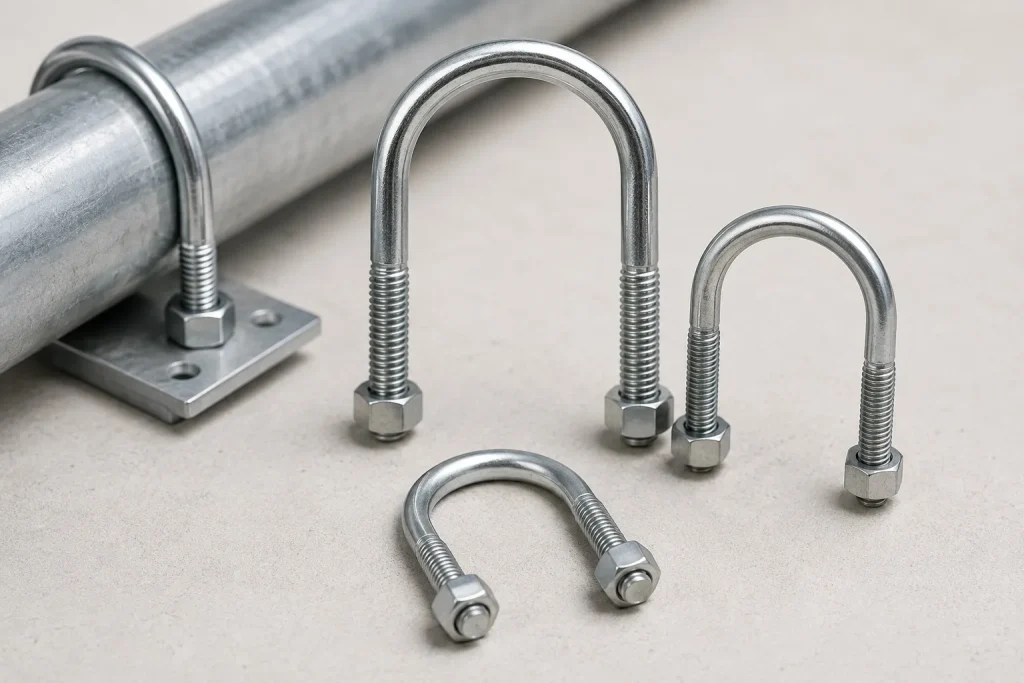
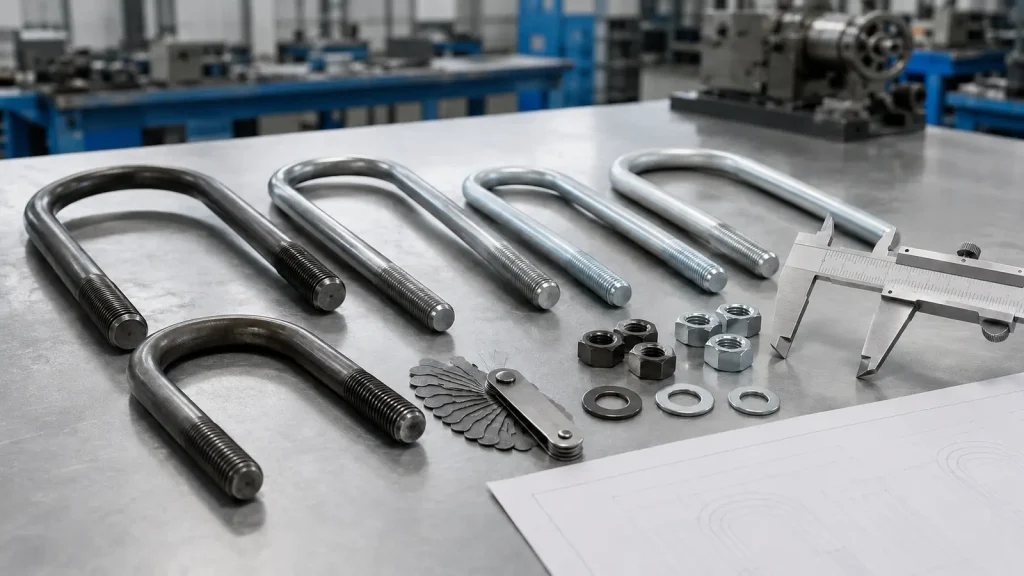
U-bolt ( / U-bolt, M10/M12/M16/M20/M24 multiple specifications)

U-bolt ( / U-bolt, M10/M12/M16/M20/M24 multiple specifications)

Brand: Wotu Surface: natural black oxide / hot-dip galvanized / blue-white zinc plated, multiple processes available Specifications: Based on common industry drawing parameters, suitable for pipe diameter 25mm~139.7mm, screw diameter M10~M24, total length can be nonstandard customized Matching: can be matched with nut, flat washer and spring washer of the same specifications for complete shipment Packaging: Bundling and packaging + 25kg export carton, full-container wooden pallet wrapped with film, supports private-label export packaging

Read More
Hex nut (Chinese national standard GB52-1976)

Hex nut (Chinese national standard GB52-1976)

Brand: Wotu Surface: 304 stainless steel Specifications: in stock M6~M24 full standard metric specifications, supports nonstandard pitch, thickening/customized Matching: Can be matched with bolts of corresponding specifications, flat washer, spring washer complete set of supporting shipment Packaging: 25kg cartons, whole wooden pallets

Read More
Hex flange nut (Chinese national standard GB/T6177.1-2000)

Hex flange nut (Chinese national standard GB/T6177.1-2000)

Brand: Wotu Surface: zinc plated Specifications: in stockM6/M8/M10/M12/M14/M16/M20 Chinese national standardfull range of specifications, support nonstandard thickness, tooth pitch customized Matching: can be matched with bolts of the same specification, flat washer, spring washer complete set of shipment Packaging: 25kg cartons, whole wooden pallets

Read More
Grade 8/Grade 10 High-strength Black Oxide Hex Nut (DIN934/GB Chinese National Standard Thickened Nut)

Grade 8/Grade 10 High-strength Black Oxide Hex Nut (DIN934/GB Chinese National Standard Thickened Nut)

Brand: Wotu Surface: quenching and tempering heat treatment + high temperature black oxide anti-rust treatment Specifications: Comply with DIN934, GB/T6170 standards, in stock M6-M48 full range of specifications, nonstandard sizes can be customized Packaging: 25kg carton/woven bag inner packaging, whole wooden pallet wrapped with film for export packaging, supports neutral/private-label customization packaging

Read More
Hot-Dip Galvanized Hex Nut (DIN934 Thickened/GB Thin Nut In Multiple Specifications)

Hot-Dip Galvanized Hex Nut (DIN934 Thickened/GB Thin Nut In Multiple Specifications)

Brand: Wotu Surface: high temperature hot dip zinc plated surface treatment Specifications: Comply with DIN934, GB/T6170, GB/T6172.1 Chinese national standard German standard, in stock M6-M64 full range of specifications, length is nonstandard customized as required Packaging: 25kg woven bag/export carton, full-container wooden pallet wrapped with film, supports neutral packaging, private-label customization

Read More

Choosing nut and bolt details for a secure joint

Fastener selection criteria

Compare fastener nut and bolt options by joint type, dimensional standard, thread fit, nut height, bolt head style, finish and grade compatibility. These details decide whether the parts assemble cleanly, tighten correctly and stay serviceable over time.

Criterion What To Check Why It Matters Buyer Tip
Thread standard and fit between nut and bolt Confirm the thread system, diameter, pitch, tolerance class and whether the nut and bolt are intended to be assembled together. A nut can look correct but fail to run smoothly or clamp properly if the thread form or pitch differs. Mixed standards also create maintenance problems later. Ask: Which thread standard and tolerance class should the nut and bolt follow, and will you verify fit as a matched assembly?
Bolt grade and compatible nut grade Compare the specified strength grade or property class for both parts, not only the bolt size. Using a weaker nut with a stronger bolt can strip threads before the joint reaches the required preload. Over-specifying grades can also add cost without improving the assembly. Ask: What bolt grade and matching nut grade do you recommend for this joint and service load?
Head, nut style and available space Review the bolt head type, nut height, washer use and tool access around the joint. Standard hex nuts suit many assemblies, while thin nuts or special head styles may be needed where space is limited. The wrong shape can make installation slow or impossible. Ask: Are there clearance drawings or photos of the joint so the nut height, head style and wrench access can be checked?
Surface finish and service environment State whether the fasteners will be used indoors, outdoors, near chemicals, in damp areas or with dissimilar metals. Finish affects corrosion resistance, thread feel and long-term removability. A coating can also change how a nut runs on a bolt if allowance is not considered. Ask: Which finish is suitable for the exposure conditions, and will the coating be compatible with the thread fit?
Critical dimensions beyond nominal size For bolts, confirm length, thread length, shank length and head dimensions; for nuts, confirm across-flats size, height and chamfer style where relevant. Nominal size alone does not define the fastener. Small differences in length or nut height can affect clamp length, engagement and whether the assembly seats correctly. Ask: What drawing, standard number or sample should be used as the dimensional reference before production or ordering?

Key checks before ordering fastener nuts and bolts

The practical difference between common nut and bolt options is how they control clamping force and resist loosening. A standard hex bolt with a matching hex nut suits many general assemblies, while anchor bolts, U-bolts, thin nuts or locking arrangements solve more specific problems such as fixing to concrete, supporting pipes, saving space or resisting vibration.

That distinction matters because interchangeable-looking fasteners can fail in different ways. A thin nut may solve a clearance issue but offer less thread engagement than a standard nut. A coating may improve corrosion resistance but can affect fit or installation method. A bolt length that looks close on paper may leave too little thread after washers and mating parts are included.

Start with the joint details before choosing the fastener. Confirm the bolt diameter and thread standard, required length, nut type, washer use, hole size, grip thickness and whether the bolt will be tightened from one side or both sides. For anchor bolts or U-bolts, the shape and key dimensions are just as important as the nominal thread size.

Match the material and strength grade to the application. General fabricated steelwork, pipe supports, machinery frames and structural connections can place very different demands on the same-looking fastener. Avoid mixing nuts and bolts with uncertain grades, because the weaker part of the pair will govern the joint performance.

Choose the finish for the environment and assembly method. Indoor dry use, outdoor exposure, humid plants and chemically aggressive areas may need different surface treatments. If the fastener will be torqued to a specified value, confirm that the finish and lubrication condition are suitable for the intended tightening process.

A common avoidable mistake is ordering from a short description such as “M16 bolt with nut” without a drawing, standard or length basis. For a useful inquiry to Hebei Wotu Fastener Manufacturing Co., Ltd., send the fastener type, size and thread, applicable standard or drawing, material or grade, finish, quantity and the working environment.


Criteria Importance Description Example Options
Fastener type High impact on joint function A standard hex bolt, anchor bolt, U-bolt and stud serve different connection needs. Choosing by diameter alone can result in a part that fits the thread but not the application. A pipe support may need a U-bolt, while a base plate fixed to concrete may need an anchor bolt.
Thread standard and size Essential for assembly compatibility The nut and bolt must match in diameter, pitch and thread form. Mixed or unclear standards can cause poor fit, cross-threading or unreliable tightening. An inquiry should distinguish a complete thread specification from a simple note such as “M20 bolt.”
Strength grade pairing Controls the safe performance of the connection The bolt and nut should be selected as a compatible pair. If one part has a lower or unknown grade, it can become the weak point even when the other part appears suitable. A high-strength bolt should not be paired with an unidentified nut for a demanding clamped joint.
Nut height and space Important where access or clearance is limited Standard hex nuts suit many general joints, while thin nuts can help in restricted spaces or secondary locking positions. The trade-off is reduced thread engagement compared with a standard nut. A compact machinery assembly may need a thinner nut, but the buyer should confirm whether the reduced height is acceptable for the load.
Surface finish and service environment Affects durability and installation behavior Finish selection should reflect moisture, outdoor exposure, chemicals and tightening requirements. Coatings may improve protection but can also affect fit and friction. An indoor dry assembly and an outdoor pipe support may require different finish choices even if the fastener size is the same.

Blog Articles / Reviews

Anchor Bolts: 7 Ordering Errors That Cause Site Rework

Anchor Bolts: 7 Ordering Errors That Cause Site Rework

ost anchor bolt ordering errors come from incomplete drawings, unclear dimensions, unsuitable material or coating choices, undefined tolerances, and mismatched nuts or washers. These mistakes affect steel fabricators, EPC contractors, equipment installers, importers, and distributors because anchor bolts are usually embedded before the connected structure arrives on site. Once concrete has cured, even a small […]

Why Do U Bolts Loosen in Pipe Supports? 6 Causes and Prevention Methods

Why Do U Bolts Loosen in Pipe Supports? 6 Causes and Prevention Methods

U bolts usually loosen in pipe supports because the connection loses clamping force, receives continuous vibration, restricts thermal pipe movement, uses an incorrectly sized U bolt, experiences surface settlement, or suffers from corrosion and inadequate inspection. This issue affects EPC contractors, pipe installers, industrial maintenance teams, equipment manufacturers and fastener distributors working with water, oil […]

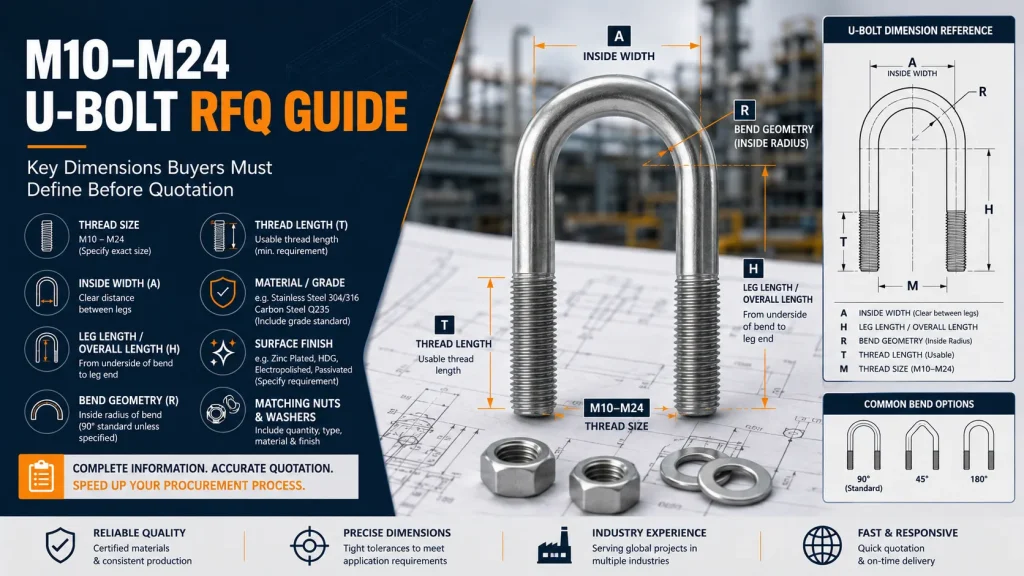
Which M10–M24 U-Bolt Measurements Must Buyers Send Before an RFQ?

Which M10–M24 U-Bolt Measurements Must Buyers Send Before an RFQ?

Direct Answer: For an M10–M24 U-bolt RFQ, buyers should send a dimensioned drawing that defines thread diameter, inside width, leg or overall length, bend geometry, thread length, application diameter, material or grade requirement, surface finish, matching nuts/washers, quantity, and packing needs. Nominal thread size alone is not enough because different measurement datums can produce U-bolts […]

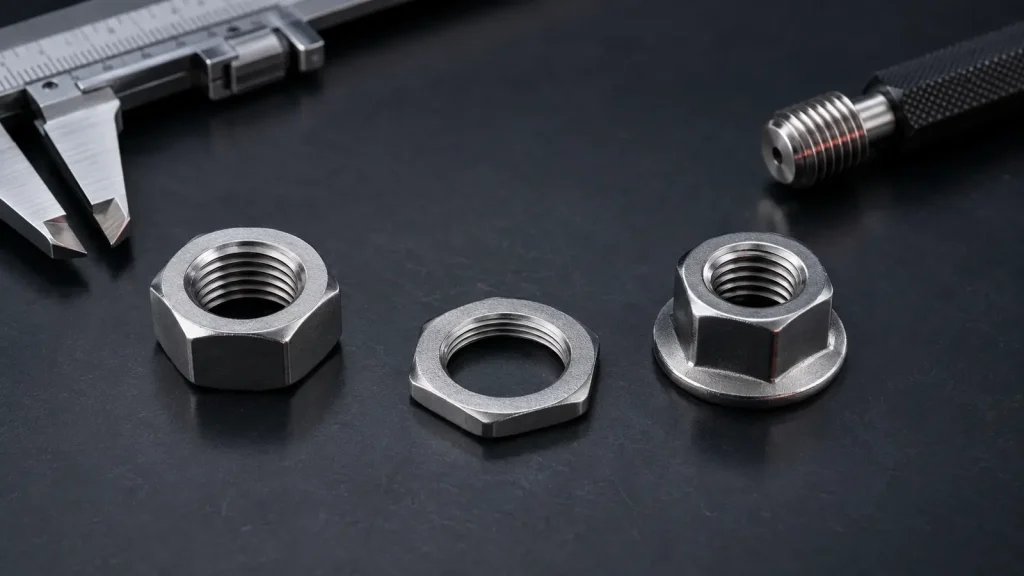
Hex Thin Nut vs Standard Hex Nut: Which Fits Space-Limited or Locking Assemblies?

Hex Thin Nut vs Standard Hex Nut: Which Fits Space-Limited or Locking Assemblies?

Direct Answer: Choose a hex thin nut when reduced nut height is genuinely required by the assembly or when the engineering design specifies it as part of a locking arrangement. Choose a standard hex nut when full nut height, normal thread engagement, and the specified load-bearing function are required. Buyers should compare nut height, thread […]

How Should Buyers Select Chinese and German Standard Hex Nuts?

How Should Buyers Select Chinese and German Standard Hex Nuts?

Direct Answer: Select a hex nut by the exact standard number and edition, thread diameter and pitch, nut style, property class, material, finish, mating bolt and acceptance method. “Chinese standard” or “German standard” alone is not a complete specification. Regular, thick, thin and flange nuts can differ in geometry and load behavior, so buyers should […]

What Should Buyers Verify When Comparing Bolt Manufacturers?

What Should Buyers Verify When Comparing Bolt Manufacturers?

A bolt manufacturer should be evaluated against a defined joint, drawing and acceptance plan—not a product list or unit price alone. Buyers need to verify whether the supplier can manufacture the required geometry, control material and heat-treatment requirements where applicable, manage threads and coatings as one dimensional system, inspect critical characteristics, preserve batch traceability and […]

Frequently Asked Questions

How do I choose a nut and bolt set for a load-bearing joint?

Start with the joint design rather than the nominal diameter alone. Confirm the thread standard, bolt length, grip thickness, strength grade, nut style, washer arrangement and tightening access. If the joint carries structural, lifting or safety-critical loads, the required grade and installation method should come from the design specification.

Is a thin nut a direct replacement for a standard hex nut?

Not always. A thin nut can help where space is limited or where it is used as part of a locking arrangement, but it usually provides less thread engagement than a standard-height nut. Check whether the joint needs full nut strength, clearance, locking support or only a secondary retaining function.

What is the common mistake when ordering bolts with matching nuts?

A frequent mistake is specifying only a size such as “M16” and assuming every supplier will interpret the rest the same way. Buyers should also state the thread pitch or standard, bolt length basis, grade, finish, nut type, washer requirement and any drawing tolerance that affects assembly.

When should I consider a U-bolt or anchor bolt instead of a standard hex bolt?

Use a U-bolt when the fastener has to wrap around or restrain a pipe, tube or round member. Use an anchor bolt when the connection is fixed into concrete or a base material rather than clamping two loose parts together. The shape, bend dimensions and embedment or support geometry become critical in those cases.

Does surface finish only affect appearance?

No. Finish can influence corrosion resistance, thread fit, friction during tightening and compatibility with the service environment. For outdoor, humid or chemically exposed applications, confirm the finish and installation condition instead of choosing by color or appearance alone.

What details should I send for a practical purchasing inquiry?

Send the fastener type, diameter, thread standard, length, nut style, material or grade, surface finish, quantity and application environment. If the part is an anchor bolt, U-bolt or non-standard assembly, include a drawing or the key dimensions so the shape is not guessed from the nominal size.

Leave Your Message

Send the fastener type, size and thread standard, required material or grade, surface finish, quantity and any drawing or application details so the inquiry can be checked accurately.